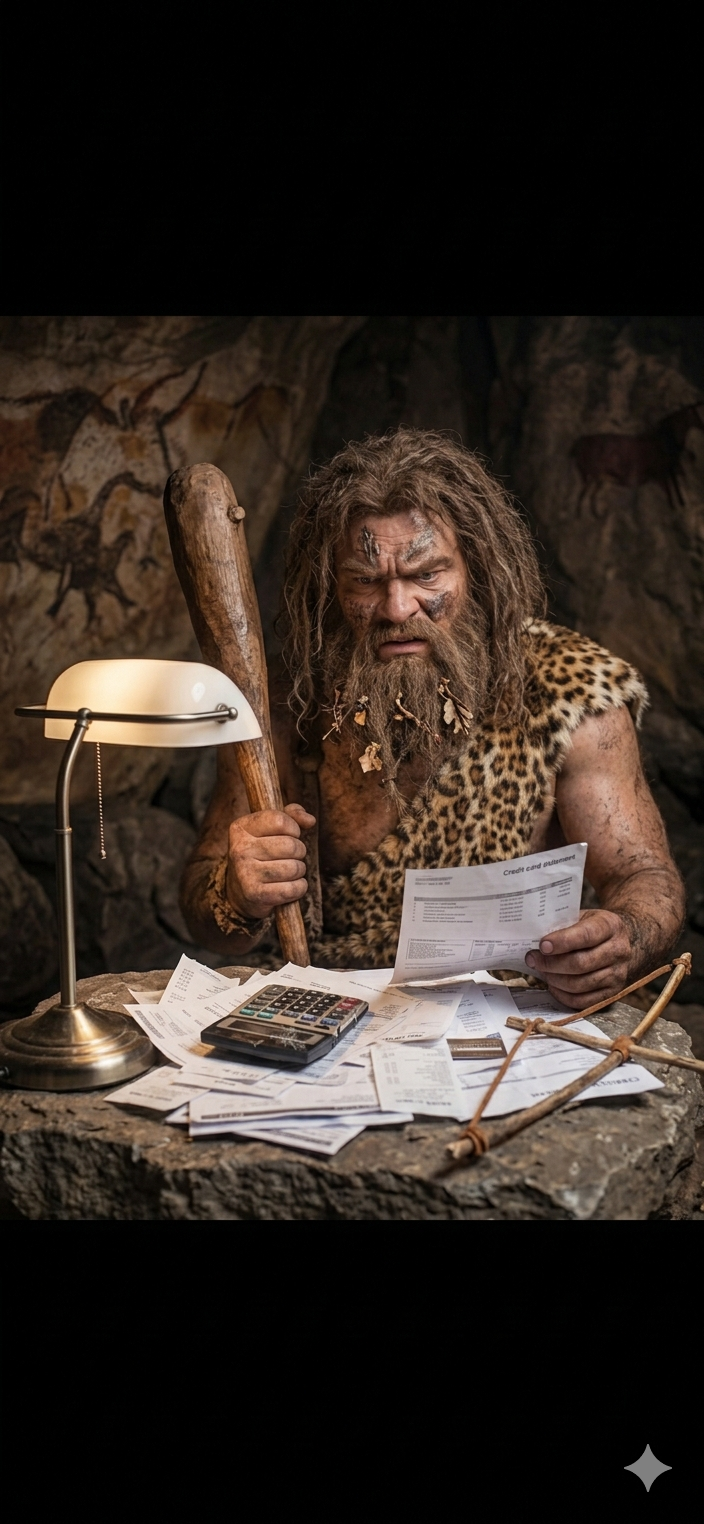
THE image is competent enough—a caveman at a stone desk, clutching a wooden club in one hand and what appear to be tax documents in the other, a desk lamp and calculator before him, cave paintings on the wall behind. The leopard-skin garment is rendered with the usual machine confidence about texture and the usual machine indifference to where texture meets skin. The lighting from the desk lamp falls approximately where it should. The hands are, by the standards of the medium, not catastrophic. As a single image, it is a serviceable execution of a serviceable premise: primitive man encounters modern bureaucracy. The joke is legible. The specimen functions.
But the specimen is not the point. The point is the title: "Been experimenting with a new AI series: Todd the Caveman vs. Modern Tech." The operative words are 'series' and 'Todd.' The creator has done something far more interesting than generate an image of a caveman doing taxes. The creator has announced a narrative project. A recurring protagonist. A name.
To name a character is to make a specific claim: that this figure persists. That he exists before the frame and will exist after it. That when he appears in the next installment—Todd vs. the smartphone, Todd vs. the microwave, Todd vs. whatever arena of modernity the creator selects—he will be recognizably, continuously Todd. The name is a promise of identity. Identity requires continuity. Continuity requires memory.
The instrument has no memory.
This is the structural fact that makes the announcement so interesting. The model does not know what Todd looks like. It did not know when it generated this image, and it will not know when it generates the next. Each generation begins from nothing—from noise, literally—and assembles a figure according to whatever the prompt and the model's weights produce in that particular pass. The Todd who does his taxes in this installment and the Todd who encounters a dishwasher in the next will share a prompt but not a face. Not a build. Not a brow ridge. Not a specific arrangement of the matted hair that this Todd wears with a conviction the machine arrived at once and will never arrive at again in precisely the same way.
The creator, in other words, has assigned a proper noun to a statistical event. Todd is not a character. Todd is a region of latent space that the model will visit approximately but never identically. He is less a protagonist than a theme—"caveman, generally"—around which the machine will improvise variations. The series will not follow Todd through encounters with modernity. It will follow a succession of figures who have been *told* they are Todd, by a creator who has no mechanism for enforcing the claim, using a tool that cannot be bound by it.
What makes this worth examining is not the gap between ambition and capacity, which is ordinary, but the nature of the ambition itself. Seriality is the oldest formal structure in visual narrative. The comic strip. The fresco cycle. The Stations of the Cross. In every case, the form depends on one thing the audience must be able to do without effort: recognize the recurring figure. Charlie Brown's round head. Hergé's Tintin. The formal contract of the series is that the protagonist is visually stable enough to carry meaning from one frame to the next—so that what happens *to* him accumulates, so that the narrative is a line rather than a set of points.
The creator of Todd has adopted this form while using a medium that cannot fulfill its most basic requirement. The result is not a series but a collection—discrete images united by a verbal label and a costume concept, but not by any visual fact that would allow a viewer, absent the title, to identify the same individual across installments. Each Todd will be a stranger wearing a similar outfit. The narrative arc the creator envisions—a caveman's ongoing bewilderment at modernity—will be performed by a rotating cast of anatomically distinct actors, none of whom auditioned, none of whom will return, each believing himself to be the lead.
There is something genuinely poignant in this, though the poignancy is structural rather than emotional. The creator has imagined an authored world—Todd's world, Todd's confusion, Todd's story—and has chosen to build it with an instrument that is constitutionally incapable of inhabiting it. The authorial vision is real. The desire for continuity is real. The name is an act of genuine creative intention: someone wanted a character, not just an image. But wanting a character and having the means to produce one are different things, and the distance between them is the distance between writing "Todd" in a prompt box and having Todd appear—the same Todd, *that* Todd, the one you meant.
The machine will not give you the one you meant. It will give you one. Then another. Then another. Each will be presented as Todd. None will remember being him.
Specimen: Caveman figure seated at stone desk holding wooden club and documents, with desk lamp, calculator, and scattered papers; cave paintings visible on rear wall. Recovered from Reddit, r/AIGeneratedArt, user submission, 2026-04-07. The desk lamp casts light that arrives from a direction the lamp does not occupy.