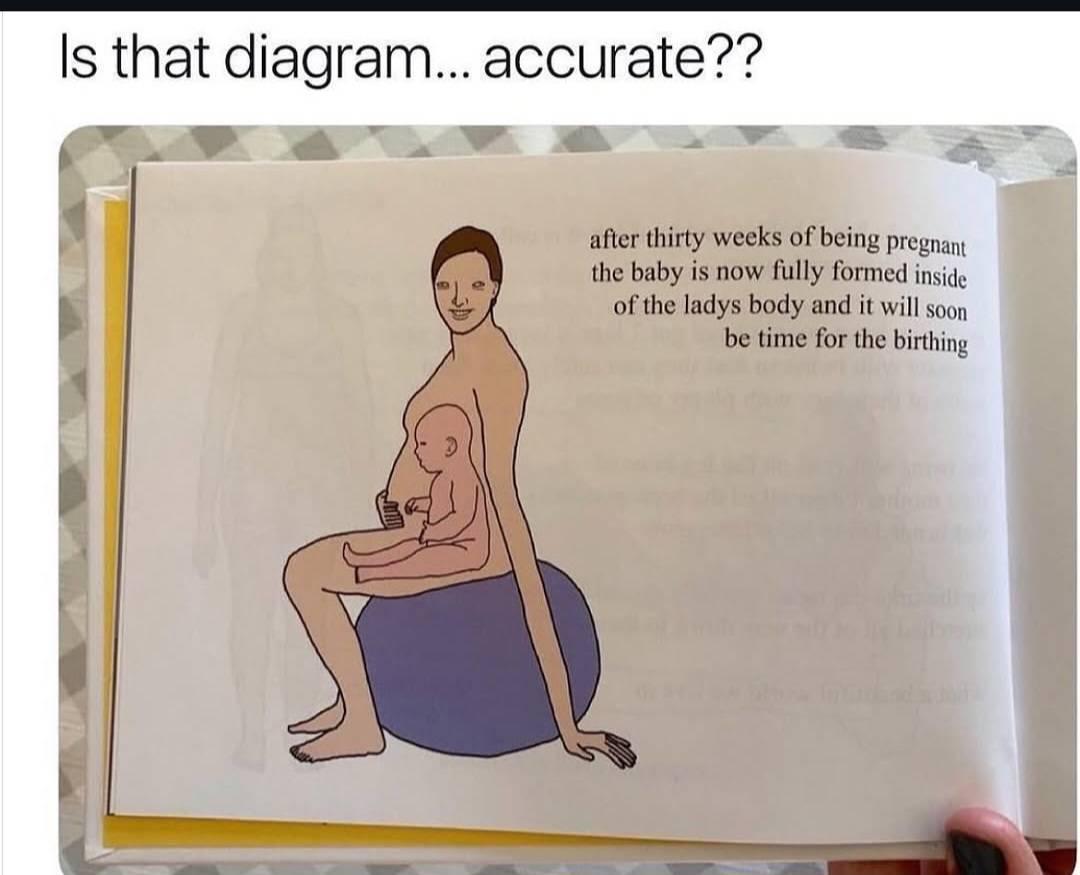
**T**HE specimen arrives with a caption, and the caption is the work. "I think the diagram is very accurate. What about you guys?" Eleven words, two clauses, one rhetorical maneuver of considerable interest. The first clause asserts a property—accuracy—that the image cannot possibly possess. The second clause requests confirmation of that property from an audience selected for its willingness to confirm. The image itself is almost incidental. It exists to be agreed with.
Examined as picture, the production fails in the conventional ways. An adult figure stands beside an infant rendered at a scale that would require either a giant or a doll; the joints of the adult bend in directions joints do not bend; a hand resolves into six fingers, or seven, depending on whether one counts the structure that emerges from the wrist and proceeds, undeterred, toward the margin. These are familiar defects. They have been catalogued in this column on previous occasions and will be catalogued again. They are not, in themselves, what makes the specimen worth the paragraph.
What makes it worth the paragraph is the word *diagram*.
A diagram is a contract. It promises that the lines on the page correspond, in some specified way, to a structure in the world: a circuit, a skeleton, a sentence parsed into its parts. The diagram surrenders the freedoms of the picture in exchange for the authority of the reference. It cannot lie about proportion, because proportion is the thing it has agreed to convey. It cannot invent a finger, because the finger is what it is for. The diagram earns its standing by accepting these constraints, and it forfeits that standing the moment it declines them.
The specimen declines them. It also keeps the word.
This is the maneuver that interests me, and it is not a maneuver the image performs alone. The image is generated, captioned, and posted, in that order, by parties who may or may not be the same person and who in any case act in concert. Each step ratifies the next. The model produces an output indifferent to anatomy. The poster designates that output a *diagram*, importing a vocabulary the output cannot support. The forum receives the designation and responds in kind, agreeing that the diagram is accurate, or agreeing that it is not, but in either case agreeing to the prior question—that the thing is a diagram, that diagrams are what we are discussing, that accuracy is the metric in play. The error has been laundered through three institutions before anyone has looked at the picture.
The auteur question, applied here, returns an unusual answer. The model has made no decisions; it has produced a distribution. The poster has made one decision—to call the result a diagram—and that decision is conscious, in the sense that the word was selected, and unconscious, in the sense that its implications were not. The forum has made a decision to participate in the frame. No one in the chain is responsible for the category error, and the category error is nevertheless committed, repeatedly, by everyone. This is the condition under which a great deal of current production is now manufactured. The defect is not located in any of the hands that touch it.
One could argue, and the forum's name invites the argument, that the caption is ironic—that "diagram" is offered with the knowingness of the poster who understands the image is not a diagram and invites the reader to share the understanding. I have considered this reading and reject it, not because irony is absent but because irony, here, performs the same work as sincerity. The ironic diagram and the sincere diagram occupy the same position in the visual economy: both are offered, both are agreed with, both train the eye to accept the word *diagram* attached to artefacts that diagram nothing. The wink does not exempt the gesture. It distributes it more efficiently.
What is lost is small and specific. It is the residual assumption that an image labeled as reference will reference something, that the labels carry obligations, that a reader encountering the word *diagram* may proceed on the basis that a diagram is what has been provided. This assumption was not robust before the specimen, and it is marginally less robust after. The cumulative effect, across many specimens, is a vocabulary in which the technical words still appear and no longer mean what they meant. The forum will not notice. The forum is not the mechanism by which such things are noticed.
CUTLINE: Specimen: figure described by its caption as a *diagram*, depicting an adult and a neonate in non-corresponding scale, with hands that exceed the standard count. Recovered from Reddit, r/shitposting, November 2026. The infant and the adult appear to have been generated by processes that did not consult one another.
*Continued on Page 4*