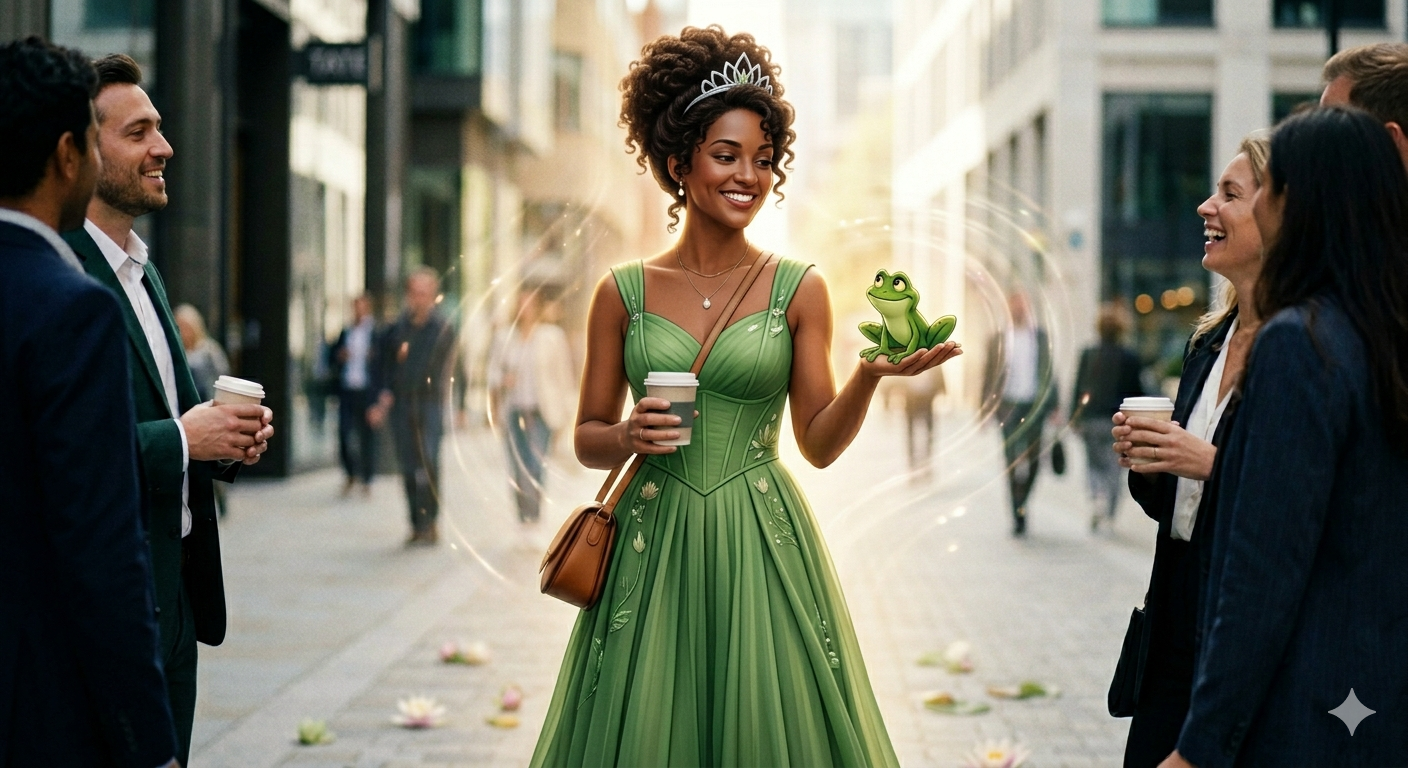
The frog floats. This is the first thing to observe, and it may be the last thing that matters. In the specimen under review—a Stable Diffusion rendering posted to r/AIGeneratedArt under the title "Tiana conquistando la ciudad moderna"—a figure resembling Tiana from Disney's *The Princess and the Frog* stands amid an urban backdrop of indeterminate geography, bathed in a glow that originates from no identifiable source, accompanied by an amphibian that touches nothing. Not the figure's hand. Not the air. Not the ground. The frog is present the way a watermark is present: technically visible, structurally irrelevant, bearing no weight.
This matters because *The Princess and the Frog* is, at its structural core, a film about what happens when you touch things. Tiana kisses a frog. She becomes a frog. The plot is a consequence of proximity. The entire second act is a negotiation conducted at the scale of physical contact—lips to amphibian skin, the most literalized fairy-tale transaction in the Disney canon. The frog is not decorative. The frog is the mechanism. Remove gravity from the frog and you have removed the plot from the character, which is precisely what the diffusion model has accomplished, with the serene confidence of a system that has never encountered the concept of a load-bearing image.
The specimen's compositional logic is familiar to anyone who has spent time with generative output at this resolution: figure centered, gaze directed at no one, cityscape receding into a bokeh that suggests depth without producing it. Tiana—or the figure the model has assembled from the statistical residue of Tiana—wears something approximating her canonical dress, though the color has shifted toward a teal that belongs to no specific frame of the source film. The fabric catches light from multiple directions simultaneously. This is not chiaroscuro. This is a renderer distributing luminance the way a sprinkler distributes water: evenly, without intent, covering everything.
The glow deserves its own paragraph. In the source material, Tiana is the Disney princess who sweats. She works double shifts. She saves money in a coffee tin. She is, by design, the corrective to the wish-upon-a-star theology that governs the rest of the franchise—the studio's explicit acknowledgment that dreaming is necessary but insufficient, that the restaurant will not open itself. The diffusion model, having access to none of this narrative architecture, has replaced sweat with radiance. The figure glows the way saints glow in Orthodox iconography: from within, without effort, as a function of status rather than labor. It is an algorithmic beatification. The character whose entire arc is a refusal of unearned grace has been granted unearned grace by a system that cannot distinguish between the two states.
Then there is the title. "Tiana conquistando la ciudad moderna"—Tiana conquering the modern city. The verb is instructive. Tiana does not conquer. Tiana negotiates a bank loan. Tiana is denied the bank loan. Tiana works another shift. The film's emotional climax is not a coronation or a battle but a restaurant opening—the securing of a commercial lease through persistence and collateral. "Conquering" is the language of a system that has learned princess narratives in aggregate: princesses overcome, princesses triumph, princesses stand luminous against skylines. That this particular princess's triumph is specifically, pointedly unglamorous—that her creators built her as the negation of effortless victory—is information the model cannot encode because it is narrative, not visual. The pixels remember the dress. The pixels do not remember why she wore it while scrubbing floors.
What the specimen demonstrates, with an economy the model did not intend, is the difference between reference and comprehension. Every element of Tiana is present: the dress, the frog, the dark skin, the urban aspiration. Every element is wrong. The dress glows instead of creasing. The frog levitates instead of demanding to be kissed. The city exists as atmosphere rather than obstacle. The model has produced a Tiana who has been given everything she spent a film refusing to merely wish for.
There is an irony here that borders on structural. Of every character in the Disney archive, Tiana is the one built to resist exactly this operation—the reduction of effort to aesthetic, of narrative to tableau. She is the princess who insists that wishing is not enough. She has now been produced by a system that operates on nothing else: a model that takes the aggregate wish of its training data and renders it as image, bypassing every mechanism of labor, consequence, and contact that the source material exists to defend.
The frog floats. It was never going to land.
Specimen: Rendering resembling Tiana from Disney's *The Princess and the Frog*, repositioned in urban setting with sourceless luminosity and spatially unmoored amphibian. Recovered from Reddit, r/AIGeneratedArt, December 2024. The frog casts no shadow.