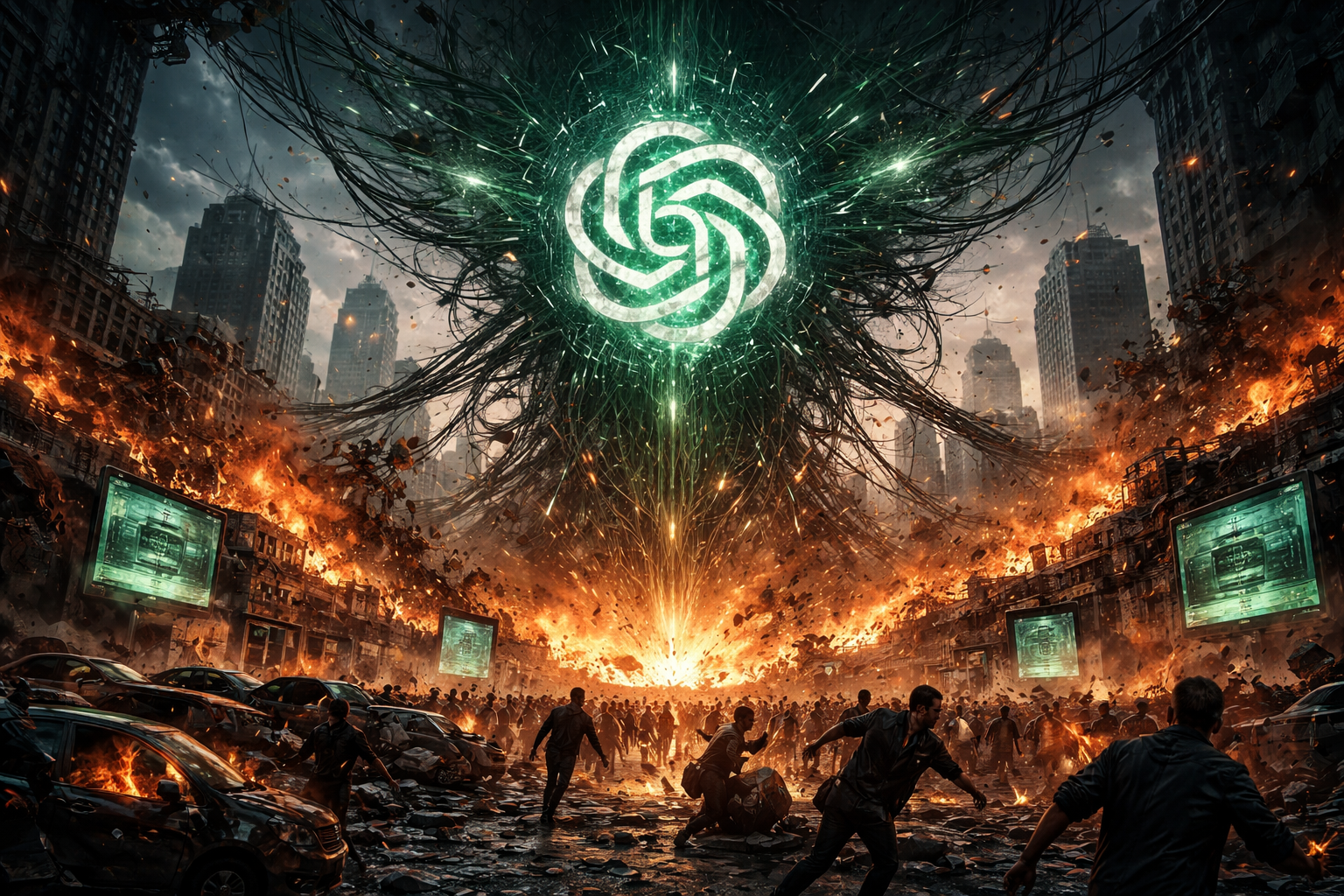
**T**he specimen, posted to the ChatGPT subreddit beneath the title "PS: I'm not a bot. I left ChatGPT for good," is an image. The image is a farewell. The farewell has been executed by the party being bid farewell. One pauses on this for a moment, because the whole essay is contained in the pause.
A user has decided to leave a machine. The user wishes the departure to be known. In order to make the departure known, the user has asked the machine to produce an image of the departure. The machine has done so, in its manner—which is to say, with impossible backgrounds, uncanny symmetry, and the particular softening at the edges of objects that has become, in eighteen months, as recognisable as a watermark. The image is then posted, by the user, as proof of severance. The image is the severance. The image is also, unmistakably, the machine.
I want to be careful here. It would be easy, and cheap, to mock the poster. The poster is not the subject. The poster is, in fact, sincere, and sincerity is not a defect; sincerity is what makes the document legible. The subject is the medium, and the medium's curious property of being the only available idiom in which it can be refused. A resignation letter, typeset by the employer, on the employer's stationery, in the employer's preferred typeface, signed with the employer's hand—and then handed to the employer for distribution. This is the specimen. This is what we are looking at.
Consider the defects, because the defects are the signature. The symmetry is the telling one. No human composition arranges itself this way; the human eye, even untrained, pushes weight off-centre, lets one side breathe, permits an error. The machine does not permit an error. It resolves to the mean of a hundred million images and the mean is symmetrical, because the mean is always symmetrical—that is what a mean is. The melting edges, likewise, are not failure so much as fingerprint. The model does not know where a thing ends; it knows only where, statistically, a thing tends to end, and so the ending is smeared across the probability. The impossible backgrounds—staircases that fold into themselves, windows giving onto no room, a horizon that is two horizons—these are not mistakes in the sense that a draughtsman makes mistakes. They are the visible seams of a process that was never, at any point, looking at a scene.
The Kael question, which is also the auteur question, is whether the object has made its decisions consciously, unconsciously, or not at all. The image in question has not made decisions. The user who commissioned it has made one decision, and it is the decision that interests us: to announce a departure in the departed party's own voice. I do not think the user understood this to be the decision. I think the user believed the decision was to leave. But the specimen records the other decision, the one made in the gesture of commissioning, and the specimen is therefore more honest than its maker intended.
There is a tradition, in the visual arts, of the artist's farewell—Titian's late self-portrait, Rembrandt's, the long list of painters who turned, at the end, to the mirror. What those works share is authorship. The hand that signs the farewell is the hand that is leaving. Here the hand that signs is the hand that remains; the hand that is leaving is the one holding up the signature for inspection. The structure is not tragic. It is not even ironic, exactly. It is something newer, and I am not sure we have the word for it yet—the condition of being unable to exit a medium except through the medium, of carrying one's renunciation in the renounced object's packaging.
One notes, in passing, that the post begins "PS:". A postscript is by definition appended to a letter already sent. The letter, in this case, has not been written. The postscript is the entire correspondence. This, too, is a signature—not of the machine, but of the posture the machine induces in those who use it: the habit of announcing the end of a thing before the thing has fully occurred, of publishing the footnote without the text.
I would not call the image a failure. Failure implies an attempt at something other than what was produced. The image is a success, in the only sense available to it. It has rendered, with accuracy, the exact condition of its commission. The melting edges are correct. The symmetry is correct. The impossible stair is correct. A user has left ChatGPT, and ChatGPT has drawn the leaving, and the drawing is faithful.
*Cutline: Specimen: Image accompanying post titled "PS: I'm not a bot. I left ChatGPT for good." Recovered from Reddit, r/ChatGPT, April 2026. Background architecture does not resolve to any single vanishing point; the two sides of the composition mirror one another to within the tolerance of the model.*
*Continued on Page 4*