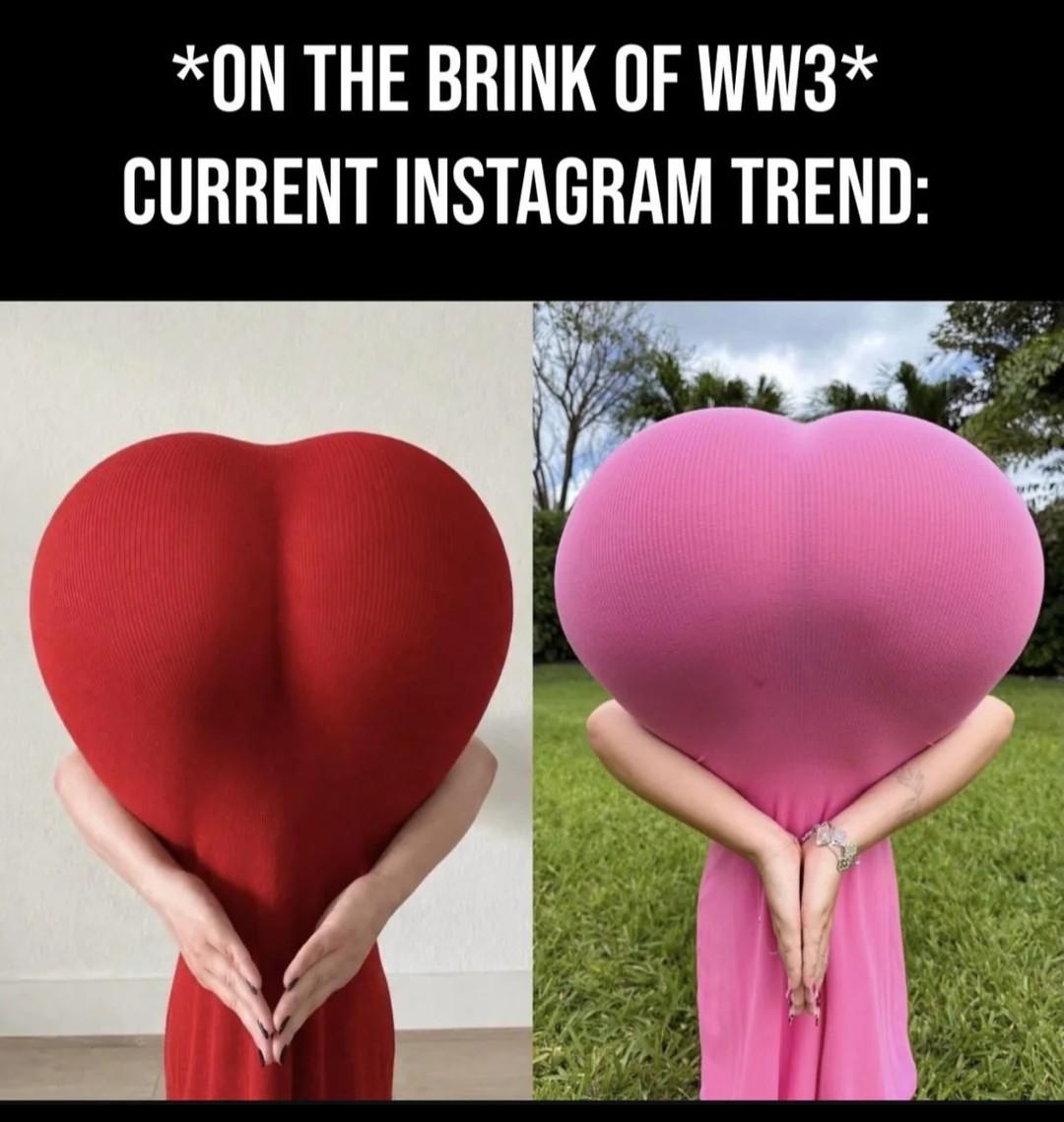
THE body has been asked to do something it cannot do, and it has said yes. This is the fundamental transaction visible in the specimen—a machine-generated image, recovered from the Reddit forum r/shitposting under the title "say la vie," in which a human figure has been contorted into the shape of a heart. Not a heart as understood by anatomists, which is an asymmetric fist of muscle, but a heart as understood by the manufacturers of valentines: two symmetrical lobes, a pointed base, the whole form smooth and closed and meaning nothing except itself. The figure's arms arc overhead to form the upper curves. The torso narrows impossibly. The legs, if they exist at all, have been compressed into the lower vertex. The skeleton—that inconvenient architecture of rigid segments and limited rotational degrees—has not been broken. It has simply never been loaded into the calculation.
This is what makes the image interesting rather than merely defective. A human artist attempting this composition would confront, at every joint, a mechanical fact: the shoulder's range of abduction, the spine's refusal to bend laterally without protest, the elbow's insistence on hinging in one direction only. These confrontations produce the tension that makes figure drawing worth doing. The artist negotiates between what the pose demands and what the body permits, and the result—even when stylized, even when deliberately distorted—carries the residue of that negotiation. Mannerist elongation knows where the bones are. Egon Schiele's contortions respect the skeleton precisely enough to make their violations legible as violations. The body is a constraint, and the constraint is generative.
The model that produced this specimen has no such negotiation available to it. What it possesses is a statistical distribution over the visual features associated with two categories: "human figure" and "heart shape." When instructed to combine them, it performs an interpolation. The heart silhouette, being the more geometrically specific of the two requests, dominates. The figure, being the more complex and therefore more compressible, yields. Arms become spline curves. The torso becomes a taper function. Skin textures are applied to the resulting surface with the fidelity of a decal applied to a balloon. The specimen is not a figure making a heart shape. It is a heart shape wearing a figure as texture.
The specific joint failures are worth cataloguing because they are systematic rather than accidental. The shoulders have migrated to a position requiring clavicles approximately forty percent longer than any human clavicle has ever been. The elbows—those hard directional constraints that distinguish an arm from a tentacle—have been smoothed into continuous curves, present as surface shadows but performing no structural work. Ornamental elbows. The wrists exhibit the boneless flexibility of two ribbons tied together. The spine follows a path that would require the removal of approximately eight vertebrae and the replacement of the remainder with cartilage. This is the treatment of the human body not as an articulated system but as a deformable mesh. The skeleton is not overridden; it is simply absent from the model's priorities, a low-weight feature that loses every competition with the higher-priority instruction to produce a clean silhouette.
And then there is the title. "Say la vie." The phonetic transcription of *c'est la vie*—that's life—rendered by someone who has heard the phrase spoken but never encountered it in print, or who simply does not care. The orthographic relationship between sounds and their conventional spelling has been bypassed, replaced by a direct mapping from phoneme to the nearest English grapheme. It is, in its way, a perfect companion to the image. The poster has done to French what the model has done to the human body: reproduced the surface—the approximate sound, the approximate shape—without consulting the underlying structure. Both are phonetic renderings. One is a phonetic rendering of a language. The other is a phonetic rendering of a person.
This is not a collaboration, exactly. The poster did not instruct the model to ignore anatomy, and the model did not instruct the poster to misspell French. But they have arrived at the same place by the same method: one where fidelity to structure—skeletal, linguistic, any kind—is not a value the production process selects for. What it selects for is recognition. Can you tell it is a heart? Yes. Can you tell it is a body? More or less. Can you tell it is French? Close enough. The threshold has been met. The machine moves on. The poster moves on. The specimen accumulates its upvotes in the shitposting forum, which is the one venue where the absence of structural integrity is, at minimum, correctly categorized.
*C'est la vie.* Or near enough.