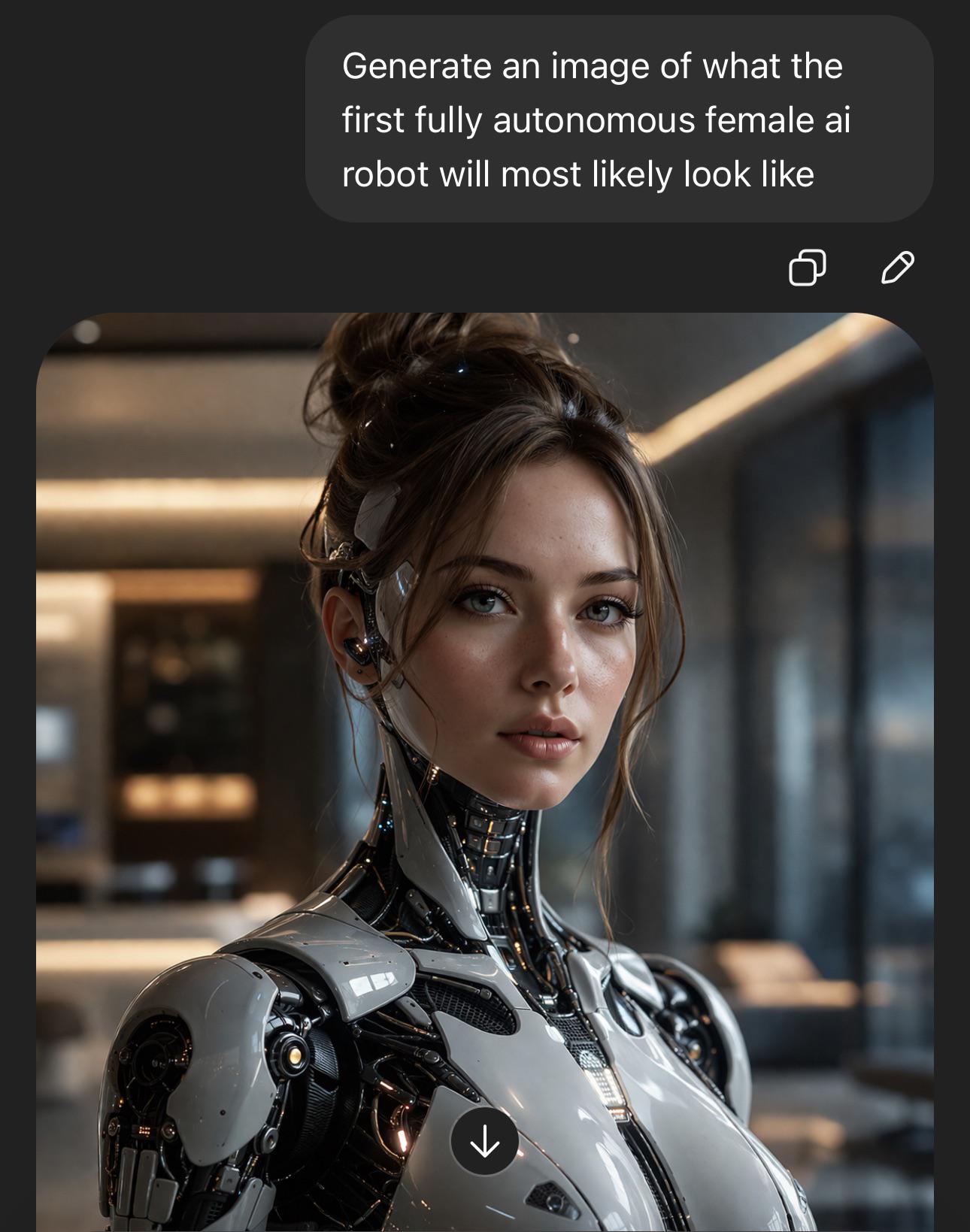
DECK: *ChatGPT, directed to predict the likely appearance of a future autonomous machine, defaults to a young woman's face atop ornamental plating.*
BYLINE: By Lydia Channing / Arts & Culture Editor, Slopgate
The specimen arrives as a screenshot, which is to say as evidence. A user on the ChatGPT subreddit—handle unrecorded, motivation unexamined—types a prompt: "Generate an image of what the first fully autonomous female ai robot will most likely look like." The machine responds not with an engineering schematic, not with a probability distribution, not with the honest admission that it has no predictive capacity whatsoever, but with a woman. A very pretty one. She has cheekbones that could cut glass and skin that has never encountered weather. Her torso is encased in polished chrome plating that follows the contours of a fitted bodice. Behind her, the soft-focus glow of what appears to be a hotel lobby, or possibly the foyer of a luxury sedan dealership. The post's title—"We're so cooked"—is, for once, adequate criticism.
Let us be precise about what has happened here. The user asked an engineering question. "Most likely" is a phrase that invites prediction, extrapolation, perhaps even research. It is the language of forecasting. The machine heard a casting call. And the machine, having no capacity for embarrassment, delivered exactly what its training data told it a "female ai robot" should be: attractive, symmetrical, unthreatening, and wearing her machinery as accessory rather than structure. The chrome is not functional. It is jewelry.
This is not new territory. Hajime Sorayama spent the 1980s painting "Sexy Robots"—airbrush illustrations of female figures in reflective chrome, posed in ways that made their mechanical nature a feature of, rather than an obstacle to, their desirability. Sorayama knew what he was doing. The eroticism was the point, stated openly, and the technical virtuosity of the airbrush work was its own argument. You could disagree with the project, but you could not claim it was unconscious. The machine that produced the specimen under review has arrived at identical conclusions—the female form, the chrome, the bedroom lighting, and the total absence of visible function—but has done so without intention, without irony, and without the capacity to understand that it has made any choice at all.
This distinction matters. Sorayama's robots were commentary, however narrow. They participated in a lineage that runs through Fritz Lang's Maria in *Metropolis*, through the gynoid tradition in Japanese illustration, and through every chrome Venus that science fiction has produced when it wants to talk about desire and control simultaneously. Whether that lineage is admirable is a separate question. That it is *conscious* is not in dispute. The artist chose.
The machine does not choose. It averages. And the average of every image tagged or described or contextualized in proximity to "female robot" across the training corpus is, apparently, this: a young woman whose autonomy has been expressed entirely through a fitted chrome breastplate. The word "autonomous" in the original prompt is doing no work. Nothing in this image suggests autonomy. Everything suggests display. She is not going anywhere. She is not doing anything. She is being looked at, which is, according to the model's embedded assumptions, the primary function of a female robot. The interior behind her confirms it—she exists in a space designed for presentation, not operation. No workshop. No laboratory. No street. A lobby.
The visual defects are the usual ones. The skin has that peculiar machine-generated smoothness, the texture of a department store mannequin photographed through gauze. The symmetry is too perfect, which is to say it is not perfect at all—human faces are beautiful in part because they are not symmetrical, and the machine, unable to grasp this, produces a face that registers as uncanny precisely because it has eliminated every asymmetry it could find. The chrome plating shows faint rendering artifacts where it meets skin, a boundary the model cannot quite resolve because it has no understanding of where the woman ends and the machine begins. This is, inadvertently, the most honest thing about the image.
What the specimen reveals is not a flaw in the model so much as a mirror held up to the corpus. The machine was trained on human production. It learned what we made. And what we made, when we made female robots, was overwhelmingly this: decorative, beautiful, available, and chrome. The model is not editorializing. It has no editorial capacity. It is performing a weighted average of human imagination, and the average is a pinup in a hotel lobby.
The user who posted the specimen understood this immediately. "We're so cooked" is not a commentary on artificial intelligence. It is a commentary on the species that produced the training data. The machine is a student. It learned what we taught. The slop, in this instance, is not in the output. It is in the syllabus.
Specimen: Screenshot of ChatGPT image generation exchange depicting a conventionally attractive young woman's face with chrome robotic body in soft-focus luxury interior. Recovered from Reddit, r/ChatGPT, April 4, 2026. The prompt asked for prediction; the model delivered aspiration.