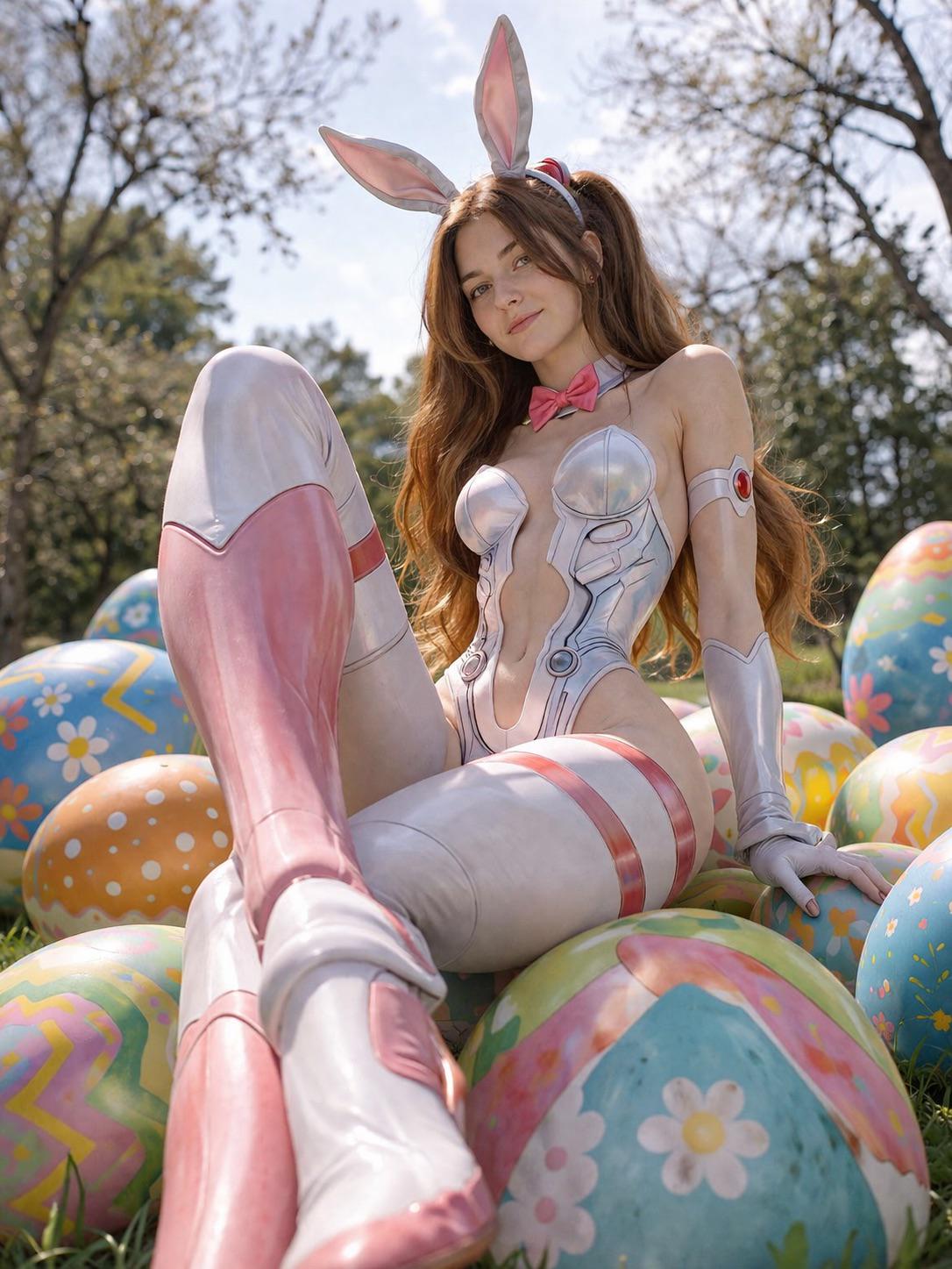
T he question the specimen raises is not whether artificial intelligence can depict Easter. It is which Easter the machine has been asked to depict, and the answer—arrived at instantly, without hesitation, without the faintest tremor of theological anxiety—is the one available at a drugstore endcap in late March. The image, posted to the Reddit forum r/AIGeneratedArt under the title "Happy Easter!," presents a female figure in a chrome-and-pink bodysuit, rabbit ears affixed, seated among oversized painted eggs in a sunlit park. The eggs are enormous. The figure is poreless. The trees are in bloom. The resurrection of Christ is not in attendance.
This is not a complaint. It is a diagnosis. The machine was given a word—Easter—and returned the statistical composite of every Easter-adjacent image in its training data, which is to say: pastels, eggs, ears, and a female body rendered with the glazed precision of confectionery. The result is not sacrilege. Sacrilege requires awareness of the sacred, and the specimen betrays no such awareness. It is a greeting card, and greeting cards are not blasphemous. They are simply insufficient, in the way that a receipt is an insufficient record of a meal.
What the image achieves is a kind of accomplished emptiness. The lighting is competent—warm, diffused, suggesting a spring afternoon that exists nowhere and therefore offends nobody. The eggs are decorated with geometric patterns of considerable regularity, each one distinct enough to register as variety, none distinct enough to have been designed. They are the eggs a committee would produce if the committee's mandate were "eggs, assorted, festive." The figure's bodysuit is metallic, futuristic, faintly robotic—a design decision that introduces science fiction into a pastoral scene for reasons the system cannot articulate because it has no reasons. It has correlations. Chrome and bunny ears have appeared in sufficient proximity to constitute, for the model, a visual argument. That the argument is incoherent is not the system's problem. Coherence was never the objective. Completion was.
The body itself exhibits the familiar signatures: skin that suggests not flesh but the memory of flesh, preserved under resin—the waxy dermal finish that has become the house style of diffusion-model figure work, turning the figure into something between a person and a product render. The bilateral symmetry is so thorough that the face reads less as a face than as a face folded along its vertical axis and duplicated—which, in computational terms, is precisely what it is.
But these are technical observations, and technical observations are the refuge of critics who have not yet located the actual problem. The actual problem is iconographic. Easter has been the subject of Western art for roughly two millennia, and in that time it has produced the Isenheim Altarpiece, Piero della Francesca's *Resurrection*, and El Greco's elongated, ecstatic figures ascending into skies that appear to be having seizures of their own. It has also produced chocolate bunnies, Peeps, and the Hallmark Corporation's annual assertion that transcendence can be communicated in fourteen-point script above a photograph of a lily.
The machine, given access to all of it, has selected the greeting card. This is not a failure of capability. It is a perfect execution of probability. The system has seen more chocolate bunnies than Piero della Francescas. It has encountered more pink-and-pastel holiday imagery than Byzantine mosaics of the Anastasis. When it reaches for "Easter," it reaches for what Easter most frequently looks like in the dataset, and what Easter most frequently looks like is a commercial surface: cheerful, decorative, and theologically weightless. The machine has produced the mode, not the meaning.
There is a long tradition of sacred kitsch, and it would be dishonest to pretend that human beings have not spent centuries producing Easter imagery of precisely this caliber—flat, bright, and emptied of everything except the holiday's retail silhouette. But that kitsch was made by people who inhabited the tradition they were simplifying. The woman who paints a cross on a ceramic egg at a church craft fair has made a decision, however small, about what Easter means to her. The machine has made no decision. It has performed an aggregation. The difference is not visible in the output. It is visible only in the premise—and the premise is everything, because art that depicts the sacred without any relationship to the sacred is not art. It is merchandise.
The specimen is merchandise. Bright, competent, seasonally appropriate merchandise, delivered on time and to specification, requiring from its viewer nothing more than the recognition that it is, indeed, Easter, and that Easter involves eggs, and that eggs are cheerful, and that cheer is the point. The resurrection—of the body, of hope, of anything at all—is not part of the delivery.
Specimen: Female figure in chrome bodysuit with rabbit ears, seated among oversized painted eggs in a parklike setting. Recovered from Reddit, r/AIGeneratedArt, April 2026. The eggs are impeccable. The tomb is empty in a way the artist did not intend.