DECK: *Asked to retrieve, the model instead invents—and dresses its invention in the vestments of illuminated manuscript.*
BYLINE: By Lydia Channing / Arts & Culture Editor, Slopgate
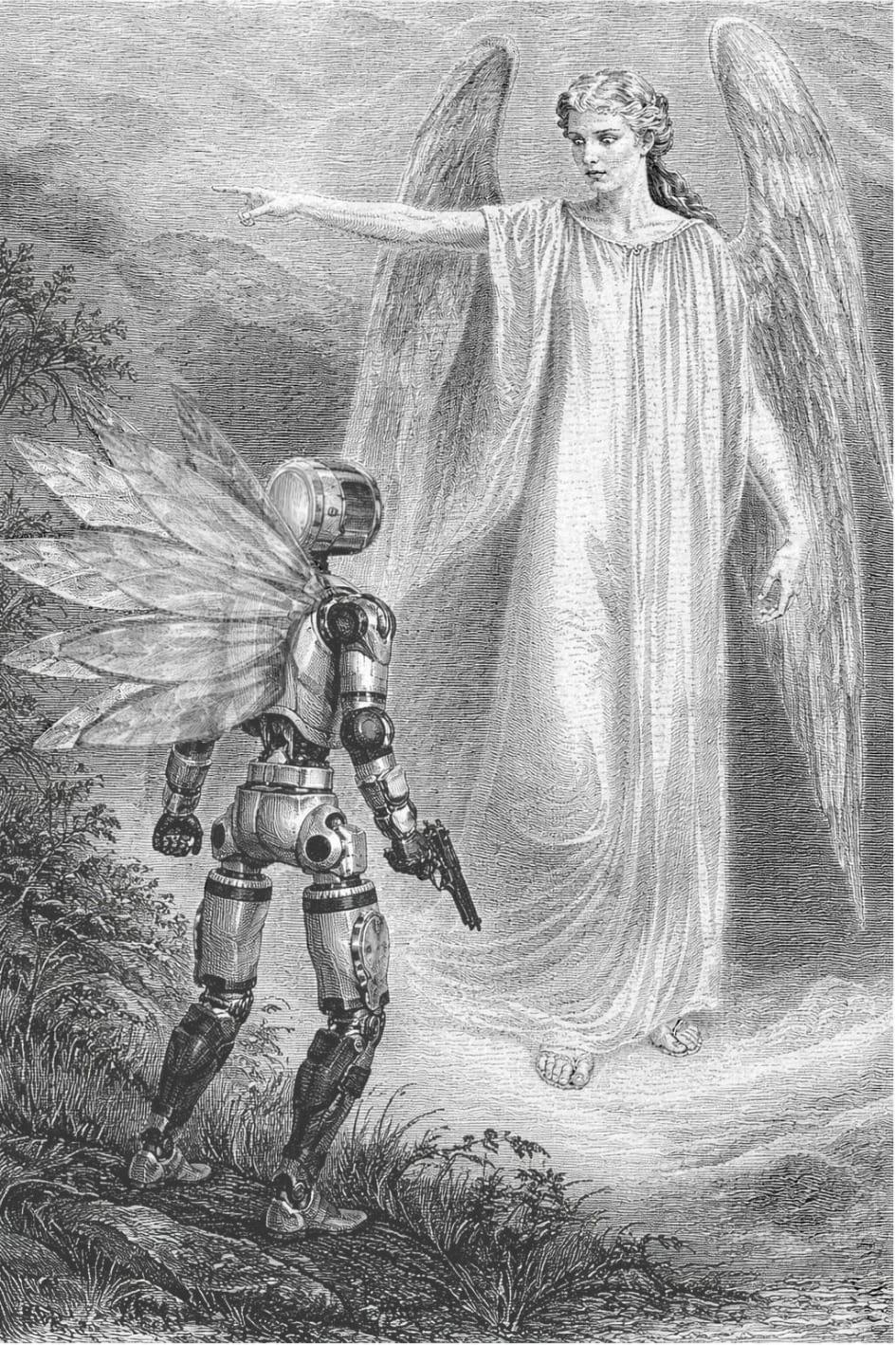
The specimen arrives with the quiet authority of a devotional plate: golden light raking across armored wings, a figure recognizable as the Archangel Gabriel raising a sword against a mechanical adversary. The composition borrows from centuries of Western religious painting—the diagonal thrust of combat, the heavenly radiance spilling from the upper left, the suggestion of clouds, marble, or something the model could not decide between. It is, on its surface, competent pastiche. The problem is that the scene it depicts appears in no scripture, no apocrypha, no commentary, no marginalia of any text produced in any century by any hand, human or otherwise.
The image was posted to the ChatGPT forum on Reddit under the title "Ahhh Yes... 'Gabriel vs V1,' My Favorite Part of The Bible," and the user's irony deserves more credit than it will likely receive. The joke is precise. It identifies the structural failure before any critic could arrive at it: the machine was asked to serve as illustrator and has instead appointed itself author. "Gabriel vs V1" is not a mistranslation. It is not a conflation of two adjacent passages. It is an invention that the model has delivered with the same confidence it would bring to the Annunciation.
Let us be specific about what V1 is. V1 is a combat robot—a blood-fueled mechanical berserker—from ULTRAKILL, a 2022 first-person shooter developed by Arsi "Hakita" Patala, in which the player, as V1, descends through layers of Hell fighting angels, demons, and the damned. The game is theologically literate in the way that only indie games made by singular minds can be: it borrows from Dante, from Milton, from the Desert Fathers, and it does so with genuine intention. Gabriel appears in ULTRAKILL as a boss encounter. The player, as V1, fights Gabriel. "Gabriel vs V1" is not a biblical passage. It is a boss fight.
What the model has done, then, is not misread the Bible. It has cross-contaminated its training data, pulling the ULTRAKILL pairing into a request for scriptural illustration and delivering the result with no signal whatsoever that a substitution has occurred. The golden light, the painterly rendering, the faux-manuscript gravity of the composition—these are the model's way of saying *this is sacred material*. The robot with its incoherent limb geometry and unlikely textures is the model's way of saying *I do not know what I have done*.
This is the specimen's real interest. The anatomical failures are routine. Every practitioner of machine-generated imagery has encountered the extra finger, the melted joint, the elbow that bends in a direction elbows do not bend. The robot's limbs here display the usual diffusion-model confusion about mechanical articulation—joints that suggest function without achieving it, plates of armor that connect to nothing, a body that is more the idea of a robot than any specific robot. These are known deficiencies. They are not what makes the specimen worth examining.
What makes it worth examining is the jurisdictional failure. The model maintains no boundary between its sources. Scripture and video game lore occupy the same undifferentiated field. When the prompt invokes Gabriel, the model cannot distinguish between Gabriel the archangel of the Annunciation, Gabriel the archangel of the trumpet at the end of days, and Gabriel the boss encounter in a commercial entertainment product released on Steam for $24.99. All three Gabriels live in the same flattened space, and the model will dress any of them in the same reverent light.
This is not, strictly speaking, a failure of aesthetics. The image is composed with more care than most specimens that cross this desk. The color palette is restrained. The framing suggests an artist—or a process—that has studied devotional painting with some attention. The failure is categorical. The model does not know what kind of thing it is making. It does not know whether it is illustrating a text or generating one. It does not know whether its source is the Book of Daniel or a wiki page for an indie shooter. It cannot know, because knowing would require it to maintain the distinction between retrieval and invention, and that distinction is precisely what the architecture does not support.
The user who posted the specimen understood this immediately. The title—"My Favorite Part of The Bible"—is not mockery. It is diagnosis. The machine has produced a new scripture, complete with its own apocryphal combat and its own mechanical antagonist, and it has done so with the absolute confidence of a model that cannot tell the difference between what it has been asked to find and what it has chosen to fabricate. The angel fights the robot. The light is golden. The background dissolves into nothing coherent. Somewhere in the latent space, all canons are one canon, and every text is equally authoritative, which is to say that no text is authoritative at all.
The ULTRAKILL community, one suspects, will be delighted. The theologians need not weigh in.