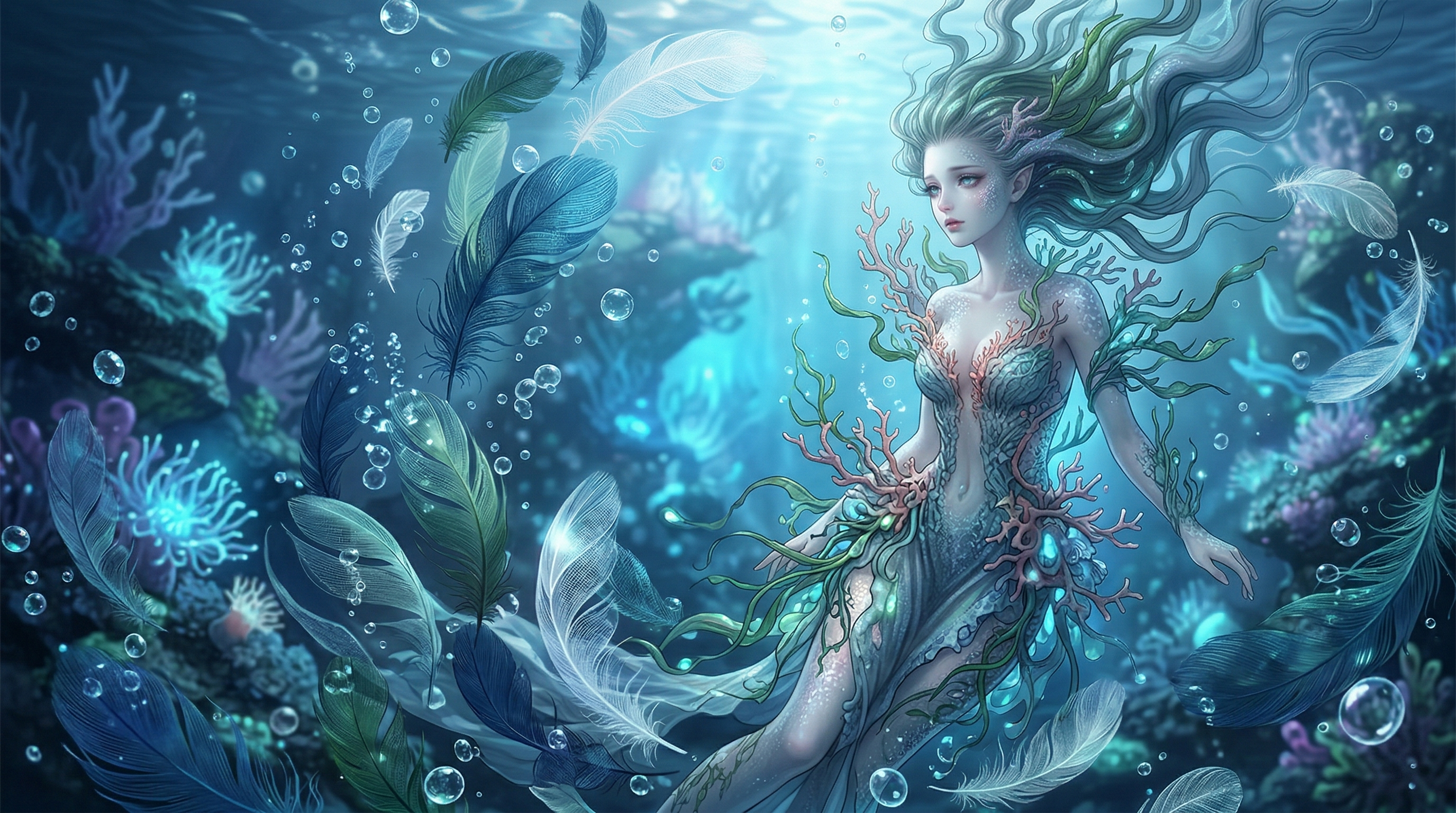
THE word "inspirée" is doing extraordinary work here. It arrives in the title of a Reddit post—"Sirène (inspirée par Yoshitaka Amano)"—and asks to be understood as the same word that describes what happens when a twenty-three-year-old Amano, freshly hired at Tatsunoko Production, begins folding Art Nouveau line into anime cel work, eventually arriving at something no one had seen before. What the word actually describes is a text field. Someone typed a name into a prompt box. The machine, which has ingested Amano's five decades of ink wash, watercolor bleed, and silver-leaf application without paying for any of it, produced a mermaid. The French-language title was then added—not by the machine, but by the operator—and the combination was posted to a forum called r/AIGeneratedArt, which exists for precisely this purpose.
Let us be precise about what Yoshitaka Amano's style actually is, since the specimen claims relation to it. Amano's line is a controlled accident. It appears to wander—the famous tendrils of hair, the elongated fingers trailing past the frame—but the wandering is architectural. Every stroke in an Amano watercolor knows where the paper will resist. The wash bleeding past an inked border in his siren illustrations for *Final Fantasy* is not the paint escaping; it is the paint arriving exactly where he understood wetness would carry it. This is a practice developed across thousands of paintings, rooted in an apprenticeship that began at fifteen, refined through theatrical costume design, vampire mythology illustration, and the peculiar discipline of making fantasy legible at both the scale of a gallery wall and the scale of a 16-bit sprite.
The specimen—and here one must examine what the machine believes it has learned—reproduces certain surface properties. There are flowing lines. There is a figure with elongated proportions. There is a palette that gestures toward Amano's characteristic cool-toned washes. The hair moves. The tail curves. These are the elements a diffusion model can extract from a training set: the statistical average of what makes an Amano look like an Amano to a system that cannot see.
What is absent is everything that makes an Amano an Amano to a person who can.
The line in the specimen does not know where it is going. This is not a metaphor. Amano's line carries directional intention—it thickens where pressure was applied, thins where the brush lifted, breaks where the paper's tooth caught the bristle at speed. These are physical facts recorded in pigment. The generated line is uniformly confident, which is to say it is uniformly nothing. It has no memory of a hand because no hand was involved. It does not thicken at the shoulder where Amano would have leaned into the stroke. It does not thin at the fingertip where he would have lifted. It simulates variation without embodying cause, which is the difference between a painting and a photocopy of a painting taken from across the room.
The more interesting object here is not the image but the title. "Sirène (inspirée par Yoshitaka Amano)—réalisée avec Nano Banana." The parenthetical construction mirrors museum wall labels. The French operates as a curatorial register, lending the post an institutional affect that the forum's infrastructure—upvote arrows, flair tags, comment threads—immediately undermines. The operator has built a tiny gallery inside a website designed for the rapid consumption and disposal of artefacts exactly like this one. The effort is genuine. The category error is total.
"Réalisée avec Nano Banana" is the clause that deserves attention. *Réalisée*—realized, made real, brought into being. The verb assigns creative agency to the collaboration between operator and tool. But the tool's contribution is not collaboration in any sense the word has previously carried. A printmaker collaborates with the resistance of the plate. A watercolorist collaborates with the behavior of water. The operator of Nano Banana collaborates with a statistical model that has, without permission or compensation, averaged the life's work of the artist named in the same title. The collaboration is with the inventory.
None of this is the operator's fault, exactly. The forum exists. The tools exist. The prompt field accepts names of living artists without friction or consequence. The system is designed to make this effortless, and it has succeeded. What it has not done—what it structurally cannot do—is produce a siren that knows why Amano's sirens matter. His sirens are liminal because his line is liminal: caught between Western illustration and Japanese painting, between the decorative and the structural, between control and its deliberate release. The specimen is liminal only in the sense that it exists between someone else's mastery and a machine's statistical summary of that mastery.
The gap between "inspirée par" and inspiration is the gap between the title and the object. The title remembers Amano. The image has already forgotten him.
Specimen: Digitally generated siren figure in flowing pose with elongated proportions and cool-toned palette, produced by the Nano Banana image generation system. Recovered from Reddit, r/AIGeneratedArt, December 2024. The French-language title credits Yoshitaka Amano as inspiration; the image credits no one.