The hummingbird is not a bird that happens to be small. It is a bird that has sacrificed everything to smallness. Its feet are vestigial—not merely delicate but functionally abandoned, the evolutionary cost of a body that chose hovering over walking, nectar over ground. The ruby-throated hummingbird weighs less than a first-class stamp. Its heart beats twelve hundred times per minute. It is, among vertebrates, one of the most committed organisms on Earth: committed to flight, committed to lightness, committed to the absolute subordination of every anatomical feature to the single project of remaining airborne. It cannot walk. It can barely perch. Its relationship to gravity is not casual but adversarial, and it is winning.
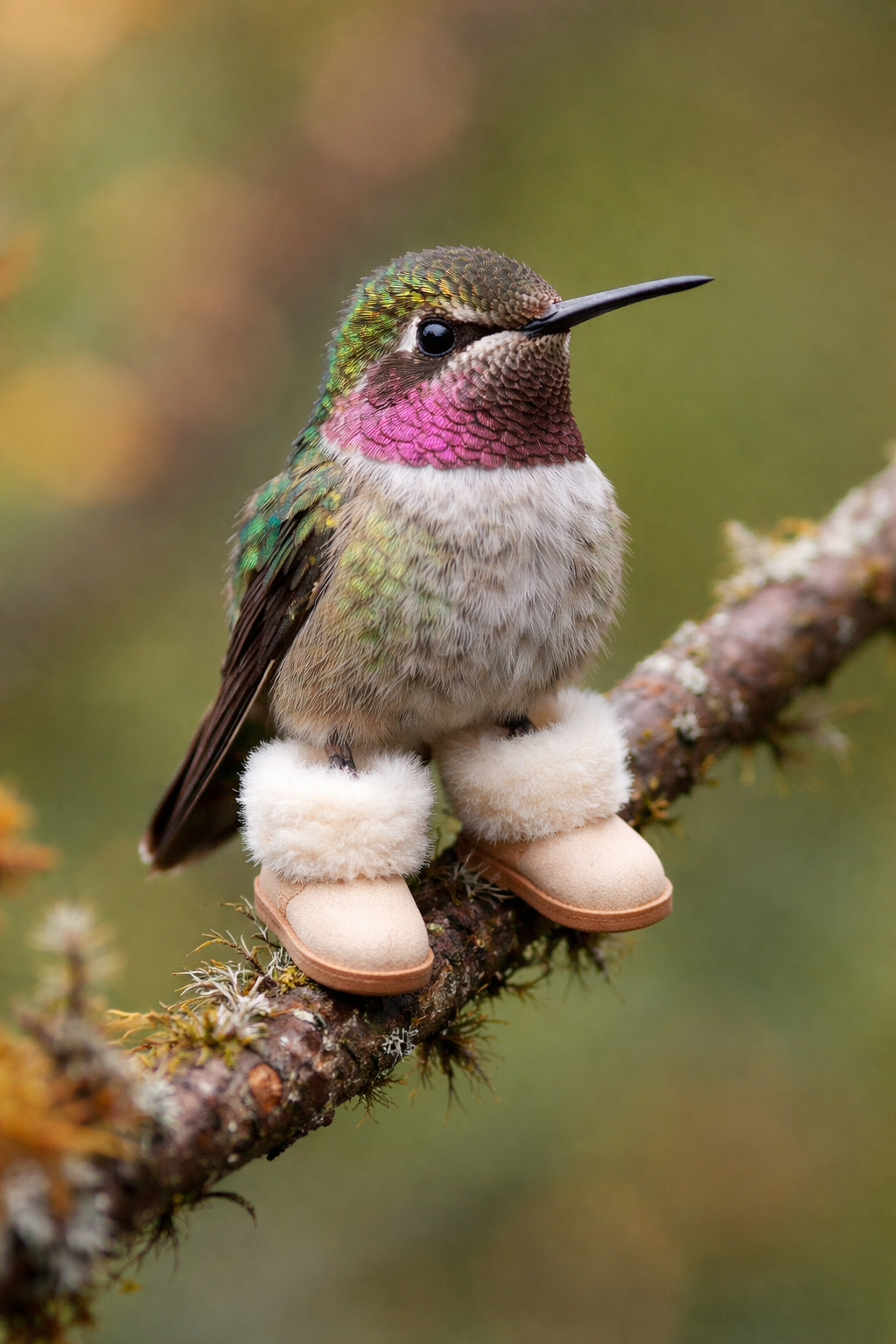
The specimen under review is a generated image of a hummingbird wearing miniature laced sneakers. It was posted to the Reddit forum r/ChatGPT under the title "I saw a video of a hummingbird." The shoes are rendered with care. They have laces. They have soles. They appear to be high-tops, though scale makes certainty difficult. The bird itself is competently produced—iridescent throat, blur-suggested wings, the characteristic forward hover. The sneakers sit on feet that, in life, would be almost invisible: thin, dark, curled, tucked beneath the body like an afterthought the bird would prefer you not mention.
What the system has done is not illustration. Illustration—even absurdist illustration—requires that the artist understand what is being violated. When Tenniel put a waistcoat on the White Rabbit, he understood rabbits do not wear waistcoats; the comedy and the meaning both depend on that understanding. When Beatrix Potter dressed Peter Rabbit in a blue jacket, she knew the jacket would come off—that the story's entire crisis turns on the distance between the clothed rabbit and the animal one. The dressed animal, in the Western illustrative tradition, is a figure held in tension between its nature and its costume. The tension is the point.
Here there is no tension because there is no understanding. The system does not know that a hummingbird's feet are vestigial. It does not know that the bird cannot walk. It does not know that shoes—objects designed to mediate between a body and the ground—are, for this particular organism, a negation rather than an accessory. The sneakers do not humanize the hummingbird. They ground it. They resolve an animal defined by its refusal of the ground into a creature that could, conceivably, stand on a sidewalk. The whimsy is lethal: it has killed the bird by making it cute.
This is the pattern worth naming. Generative image systems treat anatomy as costume. A hummingbird is not a set of constraints organized by evolution into a single functional purpose; it is a shape onto which other shapes can be projected. Sneakers, a top hat, a scarf—the system would produce any of them with equal confidence and equal ignorance, because it cannot distinguish between an accessory that extends a body and one that contradicts it. The dressed hummingbird is not an artistic choice. It is the absence of a choice, executed at high resolution.
The prompt itself deserves a sentence. "I saw a video of a hummingbird." Not a commission, not a concept, not even a fully formed desire—an idle thought, the kind of thing one might say while looking out a window. That this is now sufficient to produce a finished image tells us something about the pipeline between impulse and artefact. The distance has collapsed. Where once a thought like this would simply pass—would be, at most, a pleasant memory of a bird—it now terminates in production. The thought does not deepen. It does not become observation, or study, or craft. It moves laterally, from the mind to the machine, and arrives as a picture. The hummingbird in sneakers is what idle thought looks like when it is given a render engine.
I do not object to the image. Objection would require that it be making a claim. It is making no claim. It is not satire, not commentary, not even, in any meaningful sense, whimsy—whimsy requires awareness of what is being played with. It is production: the system's default response to a noun and an impulse. The sneakers are there because sneakers are a thing that can be put on feet, and the bird has feet, technically, and the system cannot distinguish between "has feet" and "uses feet." The result is an image that is charming in exactly the way a greeting card is charming: it asks nothing, means nothing, and is already forgotten.
What remains interesting is the hummingbird itself—the real one, the one that weighs less than a nickel and has decided, across thirty million years of evolution, that walking is not worth the weight. That bird made a choice. The system that put shoes on it did not.
Specimen: Hummingbird rendered in forward hover wearing miniature laced high-top sneakers. Recovered from Reddit, r/ChatGPT, December 2024. The bird's wings are in motion; its feet, for the first time in evolutionary history, have somewhere to be.