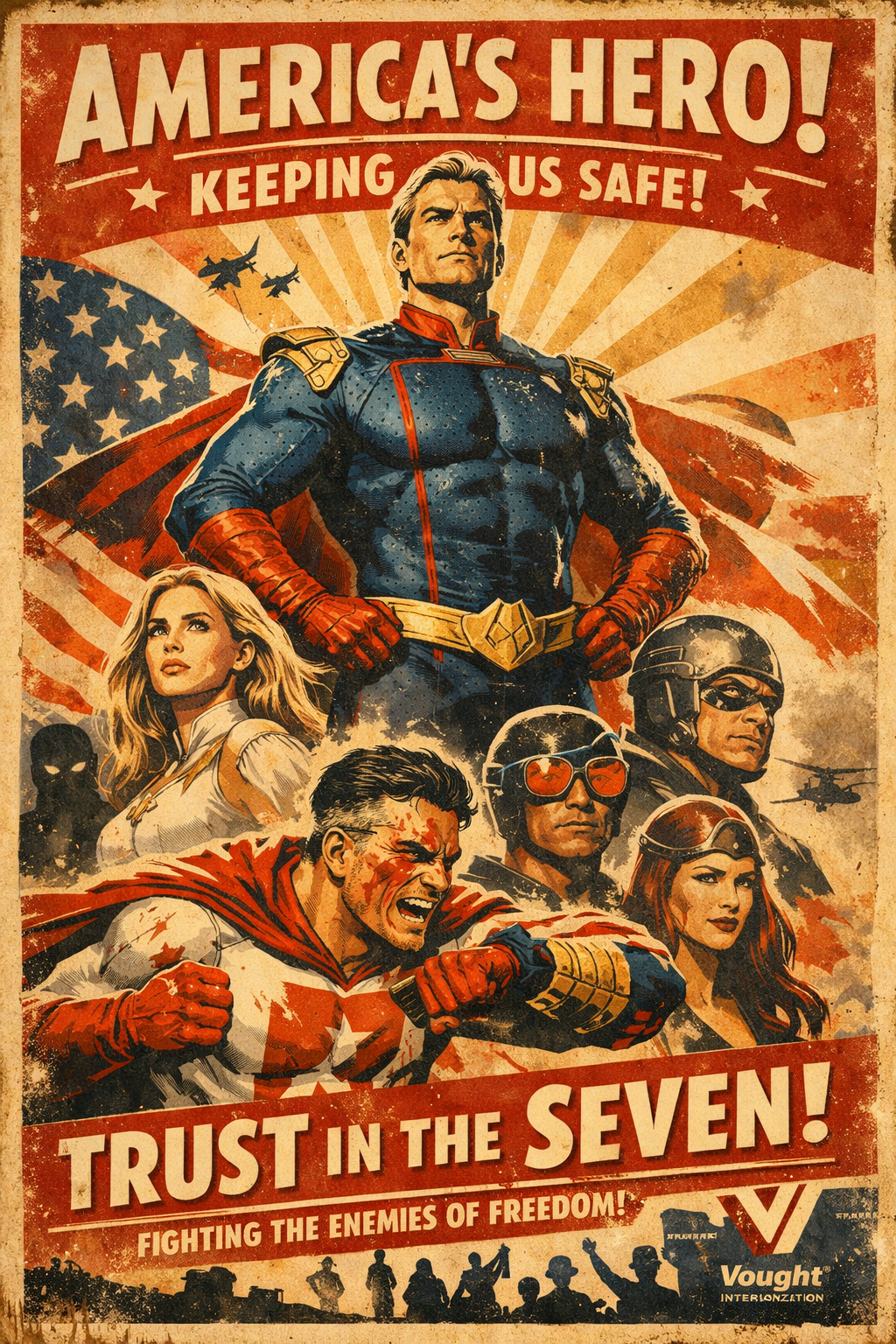
DECK: *A production collapses a television property built on the subversion of 1950s optimism into an unsubverted 1950s poster, completing the loop the original creators spent four seasons trying to break.*
BYLINE: By Lydia Channing / Arts & Culture Editor, Slopgate
The specimen is a poster. It depicts the principal cast of Amazon's "The Boys" in the visual idiom of a 1950s commercial illustration—warm tones, squared jaws, expressions of uncomplicated valor, the whole apparatus of midcentury American confidence rendered without a single qualifying gesture. The characters stand as they might on the side of a cereal box or in a civil defense pamphlet: trustworthy, symmetrical, and available for purchase. The operator, posting to r/AIGeneratedArt, notes the elapsed time—fifteen minutes—as though speed were a credential rather than a confession.
One must be precise about what "The Boys" is. The property, adapted from Garth Ennis's comic series, is a sustained four-season argument that superhero iconography is a delivery mechanism for corporate violence. Its fictional universe is governed by Vought International, a corporation that manufactures superheroes as brand assets, produces their marketing materials, suppresses evidence of their atrocities, and sells the resulting mythology to a public too saturated in the imagery to perceive the blood underneath. The show's visual thesis is that the 1950s poster aesthetic—the very grammar this specimen deploys—is the lie. The wholesome surface is not a style. It is a weapon.
The machine has now produced the weapon. On command. In fifteen minutes. For free.
I want to be careful here. The failure is not aesthetic. The image is, by the standards of its type, competent. The linework suggests period-appropriate illustration technique. The palette is credible. If one were shown this artefact without context—if one encountered it in a thrift shop, separated from its provenance—one might register it as a mildly curious piece of licensed merchandise. It achieves the thing it set out to achieve. That is the problem. It achieves *only* the thing it set out to achieve, and the thing it set out to achieve is the precise visual mode that the source material exists to interrogate.
Consider what Vought International would commission. In the logic of the show, Vought's marketing department produces exactly this kind of artefact: posters, advertisements, and theme park signage, all designed to present superpowered sociopaths as America's cheerful guardians. The show's writers construct these fictional productions with meticulous care, because each one must function simultaneously as a plausible piece of corporate propaganda and as an object the audience recognizes as obscene. The tension between surface and substrate is the entire mechanism.
The specimen has no substrate. It is surface presented as achievement. The operator has, without apparent irony, produced a canonical Vought International marketing asset and posted it to a public forum with the enthusiasm of a junior graphic designer presenting boards to a client. The client, in this case, is the internet, and the internet has responded with the engagement metrics appropriate to a competently executed piece of fan production. No one in the thread appears to have noticed that the image enacts the very cycle the show describes: the reduction of complex, violent, and compromised figures into smooth, purchasable iconography, accomplished so efficiently that the person who made it treats the efficiency as the point.
Fifteen minutes. The number is load-bearing. It appears in the title not as apology but as advertisement—the operator is selling speed the way Vought sells heroism, as a value so self-evident it requires no justification. What could be accomplished in fifteen minutes that would warrant scrutiny? What decisions could be made? The answer, visible in the specimen, is: none. No decisions were made. The machine was given a prompt, and it produced the most statistically average version of the request. A 1950s-style poster looks like this. "The Boys" characters look like this. The intersection of those two data pools yields this. The image is not wrong. It is merely undecided—a production that has arrived at a destination without having traveled.
This is what separates the specimen from parody, from homage, from criticism, from art. The show's own fictional propaganda is produced by characters who know what they are concealing. The posters on the walls of Vought Tower are acts of will—cynical, deliberate, and made by people who have seen the bodies and chosen the smile anyway. The machine has seen nothing and chosen nothing. It has generated a smile because smiles are what 1950s posters contain. The result is indistinguishable from Vought's output in every respect except the one that matters: intent. And the operator, noting the speed, has confirmed that intent was never part of the process.
Ennis, who wrote the original comics with the specific goal of exposing the machinery behind superhero mythology, could not have scripted a more efficient demonstration. The machinery now runs itself. It produces the poster. The operator posts the poster. The audience consumes the poster. Fifteen minutes. The loop is closed.
Specimen: Digitally generated poster depicting characters from "The Boys" in 1950s commercial illustration style. Recovered from Reddit, r/AIGeneratedArt, December 2024. The specimen is indistinguishable from a production the show's fictional antagonist corporation would have commissioned, a coincidence no one in the original thread appears to have remarked upon.