DECK: *An image generator, commissioned to produce the one thing its audience requires be flawless, delivers a foot that cannot decide how many digits it possesses.*
BYLINE: By Lydia Channing / Arts & Culture Editor, Slopgate
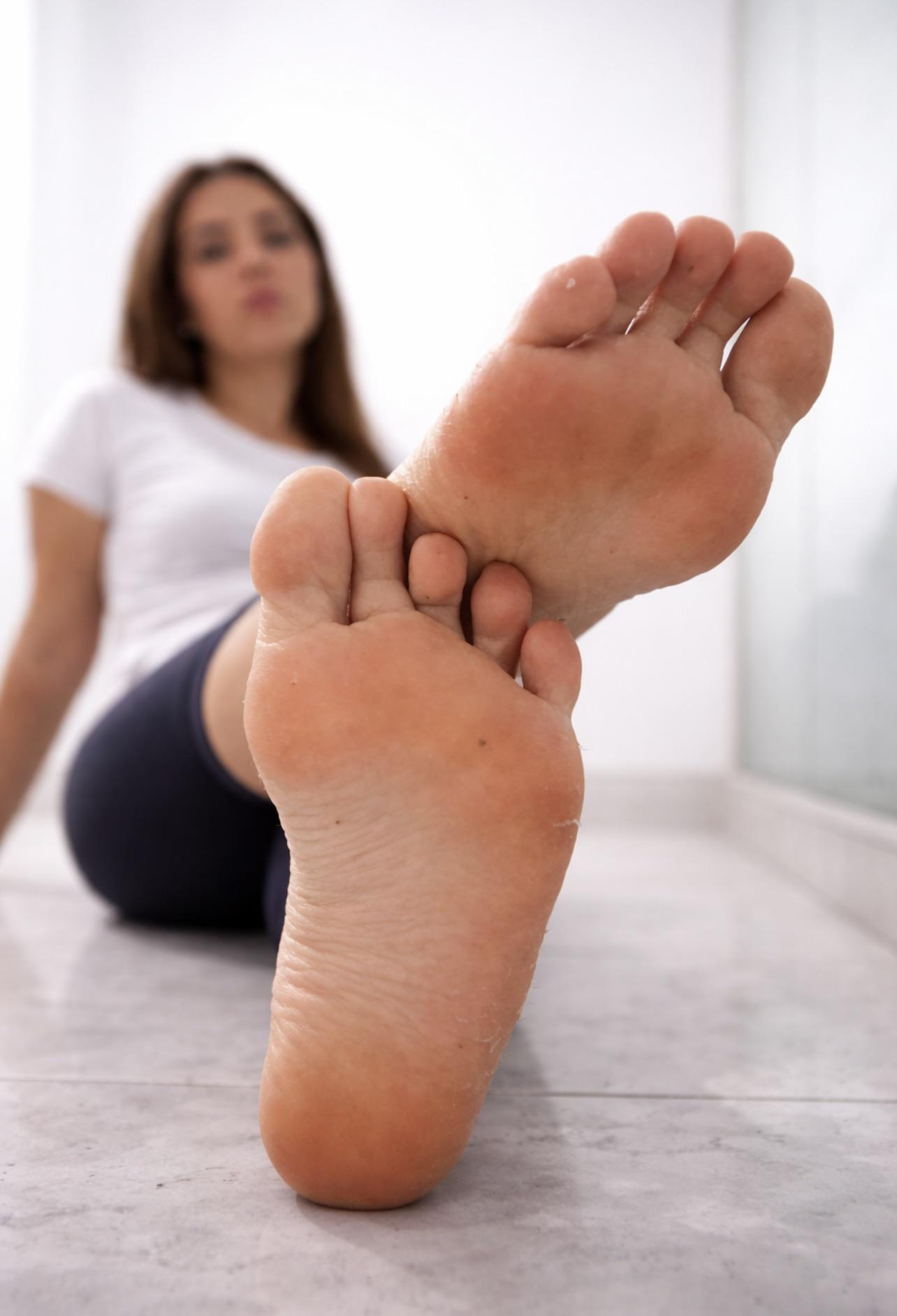
The foot is the subject. Let us be precise about this, because precision is what the machine was not. The image—posted to r/AIGeneratedArt under the Spanish title *pies estirados*, "stretched feet"—presents a woman reclining on what appears to be a pale surface, her bare soles thrust toward the lens in the forced-perspective convention familiar to anyone who has encountered this particular genre of photography. The composition is not accidental. The depth of field is not accidental. The foreshortening is not accidental. Every formal decision in this frame exists to deliver the viewer to the foot. The foot is the destination. The foot is wrong.
Examine the closer sole. The toes—and here one must proceed carefully, because enumeration is the problem—occupy a region of profound anatomical ambiguity. The hallux, which in the human body is a single, definitive digit, here appears to generate companions. What should be five toes presents as something between four and six, depending on how one reads the folds and creases the machine has rendered where discrete digits ought to be. The skin between what may be the first and second toes does not so much separate as *negotiate*. There is a crease that could be a boundary, or could be a wrinkle, or could be the machine's admission that it has lost count. The effect is not grotesque. It is something more interesting than grotesque. It is *almost right*, which is the uncanny valley's actual address.
The auteur framework demands we ask: has the maker made its decisions consciously, unconsciously, or not at all? With an artificial intelligence image generator, the answer is structurally the third. The machine has no theory of feet. It has a statistical distribution of feet—millions of feet, photographed from millions of angles, reduced to patterns of pixel adjacency. It knows that toes occur in the region where the foot terminates. It knows that the spaces between toes produce shadows of a certain character. What it does not know, because it cannot know, is that there are five. Five is not a visual pattern. Five is a fact. And facts are not what these systems trade in.
This is where the specimen becomes genuinely interesting as an artefact of its moment: the genre to which it belongs—let us call it pedal portraiture—is a genre in which the foot is not background, not incidental, not the thing the eye skips past on its way to something else. The foot is the *text*. Every viewer of this image who belongs to its intended audience will look at the toes. They will look at the toes first, and longest, and with an attention to anatomical detail that would satisfy a podiatrist. The image generator has been asked to perform in front of the one audience least likely to forgive a sixth toe.
There is an irony here that the machine cannot appreciate, but we can. Artificial intelligence image generators fail most reliably at extremities—hands, feet, and the places where the body articulates into countable digits. This is well documented, widely mocked, and, for most applications, largely irrelevant. A generated landscape needs no fingers. A generated portrait can hide its hands behind a lectern or a bouquet. But pedal portraiture offers no such refuge. The foot cannot be cropped. The foot cannot be obscured. The foot is the commission.
The poster's title acknowledges something has gone awry. *Pies estirados*—stretched feet. The elongation is noted, filed under the category of interesting distortion rather than disqualifying failure. One senses a viewer who found the proportions amusing, or perhaps appealingly strange, and shared accordingly. This is its own small revelation: that the threshold for anatomical fidelity in machine-generated imagery has been set, by at least some consumers, at a level where a superfluous toe is a curiosity rather than a defect. The foot is wrong, but not wrong enough to suppress.
Meanwhile, in the background, a second figure reclines—her face rendered in the soft blur that the depth-of-field convention demands. It is precisely the kind of controlled illegibility that artificial intelligence handles well. Blur is forgiving. Blur does not require the machine to commit to a number of anything. The face, which in this composition is the thing the viewer is meant to look past, is the one element the machine needed to get wrong and did not. The system has distributed its competence exactly backward.
One returns to the toes. One always returns to the toes. They sit there in their ambiguous plurality, fused and divided, committed to neither four nor six, a small monument to the distance between pattern and fact. The machine has produced a foot for people who love feet, and the foot does not know how many toes it has. The comedy requires no commentary. It is structural.
Specimen: Photograph-style generated image of reclining female figure, bare feet extended toward camera in forced perspective. Recovered from Reddit, r/AIGeneratedArt, user-posted under title *pies estirados*, December 2024. The foregrounded foot exhibits between four and six toes, depending on one's generosity.