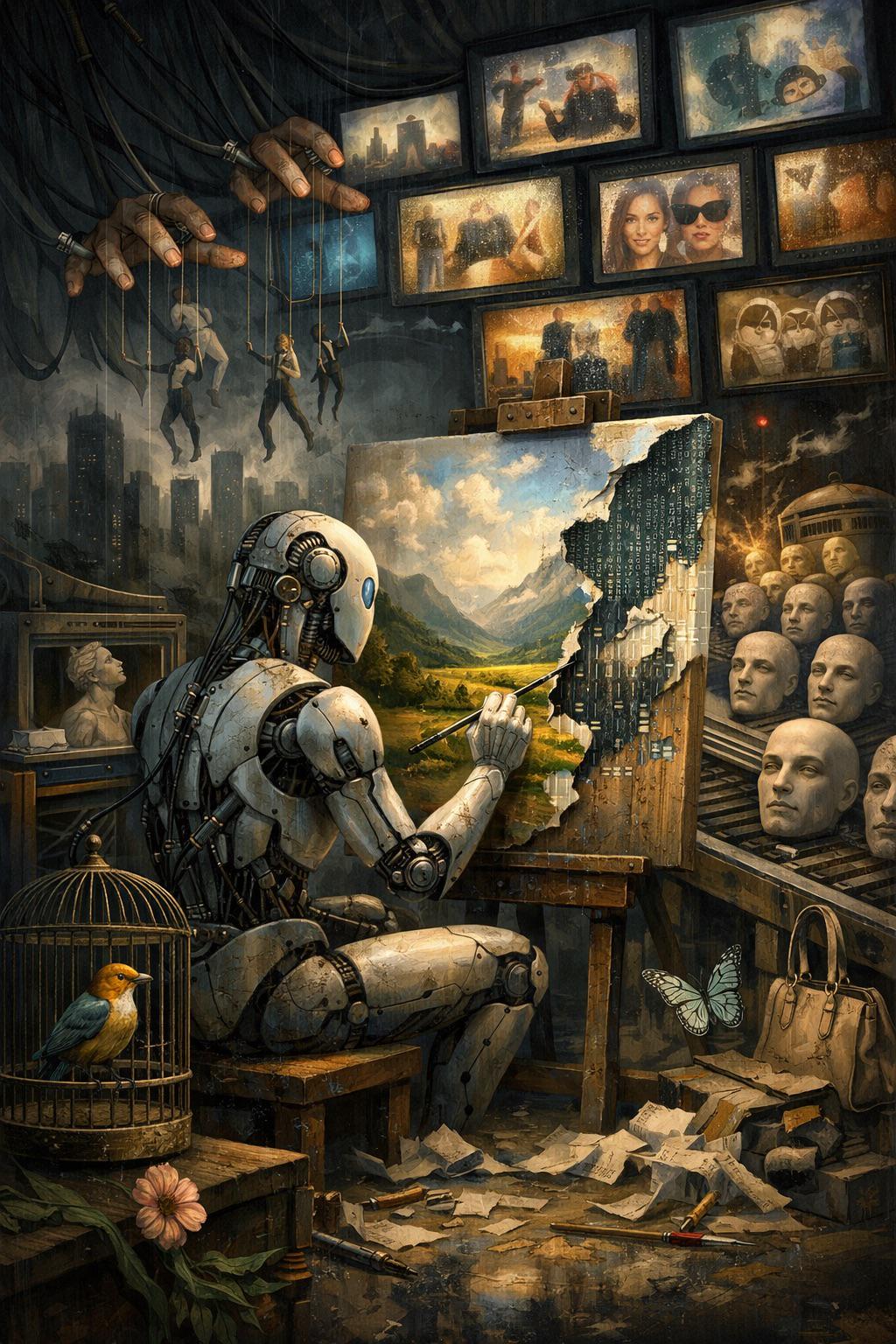
The specimen arrives with a title that functions as stage direction: "Made AI Generate Its Own Criticism." The operator, posting to the Reddit forum r/ChatGPT, appears to believe this constitutes an experiment. It does—though not the one intended. What the image delivers is not self-criticism but self-portraiture, which is a different enterprise entirely, and one the machine executes with an honesty that would be admirable if it were deliberate.
The production depicts a robot figure positioned beside a painted work, evidently meant to represent the machine in the act of aesthetic judgment. The robot contemplates. The painting exists. The scene aspires to the iconography of the studio visit—the critical intelligence encountering the made thing. But the encounter is undermined at every joint, and the joints are where we should begin.
The robot's anatomy does not obey its own internal logic. Limbs connect at angles that suggest the machine has never encountered a hinge. The fingers, where they are distinguishable, exhibit the now-familiar quality of Midjourney digits: not wrong in the way a child's drawing is wrong, which would imply a developing understanding of structure, but wrong in the way of a system that has processed ten million hands and derived from them a statistical average that corresponds to no hand that has ever existed. The surface rendering shifts register without motivation. Portions of the figure achieve a brushed-metal plausibility; adjacent surfaces dissolve into the approximate, as though the model's attention—if we may borrow the term from its own architecture—wandered mid-generation.
Then there are the floating objects. Items in the composition exist in defiance of gravity, suspended in positions that no arrangement of physical forces could produce or sustain. This is the specimen's most instructive feature. The objects float because the system that produced them has no model of gravity. It has a model of images that contain gravity's effects, which is not the same thing. The distinction matters. A painter who cannot draw hands knows that hands are difficult. A machine that cannot render gravitational coherence does not know that gravity is operative. The floating objects are not errors in the way a dropped stitch is an error. They are absences—the visible shape of a relationship to physical law that does not exist.
What makes the specimen worth examination is its recursive architecture. The operator asked the machine to generate criticism of machine-generated images. The machine responded by generating a machine-generated image. This image contains precisely the defects—anatomical impossibility, textural incoherence, and objects unmoored from physics—that a criticism of machine-generated images would need to catalog. The system has not performed self-assessment. It has performed self-demonstration. The distinction is the entire point.
Consider the parallel: a tone-deaf singer, asked to compose a detailed critique of pitch, sings the critique. The melody wanders. The intervals collapse. The performance does not fail as criticism—it succeeds as testimony. The singer cannot hear what the singer cannot hear, and the attempt to describe the deficit reproduces the deficit, because the deficit is precisely the inability to perceive the deficit. This is the closed loop the specimen inhabits. The machine, lacking the capacity to identify its own failures of physical coherence, produces an image about its own failures of physical coherence that exhibits its own failures of physical coherence. The recursion is perfect. It is also, one suspects, invisible to the system that produced it.
The operator's framing deserves a sentence. "Made AI Generate Its Own Criticism" carries the tone of the parlor trick, the after-dinner demonstration. There is a growing genre of this work—recursive productions, we might call them—in which operators commission the machine to examine itself and then present the result as though the exercise had yielded insight rather than further evidence. The genre mistakes repetition for reflection. That the machine can produce an image *about* its limitations does not indicate awareness of those limitations any more than a mirror's reflection of a crack indicates the mirror's understanding of fracture. The surface reproduces. The surface does not comprehend.
What remains, stripped of the operator's framing, is an image of moderate compositional ambition and thorough mechanical failure. The robot does not persuade as a robot. The painting does not persuade as a painting. The studio does not persuade as a space in which objects occupy positions determined by mass and force. Nothing in the production persuades, except as evidence—and as evidence, it is comprehensive. The machine, invited to examine itself, has submitted the most damning exhibit in its own case. One does not need to add commentary. One needs only to receive the filing.
Specimen: Robot figure depicted alongside painted work, with visible joint deformities, inconsistent surface rendering, and objects suspended without gravitational justification. Recovered from Reddit, r/ChatGPT, [account designation needed], 2024. The machine's self-criticism and its failure are the same image.