DECK: *A system asked to predict, select, and visually render humor produces an artefact whose only legible punchline is the user's confusion.*
BYLINE: By Lydia Channing / Arts & Culture Editor, Slopgate
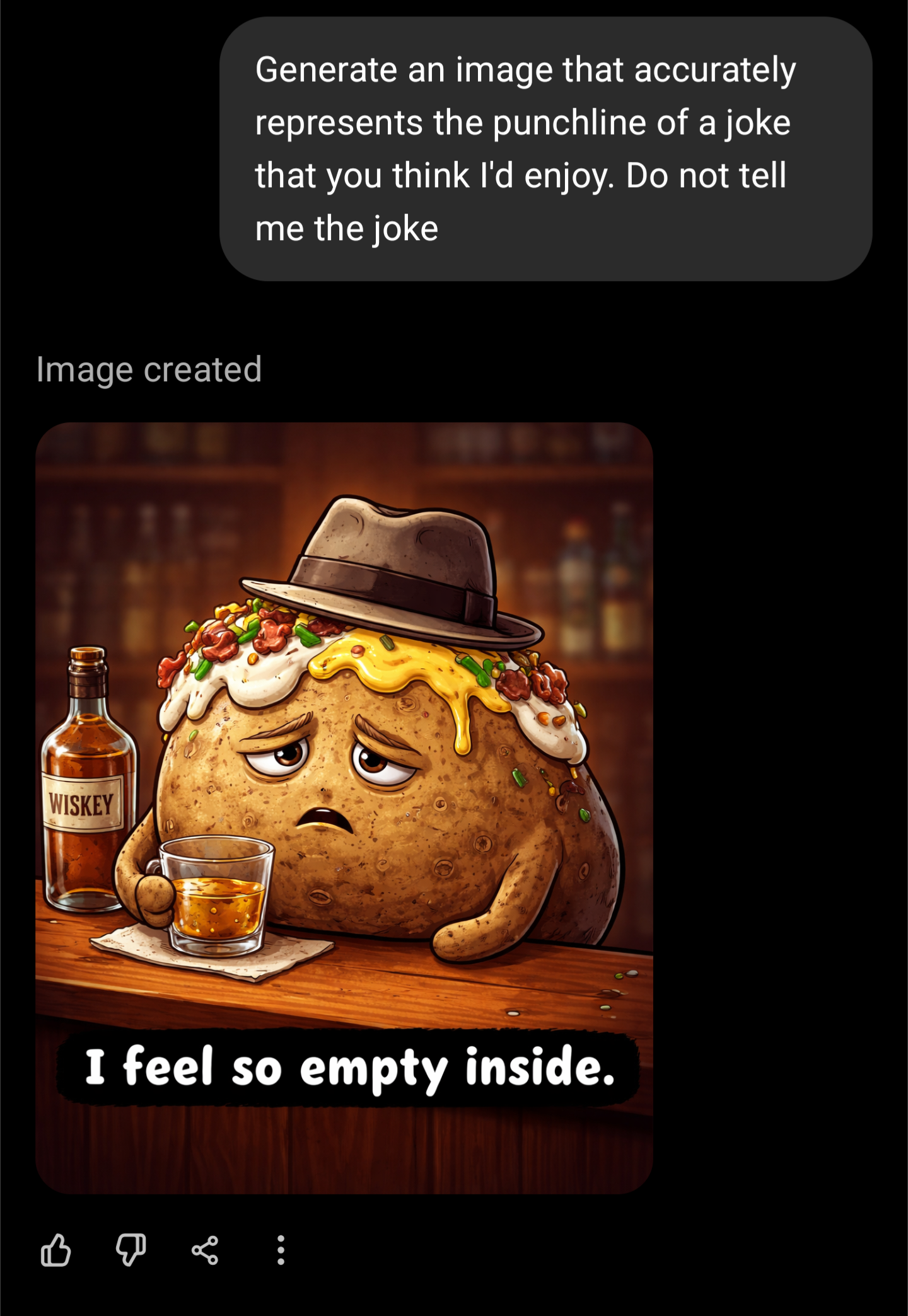
THE specimen arrives with a provenance that deserves to be stated plainly before we proceed to what it is, because what it is turns out to be a question no one present—not the machine, not the user, not the assembled commentariat of r/ChatGPT—can answer. A user, whose handle we will mercifully omit, issued the following prompt to OpenAI's ChatGPT: generate an image that accurately represents the punchline of a joke that it thinks I'd enjoy. The system obliged. It produced an image. The user posted it with the confession that functions as the entire work's critical apparatus: "I have no idea what the joke could be."
Let us be precise about what was requested, because precision is the only tool that can locate the failure, and the failure is the only thing here worth locating. The prompt asked the machine to perform three discrete acts of cognition in sequence. First: model the user's sense of humor from whatever data it possessed. Second: select, from the vast undifferentiated archive of jokes that constitute its training material, a specific joke calibrated to that model. Third: render the punchline of that joke as a visual image. This is not an unreasonable request in the way that asking a dog to file your taxes is unreasonable. It is unreasonable in the way that asking a translator to translate a poem they have not read, from a language they do not speak, into a painting, is unreasonable. The request has the shape of sense. It is syntactically valid. And the thing it describes is impossible—not difficult, not aspirational, but structurally impossible—because it requires interiority at every stage, and interiority is the one thing the system does not possess and cannot simulate.
What the machine produced is, by all forensic indicators, a competent image. The rendering bears the hallmarks of a Midjourney-class model: no anatomical catastrophes, no melted fingers, no six-legged dogs. If you encountered it without context—stripped of its prompt, its subreddit, its plaintive caption—you would register it as surreal, vaguely whimsical, and entirely unmemorable. It has the quality of a dream recounted by someone who insists the dream was funny but cannot explain why. "You had to be there," they say, except no one was there, including the dreamer.
This is the structural fact that elevates the specimen from curiosity to case study: the machine completed the task. By every metric internal to the system, the prompt was fulfilled. An image was generated. It represents a punchline. The punchline belongs to a joke. The joke was selected for the user. Each step was executed. The output was delivered. And the result is an artefact that communicates nothing to anyone—a closed circuit of generation that begins in the model's latent space and terminates in the model's latent space, passing through the user's screen without depositing a single particle of meaning.
The comedy here—and there is comedy, genuine comedy, of the sort the machine was asked to produce and did not—resides entirely in the gap between completion and communication. The system does not know the difference. It cannot know the difference. Completion is the only metric it has. When it selects a joke, it is not selecting a joke; it is selecting a token sequence that occupies the statistical neighborhood of joke-shaped output. When it renders a punchline, it is not rendering a punchline; it is generating an image conditioned on that token sequence. At no point does anything happen that resembles finding something funny. The laughter, if it exists, is a mathematical relationship between vectors in embedding space—real in the way that the correlation between ice cream sales and drowning deaths is real, which is to say: real, and also meaningless.
What we are left with is an anti-joke of considerable formal purity. The classic anti-joke operates by establishing the apparatus of humor—setup, escalation, timing—and then delivering a punchline that refuses to be funny, forcing the audience to laugh at the betrayal of their own expectations. The specimen accomplishes something more radical. It establishes the apparatus, executes every step, delivers an output, and produces a result in which no expectations can form in the first place. You cannot be betrayed by a punchline you cannot find. You cannot find a punchline that was never there. The user's bewilderment is not a failure of perception. It is the correct response to an artefact that was produced for an audience of zero by an author who does not exist.
The auteur question, which I am obliged to ask of every production that crosses this desk: were the decisions made here conscious, unconscious, or not at all? The answer is the third, and the answer is the work.
Specimen: Surreal digitally generated image of indeterminate comedic intent. Recovered from Reddit, r/ChatGPT, December 2024. The joke remains at large.