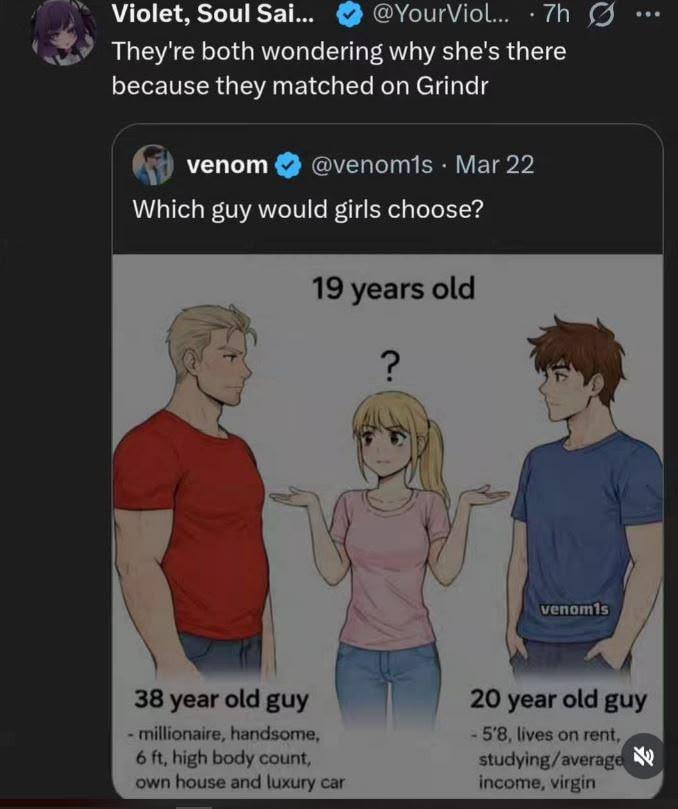
**T**HE specimen is a palimpsest of four decisions, and only one of them is interesting. An anime-style illustration presents a familiar tableau: two men flank a young woman, who shrugs beneath a question mark. The men are labeled with their specifications. The left figure is thirty-eight, a millionaire, handsome, six feet tall, possessed of a high body count, a house, and a luxury car. The right figure is twenty, five foot eight, renting, studying, average of income, a virgin. Between them the woman stands at nineteen, unburdened by a single descriptor, because she is not a person in this composition. She is the mechanism by which the two product listings are compared. The original poster, @venom1s, captions the arrangement: "Which guy would girls choose?" The question mark over the woman's head is the only honest element in the frame.
This is the first decision. It is not new. The reduction of romantic competition to a feature matrix—height as a sortable column, net worth as a filter, virginity as a deficit requiring disclosure—has been the organizing grammar of a particular online masculinity for a decade. The illustration merely makes the grammar visual. That it does so in anime style is appropriate: the figures exist at the exact level of abstraction the premise requires. They are not portraits. They are positions in an argument.
The second decision belongs to @YourViol, who quotes the tweet and supplies the reply: "They're both wondering why she's there because they matched on Grindr." In eight words and a proper noun, the entire apparatus collapses. The woman whose choice was the engine of the meme is revealed as irrelevant—not because she has chosen poorly, or refused to choose, but because the two men whose specifications were arrayed for her inspection were never oriented toward her in the first place. The spec sheet was a performance staged for an audience that was never its audience. The question "Which guy would girls choose?" is answered: neither, because the question was addressed to the wrong room.
This is the reply that elevates the specimen from production to artefact. The original illustration operates within a genre so thoroughly established that its conventions have calcified into liturgy—the height requirement, the income disclosure, the implicit ranking that pretends to solicit judgment while having already rendered it. The reply does not argue with the liturgy. It does not object to the reduction of persons to feature sets. It simply reveals that the ceremony was being conducted in an empty church, that the congregants had left through a door the architect did not draw.
The third decision is the one that delivered the specimen to this desk. A Reddit user posts the screenshot to r/shitposting under the title "The grind never stops." The title is a masterwork of ironic recontextualization. "The grind" here does not refer to entrepreneurial perseverance. It refers to the ceaseless, self-reproducing manufacture of gendered dating discourse—the industrial output of memes that pose the same question in the same format with the same implied answer, circulating through the same networks, accruing the same engagement, and generating the same replies, forever. The grind, in this usage, is the machinery of the genre itself, and the poster's observation—that it never stops—is confirmed by the specimen's own existence. It has not stopped. Here is another one.
The auteur question applied to the illustration returns the expected ambiguity. The skin has the polymer quality of figures that were never drawn so much as resolved; the proportions are correct without being observed. Whether the illustration is the product of a generative model or of a human artist who has internalized the same frictionless aesthetic is, for the purposes of this analysis, a distinction without a difference. The figures communicate nothing that was not specified in the prompt, whether that prompt was typed into a text field or held in the mind of an artist trained on the same inputs. Convergence, in either case, is the medium.
What interests me is the fourth decision—the one nobody made. The screenshot that circulates on Reddit preserves every layer: the original illustration, the original caption, the reply that detonates the premise, and the Reddit title that frames the detonation as evidence of an ongoing condition. Each layer was added by a different hand. None of the hands consulted the others. Yet the composite object is more coherent than any of its parts—a complete critical essay on the production of gendered comparison memes, assembled accidentally, by a process of sequential annotation that resembles nothing so much as the way a coral reef is built. No architect. No blueprint. Aggregate accretion toward a structure that, examined from a sufficient distance, appears to have been designed.
The specimen is slop in its first layer and criticism in its last, and the distance between those layers is three strangers and a screenshot button. That this constitutes a folk practice—the ironic redistribution of generative material through platforms whose architecture rewards exactly this kind of repackaging—is by now beyond dispute. What remains unresolved is whether the practice produces understanding or merely the sensation of understanding, whether the Grindr reply and the shitpost title constitute genuine reading or simply another stage of processing in a pipeline that refines material without comprehending it. The grind, as advertised, never stops. It is not clear that it needs to know where it is going.
CUTLINE: Specimen: screenshot of a Twitter exchange depicting an anime-style illustration of two men flanking a young woman, captioned with competing biographical specifications, and a reply redirecting the premise via Grindr. Recovered from Reddit, r/shitposting, April 2026. The woman's question mark is the composition's only accurate label.
*Continued on Page 4*