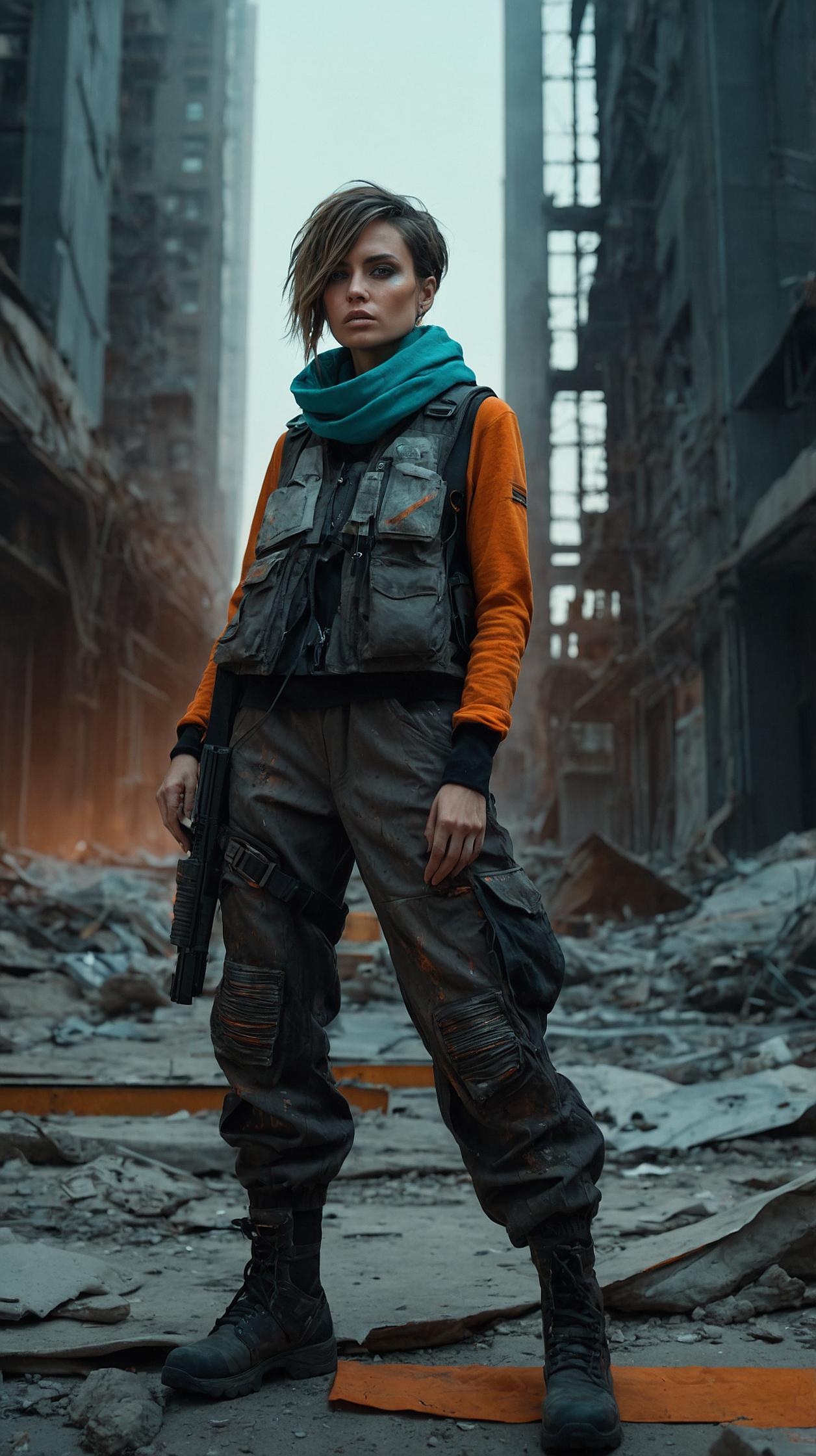
DECK: *A generated figure poses in tactical garments amid rubble that has destroyed nothing and was destroyed by nothing.*
BYLINE: By Lydia Channing / Arts & Culture Editor, Slopgate
The specimen is a woman standing in a destroyed city. She is not destroyed. Nothing about her has been touched by the event the image insists has occurred. This is the first and most important observation, and everything else follows from it.
Posted to the r/AIGeneratedArt forum under the title "This isn't just fashion," the image depicts a young woman in an orange long-sleeve shirt, olive tactical vest, and teal scarf, holding a sidearm at her side, posed amid the concrete ruins of an unidentified urban structure. The palette is the now-familiar teal-and-orange color grading that has become the lingua franca of machine-generated consequence—a shorthand learned from a thousand movie posters in which attractive people survive the end of the world attractively.
Let us begin with what the image knows. It knows the visual grammar of the fashion editorial. The woman's stance is three-quarters, weight shifted, chin slightly elevated. The vest sits with the fitted precision of a garment that was never purchased from a surplus store. The lighting falls across her face with the deliberate softness of a studio key light, which is remarkable given that the nearest intact ceiling appears to be several blocks away. The machine understands posture, silhouette, and the way fabric should catch light to communicate expense. These are the inherited residue of ten thousand decisions made by photographers and art directors who understood what they were constructing and why. The machine has absorbed the syntax. It has not absorbed the grammar.
Now let us address the scarf.
The scarf is pristine. It is teal silk, or the simulation of teal silk, draped with the loose specificity of an accessory chosen to complement. It does not have dust on it. It does not have ash on it. The concrete rubble surrounding this woman produces no particulate matter that might settle on fabric. The rubble is not rubble. It is the idea of rubble, generated by a system that understands "destroyed building" as a visual category rather than a physical process. Real rebar bends. Real dust migrates. Real catastrophe is indiscriminate in its distribution of evidence. The machine has produced a set, not a site. The scarf knows this, even if nothing else in the image does.
The weapon is instructive in a different register. It sits in her right hand with the grip of someone holding a telephone—present, acknowledged, but not active. There is no trigger discipline because there is no trigger knowledge. The sidearm functions here exactly as the vest functions, exactly as the ruins function: it is a signifier of seriousness deployed in the service of appearance. The machine has learned that guns in the hands of beautiful women, set against destruction, communicate something. What they communicate, specifically, the machine cannot say, because it has no access to the referent. It has seen the photograph. It has not heard the gunshot.
The title deserves the close reading it is begging for. "This isn't just fashion." The word "just" performs all the labor here—it concedes the fashion while insisting on a surplus. The poster believes the image transcends its genre. This is the precise opposite of what has occurred. The image is so entirely fashion that it has consumed its own ostensible subject. The ruins exist to provide contrast for the outfit. The weapon exists to provide edge for the pose. The muted palette exists to make the teal scarf vibrate. She looks, it must be said, very good. The machine is excellent at this. It is excellent at nothing else visible here.
What we are witnessing is the emergence of a specific genre: the aesthetic of consequence without event. No bomb fell on this city. No one sheltered in these buildings before they became scenic. The destruction is born pre-ruined, the way certain furniture is born pre-distressed—to suggest a history of use that never occurred. The woman has not survived anything. She has been placed in the visual aftermath of nothing by a system that has learned that aftermath is beautiful and that beauty is the point.
This is, to be precise, what the image accomplishes: it borrows the weight of suffering to sell the silhouette. The machine does this without malice, which is what makes the specimen so useful for study. A human art director who staged a fashion editorial in a warzone would be making a choice—cynical, exploitative, possibly deliberate, possibly effective. The machine makes no choice. Ruins plus beauty plus weapon plus color grading equals response. The formula is not wrong. What the formula is not, and cannot be, is *about* anything.
The poster was correct, though not in the way intended. This isn't just fashion. It is fashion in its purest state—stripped of context, occasion, body, and need. Fashion as a closed system, referring only to itself, produced by a mechanism that has never been cold, never been afraid, and never needed a scarf.
Specimen: Generated image, young woman in tactical vest and teal scarf holding sidearm amid concrete ruins. Recovered from Reddit, r/AIGeneratedArt, December 2024. The scarf remains, at press time, immaculate.