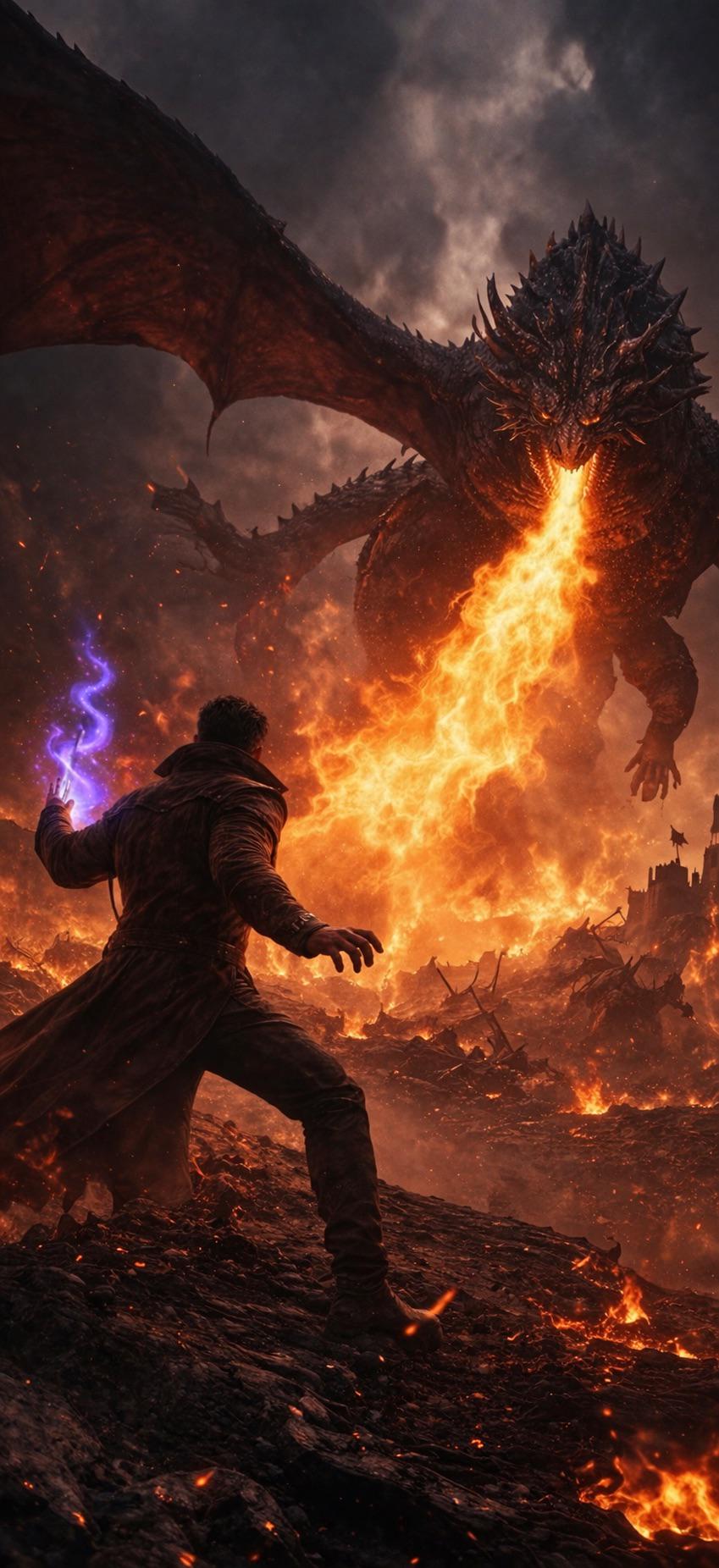
THE question is not about the hands. The question was never about the hands. The hands—six-fingered, spatulate, arranged on the wrist at an angle that would require the ulna to have made decisions it is not anatomically authorized to make—are not mentioned in the original post, which appeared on the Reddit forum r/ChatGPT under the title "How do I force the image generation to IPhone 16 dimensions/aspect ratio?" The petitioner has a figure. The figure has a dragon. The figure has too many fingers. The petitioner wants the figure to fit his lock screen. The fingers are not the problem. The lock screen is the problem. This is the hierarchy, and it is worth stating plainly, because it is new.
What we are examining is a machine-generated fantasy illustration of a type now as common as wallpaper and roughly as intentional. A robed figure, vaguely masculine, stands in proximity to a dragon whose bilateral symmetry is so precise that it appears not to have been drawn but folded—a Rorschach blot that someone has decided is a reptile. The color palette is the usual amber-to-teal gradient that has become the unofficial livery of fantasy imagery produced without human supervision. The scales on the dragon's flank shift texture between its left and right sides as though the creature molted halfway through rendering and no one thought to mention it.
The probable provenance is Midjourney, which has achieved a particular dominance in the fantasy-illustration vertical. Its outputs are recognizable in the way that Thomas Kinkade paintings were recognizable: not by what they depict but by how uniformly they glow. Every surface is lit. Every shadow contains color. The sun is everywhere and nowhere, illuminating without casting, warming without burning.
But the illustration is not the specimen. The illustration is the occasion for the specimen. The specimen is the question.
"How do I force the image generation to IPhone 16 dimensions/aspect ratio?" The sentence contains seven words of technical specificity directed at a problem the petitioner has identified as real, and zero words directed at the figure's supernumerary digits, which the petitioner has identified as not worth mentioning. The iPhone 16 Pro Max displays at 2556 by 1179 pixels, a ratio of approximately 19.5 to 9. This is a constraint. It can be measured. It can be solved. A prompt can be adjusted, a parameter appended, and a crop applied. The human hand's five-finger configuration is, by contrast, merely biological—a convention of developmental genetics that has held for roughly 370 million years but that carries, in this context, no operative authority. The phone's dimensions are a specification. The hand's dimensions are a suggestion.
The auteur question—has the petitioner made this decision consciously, unconsciously, or not at all?—is, for once, answerable. The petitioner has made it unconsciously, which is the most interesting of the three options. A conscious decision to prioritize display format over anatomical plausibility would imply a position. An absence of decision would imply indifference. But the unconscious decision implies something more durable: an internalized framework in which the machine's output is not expected to be correct. It is expected to be sized. The figure's body is a variable; the phone's body is a constant. The petitioner does not complain about the hands because complaining about the hands would be like complaining about the weather—a protest directed at a condition understood to be outside human control.
This represents a shift in the relationship between image and frame. For the whole of pictorial history, the frame has been subordinate to the image. You build the frame to fit the painting. You cut the matte to fit the photograph. The vessel accommodates the work. What the petitioner's question documents—with the precision available only to someone who does not know he is documenting anything—is the inversion. The work now accommodates the vessel. The image is infinitely malleable, generated on demand, adjusted by prompt, and disposable. The vessel is fixed: 2556 by 1179, Ceramic Shield front, surgical-grade stainless steel, $1,199 at retail. The phone is the real object. The six-fingered sorcerer is the wallpaper.
One notes, finally, that the dragon is fine. The dragon is better than fine. The dragon is, by the standards of machine-generated fantasy illustration, accomplished—its horns symmetrical, its wings plausible, and its expression conveying the dignified menace appropriate to a creature of its station. This is because dragons do not have a correct anatomy. They have never existed. There is no developmental biology to violate, no ulna to misplace, and no finger count to exceed. The machine excels at dragons for the same reason it fails at hands: it has no referent to betray. The dragon is pure invention, and pure invention is what the machine does best. The hand is a record of reality, and reality is what the machine cannot hold.
The petitioner's figure will, one assumes, eventually fit his lock screen. Someone in the thread will supply the correct prompt syntax. The hands will remain as they are. The dragon will go on being magnificent. And the phone—the phone with its fixed, manufactured, and immutable dimensions—will go on being the only body in the composition whose proportions were designed by someone who meant them.
Specimen: Machine-generated fantasy illustration depicting a robed figure with a dragon, in amber-to-teal palette. Recovered from Reddit, r/ChatGPT, December 2025. The figure possesses six fingers on the visible hand; the dragon possesses none, and is the better for it.