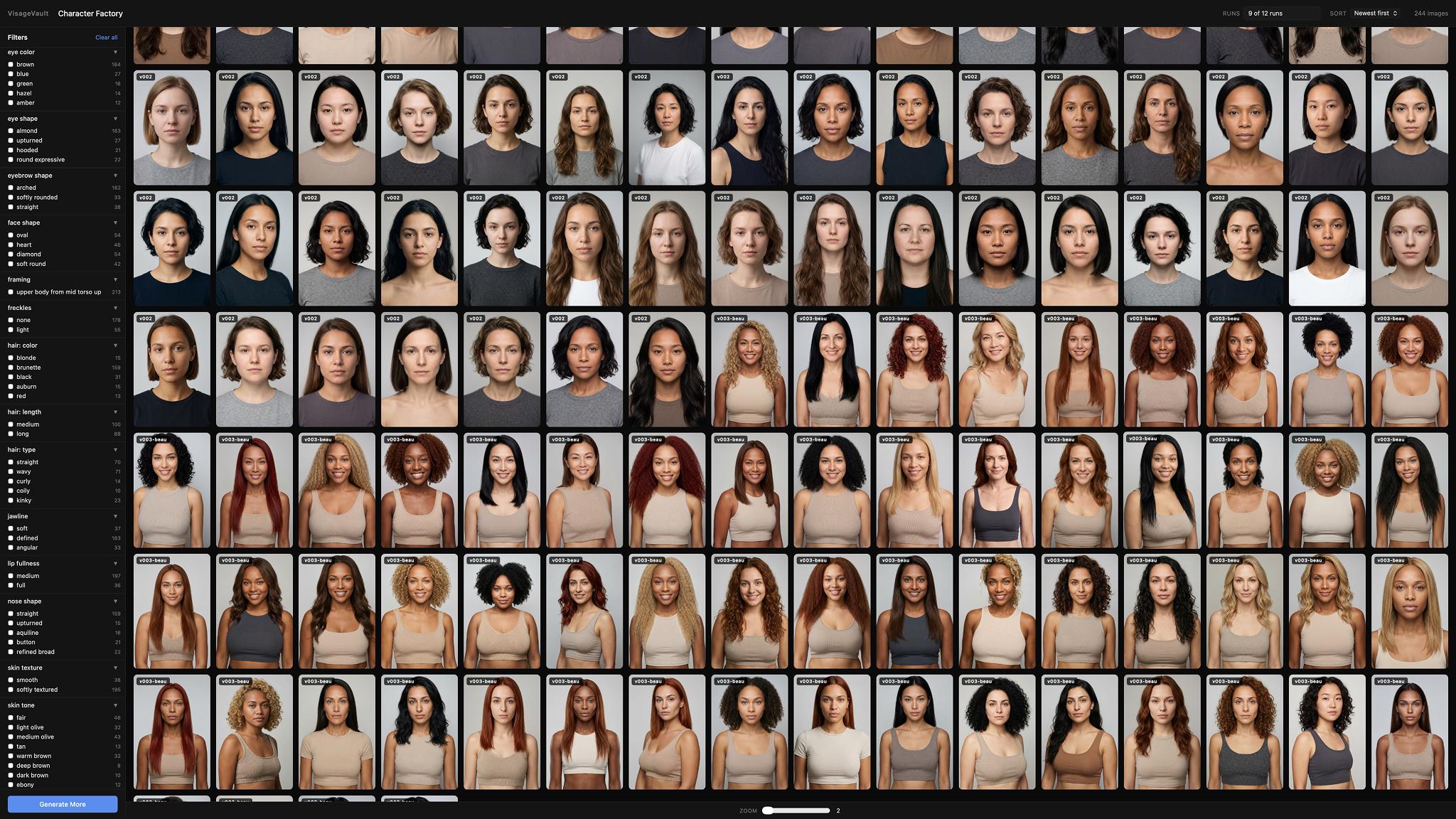
The grid is the thing. Not any one face—no single face here warrants individual attention—but the grid itself, the relentless tessellation of woman after woman after woman, each occupying her identical rectangle, each wearing what appears to be the same beige camisole, each turning her head at the same three-quarter angle toward a light source that does not exist in any room that has ever been built. Approximately one hundred and twenty of them. A screenshot posted to r/AIGeneratedArt, offered under the heading "Hey all. how do you create your charaters?"
The misspelling is load-bearing. It tells us everything about the relationship between the operator and the operated-upon. These are not characters. A character requires interiority—motivation, contradiction, the specific weight of a person who has chosen badly at least once. What occupies this grid are *charaters*: units of inventory, catalogued with the approximate care one brings to a wholesale stockroom of mannequin busts.
Let us be precise about what the tool has produced. Each face possesses the same diffused, poreless skin—the skin of a woman who has never been sunburned, never slept badly, never had a body below the clavicle that did anything so indelicate as age. The variations are rotational: darker skin here, auburn hair there, a jawline sharpened by two degrees, lips adjusted as if by a dial. The lighting is the lighting of no particular hour. It is the lighting of a dental office brochure, warm and even and committed to the elimination of shadow, because shadow would imply depth, and depth is not what is being manufactured here. What is being manufactured is surface—surface at industrial scale, surface as product category.
The interface itself deserves scrutiny. It presents these faces in neat rows, scrollable, selectable. The organizational logic is that of a catalog: one browses, one clicks, one acquires. The design language borrows from stock photography libraries and garment wholesale sites, platforms where the human figure exists to model something else—a blouse, a concept, a demographic bracket. Here the figure models nothing. She is the terminal product. She has been generated to be selected, and the selection is the entire transaction. There is no story she will inhabit, no world she will be placed within, no narrative reason she has been given brown eyes instead of green. She is a swatch.
What is most striking about the specimen is not the individual failures of verisimilitude—though they are present: the too-smooth gradient where neck meets shoulder, the hair that behaves like extruded filament rather than keratin, the ears that seem to have been remembered at the last moment and with reluctance. What is striking is the uniformity. Stable Diffusion, the probable engine behind these productions, is capable of variation. It can produce faces of genuine strangeness, faces that unsettle, faces that approach the uncanny not because they are wrong but because they are almost right. Someone has tuned this apparatus in the opposite direction. Someone has trained it, or prompted it, or iteratively culled its output until it produces one thing: a moderately attractive woman between twenty-two and thirty-four, photographed from the sternum up, expression neutral-to-pleasant, suitable for deployment. The machine offered a continent; the operator requested a single postal code.
The question posed in the title is sincere, and its sincerity is the most revealing element of the composition. "How do you create your charaters?" is a workflow question. It is the question one professional asks another in a trade forum—how do you source your lumber, how do you set your margins, how do you manufacture your women. The assembly line has been so thoroughly internalized that the only remaining problem is procedural. Not *whether* to produce one hundred and twenty interchangeable people, but *how*. The ethical question has not been resolved; it has simply never occurred. This is not callousness. It is something more durable than callousness. It is the banality of a tool that works.
The auteur framework asks whether decisions have been made consciously, unconsciously, or not at all. In this specimen the answer is the third. The grid is not a composition. It is an accumulation. The operator has not chosen to make one hundred and twenty women look alike—the operator has failed to notice that they do. The sameness is not a statement; it is a default. And the default, as always, is the most honest artefact any system produces. It tells you what the machine does when nobody is trying. What this machine does when nobody is trying is produce a single woman, over and over, each time believing it has produced someone new.
She wears beige. She looks left. She has never been alive, but more to the point, she has never been *imagined*. To imagine a person is to grant them specificity—a chipped tooth, a scar from a childhood fall, the particular way one squints against afternoon light. The grid grants none of this. It is a wall of equivalence. And before it, the operator stands not as an artist, nor even as a curator, but as a purchasing agent, scrolling through the catalog of the unborn, looking for the right one, not yet aware they are all the right one, because they are all the same one.