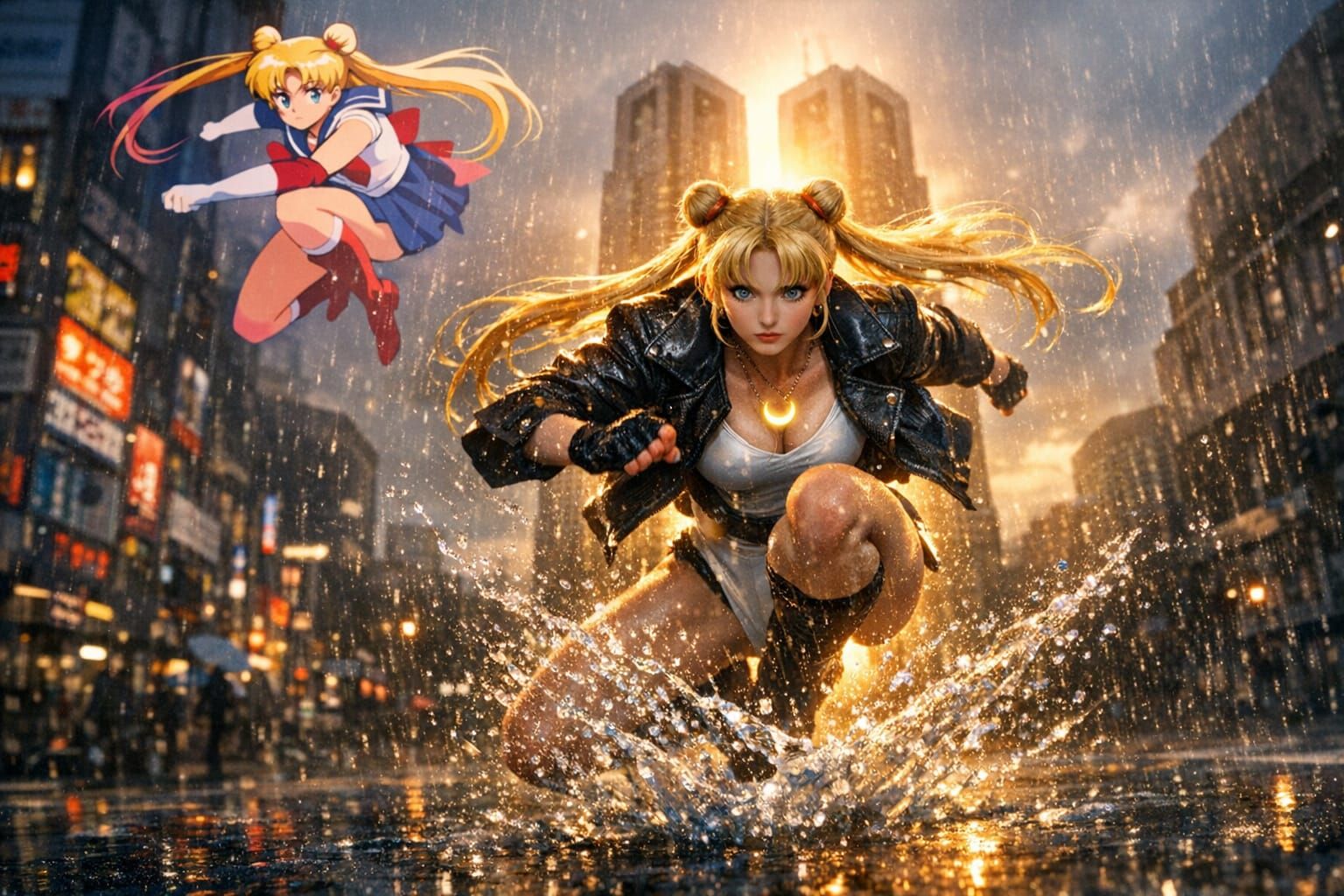
The specimen arrives titled "Celestial Phase: The Shinjuku Strike," which tells us two things: the maker believes this is Shinjuku, and the maker believes something is striking it. Both beliefs are unsupported by the image. What we are given is a neon intersection—wet pavement, vertical signage, the general posture of urban density—beneath a celestial phenomenon that resembles a comet's passage through atmosphere, rendered in the idiom of a prog-rock album cover circa 1974. The light is extraordinary. It is also impossible, not in the sense of the sublime but in the sense of the incoherent. Nothing in this scene casts a shadow consistent with any of its sources.
Let us begin with what is actually interesting, which is the signage. The characters on the vertical displays are not Japanese. They are not Chinese, Korean, or any other extant script. They are the memory of characters—stroke order recalled without stroke identity, radicals assembled from proximity rather than meaning. This is not an error in the way that a misplaced diacritical mark is an error. It is a structural revelation. The model has learned that Shinjuku means vertical text on illuminated panels, and it has produced vertical text on illuminated panels, and it has done so with the absolute confidence of a student who has memorized the shape of an exam answer without understanding the question.
The confidence is the thing. A human artist producing a fantasy Tokyo might invent a script and signal its invention—through internal consistency, through design logic, and through the frank admission of fabrication. What the diffusion model produces instead is a script that insists on its own legibility. Each character panel presents itself as though it could be read, as though a person standing at this intersection would know which establishment to enter and which to avoid. The signs perform the function of signs while performing none of the work. They are typography without language. They are, in the precise sense, decoration that does not know it is decorative.
The intersection itself—the crossing, the pedestrian geometry—deserves examination. Shinjuku's crossings are specific. They are engineered responses to pedestrian volume, signal timing, and the particular spatial constraints of a district that rebuilt itself around rail infrastructure. The crossing in this specimen resolves into nothing. Follow any sightline and it terminates in another surface rather than in space. The buildings do not recede; they stack. Depth is performed through atmospheric haze and neon bleed rather than through perspective. The result is not a street one could walk but a backdrop one could stand before, which is perhaps the more honest relationship the image proposes between viewer and place.
The celestial event overhead—the strike of the title—is the specimen's most ambitious and least examined element. A luminous body trails fire across the upper third of the frame, its light warming the wet surfaces below in precisely the way that a competent digital painter would warm wet surfaces below. But competent digital painters understand that a light source of this magnitude and proximity would reorganize the entire tonal structure of the scene. The neon would wash out. The shadows would unify. The atmosphere would shift from the blue-violet register of urban night to something approaching the terrible orange of proximity to combustion. None of this occurs. The celestial body is additive. It has been placed atop the scene rather than into it, a luminance the image cannot source because the image was never asked to source it. It was asked to produce the appearance of drama, and it has.
This is the grammar of borrowed atmosphere: Shinjuku as it exists in the training corpus, which is to say Shinjuku as it has already been photographed, illustrated, and rendered by others. The specimen is not a depiction of a place but a depiction of depictions, a palimpsest with no original text. Earlier Tokyo-pastiche specimens have demonstrated the same tendency—the same wet streets, the same vertical neon, and the same convenient absence of readable text—but "Celestial Phase" advances the form by introducing a narrative element, the strike, that the image has no capacity to narrate. Something is happening in this image. The image does not know what.
The auteur question, then: has the maker made decisions? The title suggests intentionality—"Celestial Phase" implies a cosmology, "The Shinjuku Strike" implies consequence. But the image contains neither phase nor strike, only the visual vocabulary associated with each. The decisions were made elsewhere, by photographers, illustrators, and animators who built the archive from which this specimen draws. What remains is selection without understanding, composition without composing. The image is beautiful in the way that a word in a language you do not speak can be beautiful: for its shape, its sound, and its resolute and total emptiness.
One cannot say the machine has failed here. It was asked to produce an atmosphere, and it has produced one. The failure, if it exists, belongs to the vocabulary we have not yet developed for distinguishing between an image that contains a place and an image that contains the rumor of one.
Specimen: Digital image depicting neon-lit intersection beneath luminous celestial phenomenon, vertical signage in no extant script, wet-surface reflections. Recovered from reddit.com/r/AIGeneratedArt, user account unidentified, 2025. The crossing leads nowhere a pedestrian could follow.