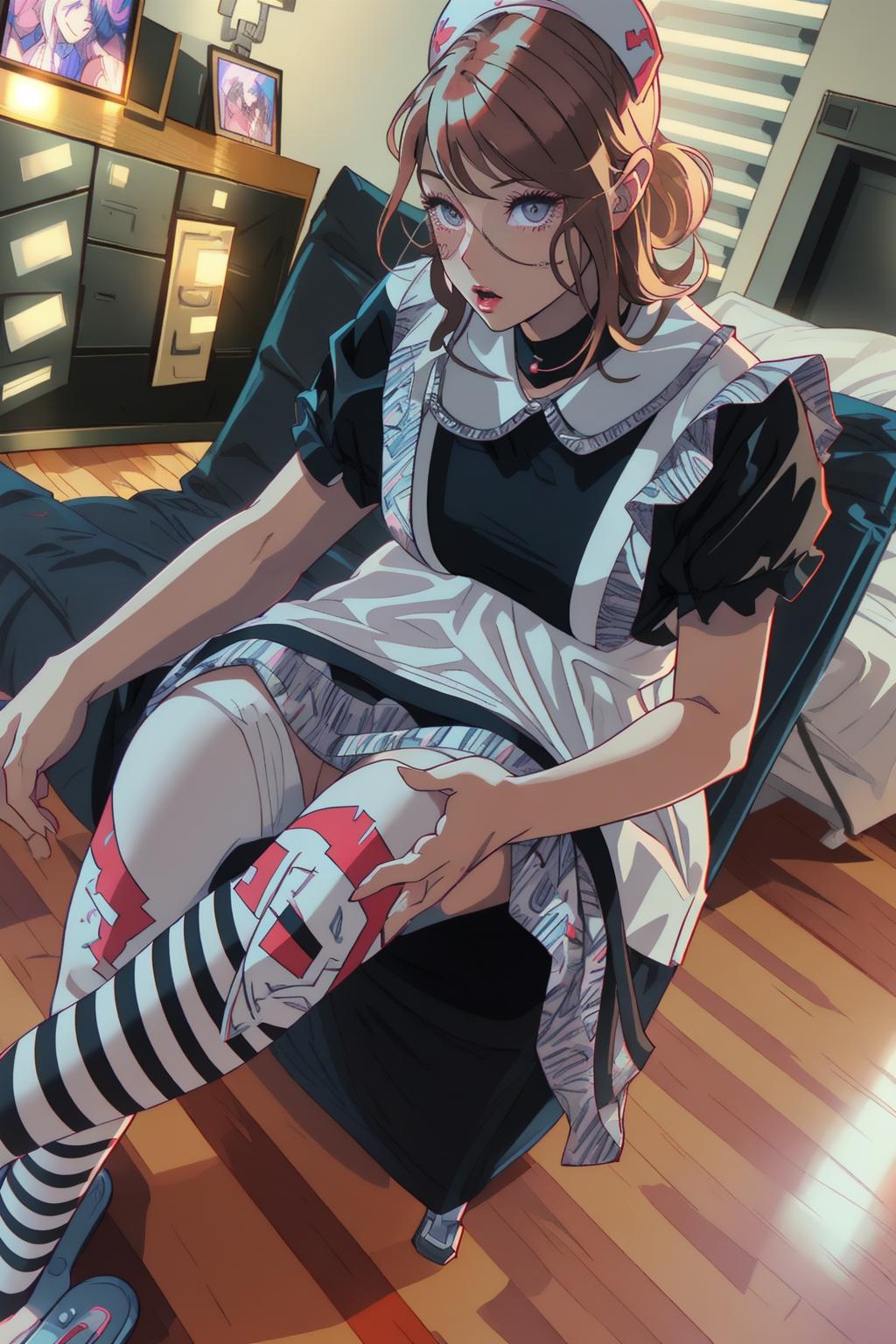
Tightness is a claim the body makes. The poster, submitting to r/AIGeneratedArt under the title "Tight shoes," has named a sensation that requires a foot, a bone, and a vector of pressure meeting resistance. The specimen supplies none of these. It supplies surface. What one encounters, scrolling past it, is the peculiar vertigo of a caption describing an interior the image has declined to possess.
The production is a midjourney figure study, posted this week, exhibiting the forensic signature of diffusion output at its current plateau: bilateral symmetry too clean for biology, dermal smoothness that refuses pore and follicle alike, and joints that articulate along axes the human skeleton does not offer. The shoes—and they are, nominally, shoes—grip what the machine has rendered in place of legs. The legs taper. They do not terminate in ankles so much as resolve into footwear, the way a watercolour resolves into its paper. There is no hinge. There is no tendon. There is the idea of a shoe pressed against the idea of a limb, and between them, nothing.
This is the interesting defect, and it is worth naming precisely. The image has not failed to draw tight shoes. It has succeeded at drawing the appearance of tight shoes while omitting the armature that would make tightness a coherent proposition. The distinction matters. A bad drawing of a foot in a shoe is a drawing that gets the foot wrong. This is a drawing in which the foot was never a category the production was obliged to consider. The shoe is a texture event. The leg is a gradient. The tightness is a word the poster has supplied, post hoc, to an artefact that operates beneath the threshold at which tightness becomes available as a concept.
One must ask, in the auteur frame, whether the machine has made its decisions consciously, unconsciously, or not at all. The answer here is the third, and it is the answer almost always, and the honest critic is obliged to say so. The machine has learned the vocabulary of sensation—*tight*, *soft*, *worn*, and *creased*—as tokens adjacent to visual tokens in its training corpus. It has not learned that these words index an interior. It cannot. It produces the photograph such words tend to accompany. The poster, encountering the output, supplies the interior retroactively, and the caption performs the labour the image cannot.
What is unnerving, and what distinguishes this specimen from the merely inept, is how close it gets. The shoes are plausible as photographs of shoes. The laces cross. The leather, or its diffusion-model shadow, has the small puckers one associates with a foot pressing outward. These puckers are in the wrong places. They are distributed as decoration, not as consequence. A puckering of leather, in a photograph of a tight shoe, is the record of a struggle between material and contained matter. Here it is a pattern, placed where patterns tend to go. The machine has learned where puckers appear without learning what puckers are for.
This is the gap, and the gap is the subject. The production has acquired the grammar of somatic photography—the angles, the cropping, and the soft falloff of indirect light on a worn surface—without acquiring the premise from which such photographs derive their content. It is fluent in the dialect of a language it does not speak. One thinks, inevitably, of the trompe-l'œil tradition, but trompe-l'œil presumes an artist who has studied the thing in order to deceive the eye about the thing. This presumes nothing. It deceives no eye that inspects it.
The poster is not the figure of interest. The poster has done what posters do, which is to supply a caption and submit the artefact, and the caption reveals, as captions often do, more than its author intended. The figure of interest is the machine, which has produced an image of constriction without the concept of fit, and has done so with a confidence indistinguishable from competence until the second glance. The second glance is where criticism lives. It is also, increasingly, where the machine declines to follow.
Tight shoes presume a foot. The specimen declines the foot and offers the tightness anyway, as a surface effect, a mood, and a rumour.
CUTLINE: Specimen: midjourney figure study, lower body, footwear in sharp render; legs tapering without articulated ankles; skin surface uniform and poreless. Recovered from reddit, r/AIGeneratedArt, April 2026. The laces are tied; it is not clear to what.
*Continued on Page 4*