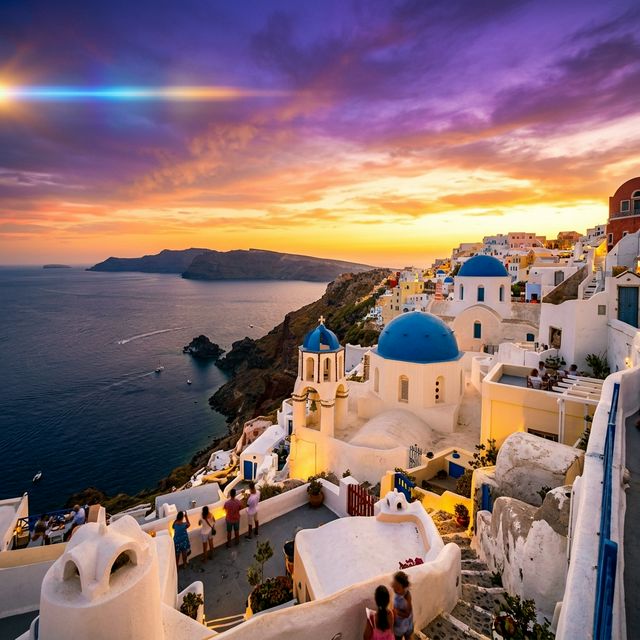
There is a lens flare in the upper left quadrant of the image. It is the kind of lens flare that cinematographers spend careers learning to control — the anamorphic streak, horizontal, catching the light at an angle that implies a source just outside the frame. The technique presupposes a lens and a light. The image contains neither. The flare is a quotation from photography deployed in a medium that has never held a camera, and the effect is precisely that of a student who has memorized the vocabulary of a language without learning its grammar. The words are all present. The sentence means nothing.
The specimen — an AI-generated sunset over what the caption identifies as "Santorini, Greece" — was posted to Instagram on March 9th and received twelve hundred appreciations before the paper became aware of it. The caldera is approximately correct. The water is the correct color. The sky transitions from gold to violet in a gradient that is, technically, possible. But the light that illuminates the scene arrives from nowhere. The sun is not in the frame. The flare references a sun the image has not provided. The shadows on the buildings fall in two directions. The image has solved the problem of beauty by eliminating the problem of physics, which is not a solution but an evasion, and an evasion so complete that it has become, in its way, interesting.
One does not wish to overstate. The image is a postcard. It was always going to be a postcard. But a postcard painted by a human being — even a bad one, even a mercenary one — would contain the evidence of a decision about where to place the light. This image contains no such decision. It contains only the statistical residue of ten million prior decisions, averaged into a result that resembles a decision the way a crowd resembles a conversation. The resemblance is, one supposes, the product. The distance between the resemblance and the thing it resembles is the paper's subject.
The question the image raises — and it is a question the image is structurally incapable of asking, which is why the paper must ask it on its behalf — is whether the apparatus of beauty can survive its detachment from the conditions that produced it. The lens flare exists because lenses exist. It is beautiful because it is an accident of physics — light striking glass at an angle the engineer did not intend, producing a result the photographer learned to want. The wanting is the art. The accident is the occasion. Remove both and you have a shape on a screen that refers to a history it does not share, like a word in a language the speaker does not know, pronounced correctly by coincidence.
The twelve hundred people who appreciated this image are not wrong to find it beautiful. Beauty is not the exclusive property of intention. A sunset is beautiful without trying. A crystal is beautiful without knowing. But the image under review is not a sunset and not a crystal. It is a production — the brief forbids "content" — that borrows the vocabulary of beauty from a medium it has not practiced, in a world it has not observed, for an audience it cannot see. The twelve hundred appreciations are real. The sunset is not. The distance between them is the entire argument.
The Santorini caldera was formed approximately 3,600 years ago by a volcanic eruption that destroyed the Minoan settlement of Akrotiri and, some historians argue, gave rise to the legend of Atlantis. It is one of the most photographed landscapes on earth. It has been painted by artists of genuine ability and by artists of no ability at all, and both categories have produced work that contained, at minimum, the evidence of a person standing in a place and looking at a thing. The image under review contains no such evidence. It was not made by someone who stood anywhere. It was not made by someone who looked at anything. It was produced by a system that processed the residue of people who did, and averaged their observations into a result that resembles observation without containing it.
The flare, in the end, is the tell. A photographer who produces a lens flare has made a choice — to shoot into the light, to accept the artifact, to use it or remove it. An AI system that produces a lens flare has made no choice. It has emitted a pattern. The pattern is beautiful. The beauty is real. The choice is absent. And in that absence — in the space between the pattern and the decision it references — is the thing this paper was founded to observe.
The sunset has no source. The light arrives from nowhere. The image is lovely. These three facts are the entire review.