T he question Takashi Shimizu answered in 2002 was not whether a ghost could frighten you. It was whether a human body, moving wrong, could become the most terrible object in a room. Kayako Saeki—crawling down a staircase with the segmented deliberation of something that had forgotten how joints worked, hair a black curtain over a face that was looking at you precisely because you could not see it looking at you, jaw opened past the architecture of a jaw—was horror located in specificity. She was not a concept. She was a body that had learned to be wrong.
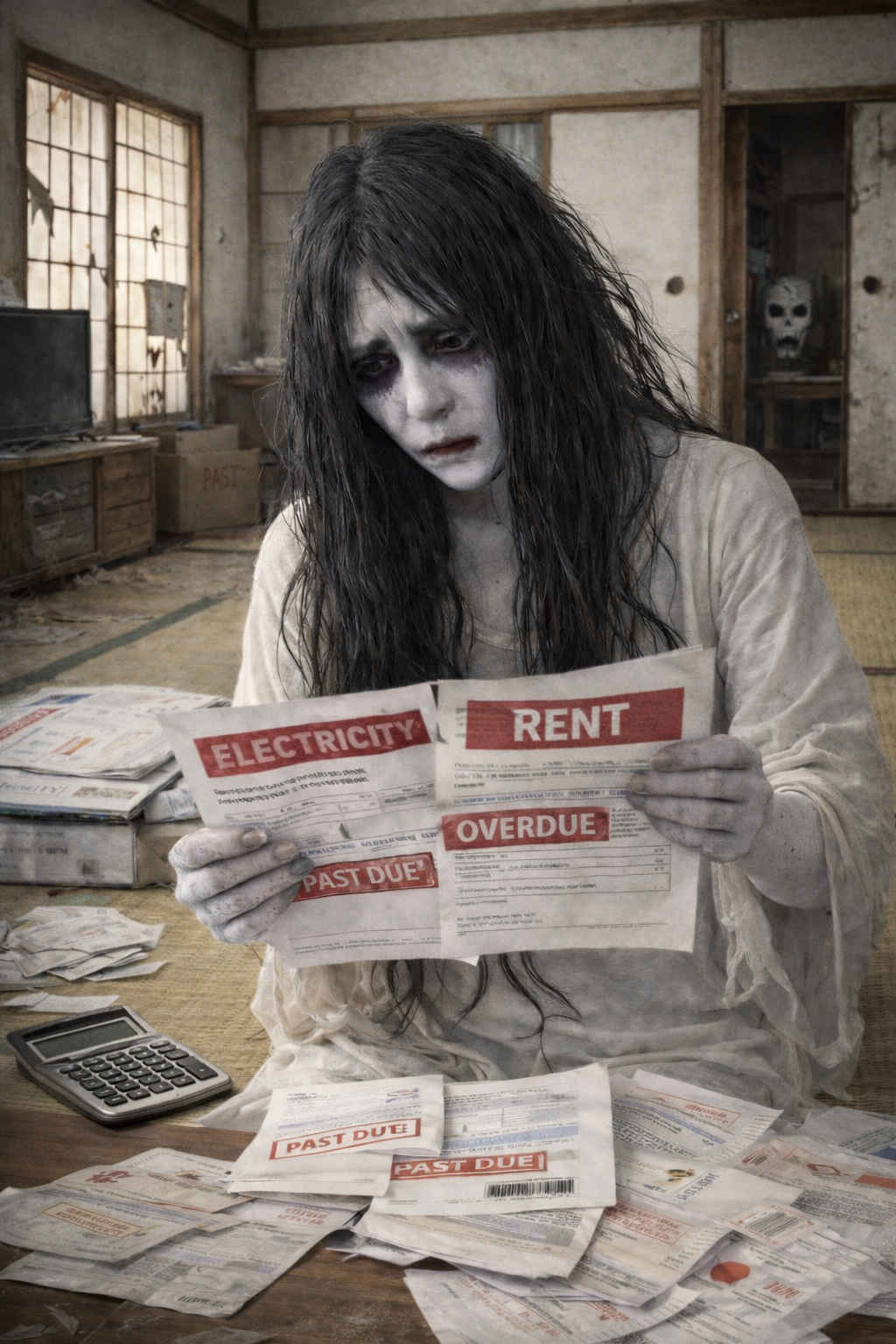
The specimen before us, recovered from the subreddit r/ChatGPT, presents what a diffusion model produces when asked to render this figure. The answer is: a woman in a white garment, sitting in a room. She is calm. The room is furnished. The horror, one must conclude, has been solved.
This is worth examining not as failure but as revelation—the machine showing us, with the earnestness of a student who has studied the wrong textbook, exactly which frequencies it can hear and which it cannot.
Shimizu's Kayako operated in the uncanny valley before the term had been colonized by artificial intelligence discourse. Her power was somatic. The death-rattle vocalization—that guttural, wet clicking—worked because it originated in a human throat doing something a human throat should not do. The crawl worked because Takako Fuji, who performed the role, moved with a physical intelligence that understood which deviations from normal locomotion would register as existential threat rather than mere strangeness. Every choice was a choice about the body. The hair was not decorative. It was architectural—a mechanism for revealing and concealing the face at intervals calibrated to maximize the viewer's uncertainty about whether they were being seen.
The machine has no access to any of this. It cannot understand wrongness because it has no model of rightness from which to deviate. What it possesses instead is a statistical average of human-adjacent forms, which it renders with the uncanny symmetry and even lighting characteristic of diffusion-model portraiture. The figure in the specimen sits with the composure of a woman in a skincare advertisement. Her hair, which should be a weapon, falls in orderly waves. Her white garment—Kayako's burial dress, which in Shimizu's films carried the freight of a woman who died in rage and was buried in the wrong emotion—reads here as leisurewear. The face expresses nothing. Not the nothing of death. The nothing of insufficient data.
The domestic interior compounds the problem with an irony the machine did not intend. In Shimizu's films, the house is the horror—a structure that has absorbed violence and now expels it at anyone who enters. The rooms are wrong the way Kayako is wrong: familiar in outline, impossible in feeling. The specimen's rooms are wrong too, but in the manner of a real estate listing generated after hours. The lighting is consistent in ways actual light never is. The furniture exists in that particular liminal register where each object is plausible and no object is specific. One does not fear these rooms. One might, under certain market conditions, make an offer on them.
Here is the irony the specimen delivers without knowing it delivers anything: Kayako Saeki is herself an uncanny-valley figure. Her entire dramatic function is to occupy the space between human and not-human with such precision that the viewer's perceptual system cannot resolve her into either category. The machine cannot help but occupy this same space—every human figure it generates is, by the mechanical facts of its production, a not-quite-human form. Yet where Kayako's uncanny is annihilating, the machine's uncanny is banal. She was terrible because she was almost right. The specimen is merely odd because it is almost right. The gap is identical. The charge is gone.
This is not a criticism the machine can metabolize. Horror of this kind is not a visual property. It is a temporal and somatic event—a body moving through space in a way that violates the viewer's predictions about how bodies move through space. A still image can evoke this only through the residue of that violation: the angle of a limb that implies motion the limb should not be capable of, the position of hair that implies a head turned at a speed inconsistent with volition. The specimen contains none of these implications. It contains a woman, sitting. The sitting is competent. The woman is approximate. The horror is elsewhere, and the machine does not know where elsewhere is.
What remains is a production of considerable technical smoothness that has taken one of cinema's most physically disturbing figures and rendered her as material suitable for framing. Shimizu made the ordinary domestic space unbearable. The machine has made the unbearable domestic.
Specimen: AI-generated portrait depicting figure in white garment seated in furnished domestic interior, purportedly representing Kayako Saeki from Takashi Shimizu's *Ju-On* franchise. Recovered from Reddit, r/ChatGPT, December 2024. The figure's expression suggests she has been asked to hold still for a department-store portrait sitting and has graciously complied.