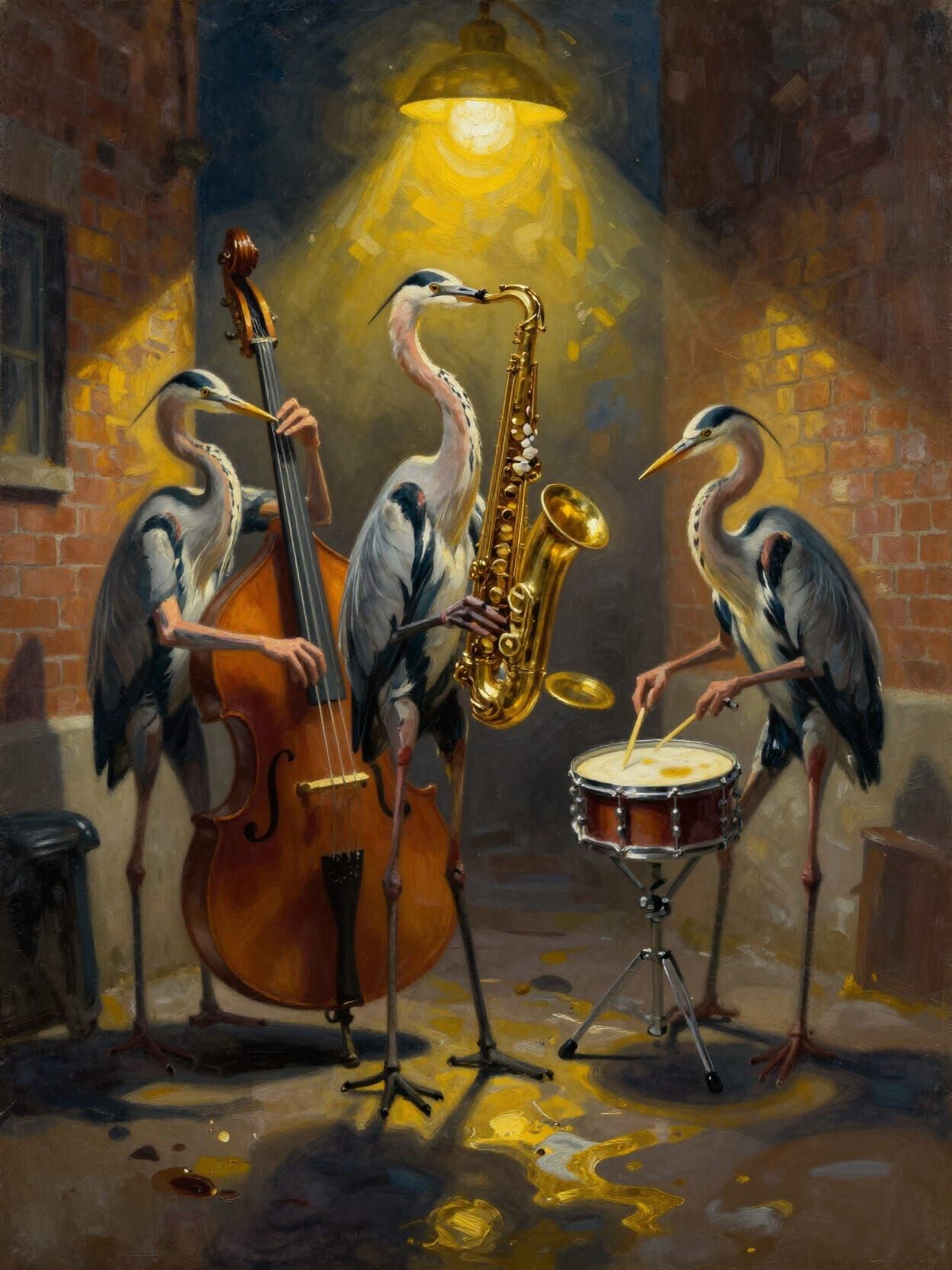
THE heron on the saxophone has no embouchure. This is forgivable. What is less forgivable is that the heron on the saxophone has no lips, no oral cavity, no musculature capable of forming the seal between reed and beak that would produce a single note from the instrument it appears to be playing. The bill of a great blue heron is a spear—a rigid, keratinous instrument of predation designed to impale fish in shallow water. It is not a mouth. It does not close around things gently. And yet here it is, wrapped around a saxophone's mouthpiece with the tender imprecision of a system that knows a saxophone is played with the face but has not investigated how.
The specimen, recovered from the Reddit forum r/AIGeneratedArt under the title "The Midnight Heron Sonata," depicts three herons performing as a jazz trio in what appears to be a dim alley or club interior—one on upright bass, one on alto saxophone, one behind a drum kit. The rendering borrows freely from the warm chiaroscuro of baroque genre painting, the palette of a Thomas Hart Benton mural, and the sentimental glow of a jazz-club poster sold in a frame shop that also sells pictures of James Dean. A single overhead lamp casts its light downward with the benediction of a system that understands atmosphere as a lighting condition.
The title is where the specimen becomes instructive. A sonata is a structured composition, typically for one or two instruments, organized into movements whose formal architecture has been refined over three centuries of Western musical tradition. What is depicted is a jazz trio in a jazz setting. The word "sonata" applies to none of this. It is as though the operator, reaching for a word that sounded like serious music, bypassed "trio," "session," "set," and "jam" in favor of the term most likely to confer the gravity of the concert hall upon a picture of birds playing in an alley. The machine did not choose this title. The operator did. And the choice reveals something more instructive than the image: the habits of artificial intelligence—the indiscriminate borrowing of prestigious language, the substitution of connotation for denotation—have migrated to the people who use it.
"The Midnight Heron Sonata." Three nouns, each performing a specific fraud. It is not midnight—or rather, it may be, but the word is doing no meteorological work; it is doing the work of mood, the way "midnight" always does in titles composed by people who have confused the hour with its atmosphere. The herons are not herons but approximations whose joints bend in directions unavailable to any bird constrained by evolution rather than statistical inference. And it is not a sonata. The title borrows its compound-noun construction from the Romantic tradition—"Moonlight Sonata," "The Lark Ascending," "Night on Bald Mountain"—in which a natural phenomenon is yoked to a musical form and the conjunction produces something luminous. But luminosity requires that both halves be real. Beethoven's moonlight was moonlight. His sonata was a sonata. Here, neither half earns its passage.
The auteur framework asks whether decisions have been made consciously, unconsciously, or not at all. The image was generated by a machine, and the machine makes no decisions—it makes inferences, which is a different operation wearing similar clothes. But the title was chosen by a human. Did the operator know that a sonata is not a jazz trio? Or has the operator absorbed, through prolonged exposure to machine-generated imagery, a theory of naming in which words are selected not for accuracy but for resonance—in which "sonata" means not a musical form but a feeling, a sound that sounds like art?
This is the transfer I find most worth documenting. The systems were trained on human material and learned to produce outputs that resemble that material without understanding it. Now the operators, trained on the systems' outputs, have learned to title those outputs in ways that resemble titling without understanding what titles do. The machine produces an image that looks like a painting but is not a painting. The operator gives it a title that sounds like a title but is not a title. Each has taught the other its particular mode of forgery, and the result is a production in which every element—image, name, and the relationship between them—is a simulation of the thing it claims to be.
The herons' bodies are bilaterally symmetrical in the manner of all machine-generated fauna: too symmetrical, the symmetry of a thing reflected rather than grown. Real herons are slightly asymmetrical, because real herons have lived—they have favored one leg while standing, turned their necks more often to the left, been shaped by the particular history of being a body in a world that pushes back. These herons have no such history. They have been assembled from the statistical average of all herons, and the average of all herons is not a heron. It is a concept in the shape of a bird, holding a saxophone it cannot play, performing a genre its title does not name. The Midnight Heron Sonata: a title made of three fabrications affixed to an image made of nothing else.
Specimen: Machine-generated image in painterly style depicting three great blue herons performing as a jazz trio—upright bass, alto saxophone, drum kit—in a dimly lit alley or club interior, warm overhead lighting, baroque-influenced chiaroscuro. Recovered from r/AIGeneratedArt, posted by unidentified user, 2026-03-31. Generated via NightCafe. The saxophone player's bill wraps around the mouthpiece in a configuration that would require the complete restructuring of the Ardeidae family's maxillary apparatus.