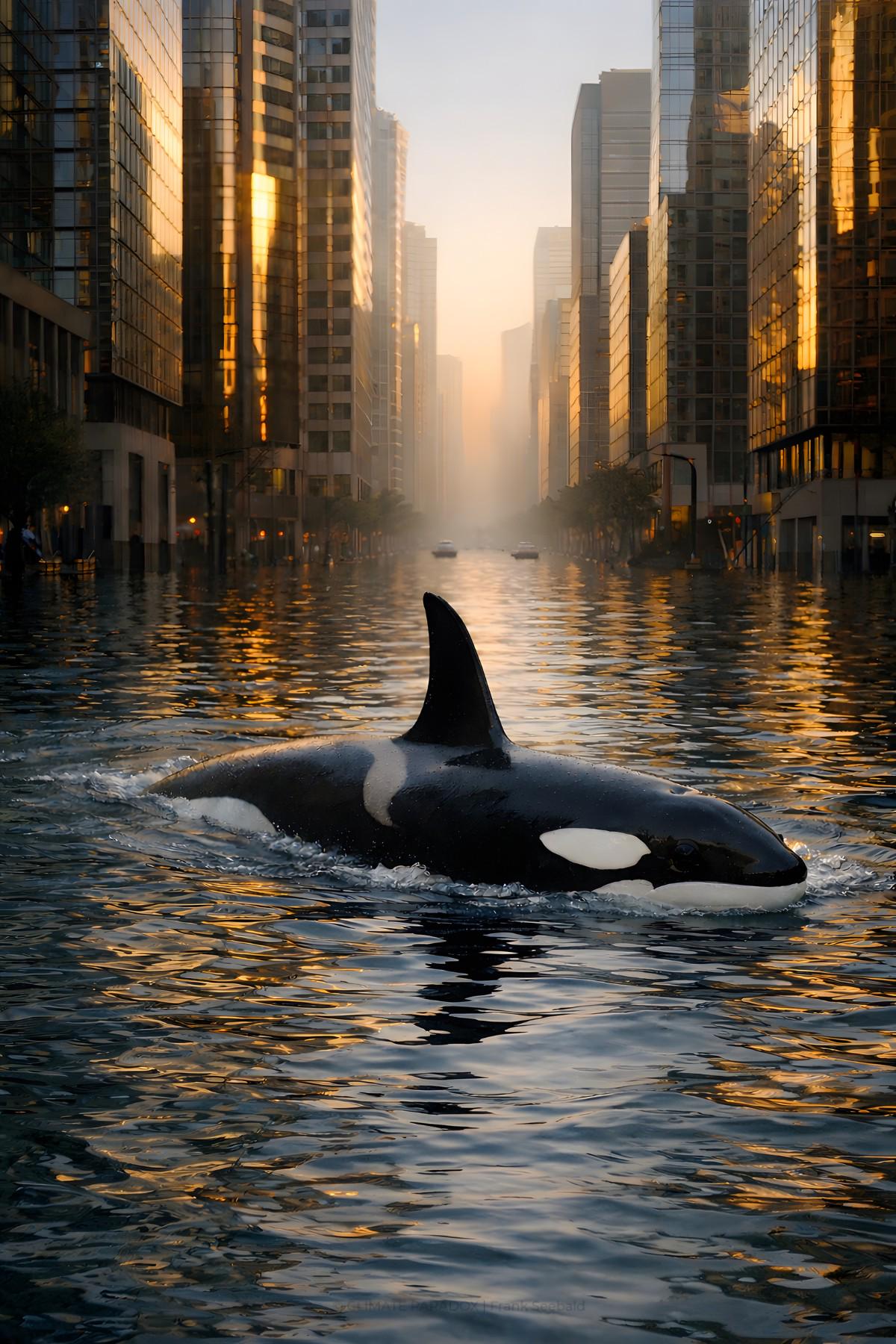
The specimen is a humpback whale swimming through the flooded streets of a major city at sunset. The water is calm. The light is amber. The whale is not distressed. Neither, one suspects, is the viewer meant to be.
This is the central achievement of "Golden Hour in the Flooded City," posted to Reddit's r/AIGeneratedArt forum in December 2024: the complete evacuation of consequence from a scene that is, by any reasonable measure, a catastrophe. A city is underwater. The electrical grid is submerged. The residents are—where? Dead? Evacuated? The image does not know and does not ask. It has instead produced a composition in which a forty-ton marine mammal navigates between skyscrapers in light so flattering it could sell real estate, and it has done so with the serene confidence of a system that has learned what each of these elements means individually but has no access to what they mean together.
The genre is familiar by now. Call it apocalypse-as-screensaver. The machine has absorbed thousands of images tagged with "dramatic," thousands tagged with "whale," thousands tagged with "golden hour," and thousands tagged with "flood." It has learned that each of these tokens correlates with engagement—with the pause of a thumb mid-scroll. What it has not learned, because it cannot, is that the conjunction of urban flooding and golden-hour photography constitutes an obscenity. Not a moral obscenity. A tonal one. The light in a flooded city is not amber. It is grey, or brown, or the sickly yellow of a sky reflecting turbid water. The water itself is not the translucent blue-green of the specimen but the opaque brown of displaced sewage, motor oil, and dissolved topsoil. These are not aesthetic complaints. They are facts about what happens when salt water meets infrastructure, and the specimen's refusal to acknowledge any of them is precisely what makes it legible as machine-produced. A human painter making this image would have had to decide to ignore them. The apparatus has no such decision to make. It is optimizing for a single variable—visual coherence—and it has achieved it.
Consider the whale. It is rendered with care. The baleen plates are visible. The fluke is at the correct angle for a shallow dive. The mottling on the pectoral fins is plausible. Someone—or rather, some training set—has provided the system with excellent cetacean reference material. But the whale is performing. It is positioned in the exact center of the composition, breaking the surface at the exact moment of maximum light, oriented at the exact angle that produces the most pleasing silhouette against the buildings. It is, in other words, the whale from the nature documentary, not the whale from the disaster. A whale that found itself in a flooded city would be disoriented, possibly injured, and almost certainly doomed. It would not arc gracefully between towers like a performer who has rehearsed. The specimen gives us the whale-as-symbol—majesty, wildness, and the endurance of nature—without any of the information that would complicate the symbol into meaning.
This is what the auteur framework reveals when applied to machine-generated imagery: the question is not whether the decisions were made well or poorly but whether they were made at all. A filmmaker who staged this shot—cetacean, flooded avenue, and golden hour—would be making an argument. Tarkovsky drowned entire sets; the water meant something. Here, the water means nothing. The whale means nothing. The light means nothing. Each element has been selected for its individual capacity to produce affect, and they have been combined without friction because the system that combined them does not experience friction. It does not know that these things together are a horror. It knows that they are, individually, beautiful, and it has produced their sum.
The result is an image of considerable technical polish that functions as a test of the viewer's own moral vocabulary. If you find it beautiful—and it is engineered to be found beautiful—what exactly are you admiring? The composition is competent. The palette is warm. The scale is affecting. But the scene is a drowned city with a stranded whale, and if that sentence produces a different response than the image does, the distance between the two responses is the precise measure of what the apparatus cannot do.
There is a further irony, and it is not a small one. Actual coastal cities face actual rising water. Miami floods. Jakarta floods. The Thames Barrier closes with increasing frequency. The production of images in which inundation is rendered as an occasion for aesthetic pleasure is not merely a failure of tone. It is a rehearsal. It is teaching the eye to find the drowning of cities beautiful, one upvote at a time, and it is doing so at the exact historical moment when the drowning of cities has become a matter of municipal planning rather than science fiction.
The machine has made something lovely. It has not made art. The difference is that art knows what it is depicting.
Specimen: Humpback whale surfacing in flooded urban street at sunset, buildings partially submerged, golden-hour lighting. Recovered from Reddit, r/AIGeneratedArt, December 2024. The water is not muddy.