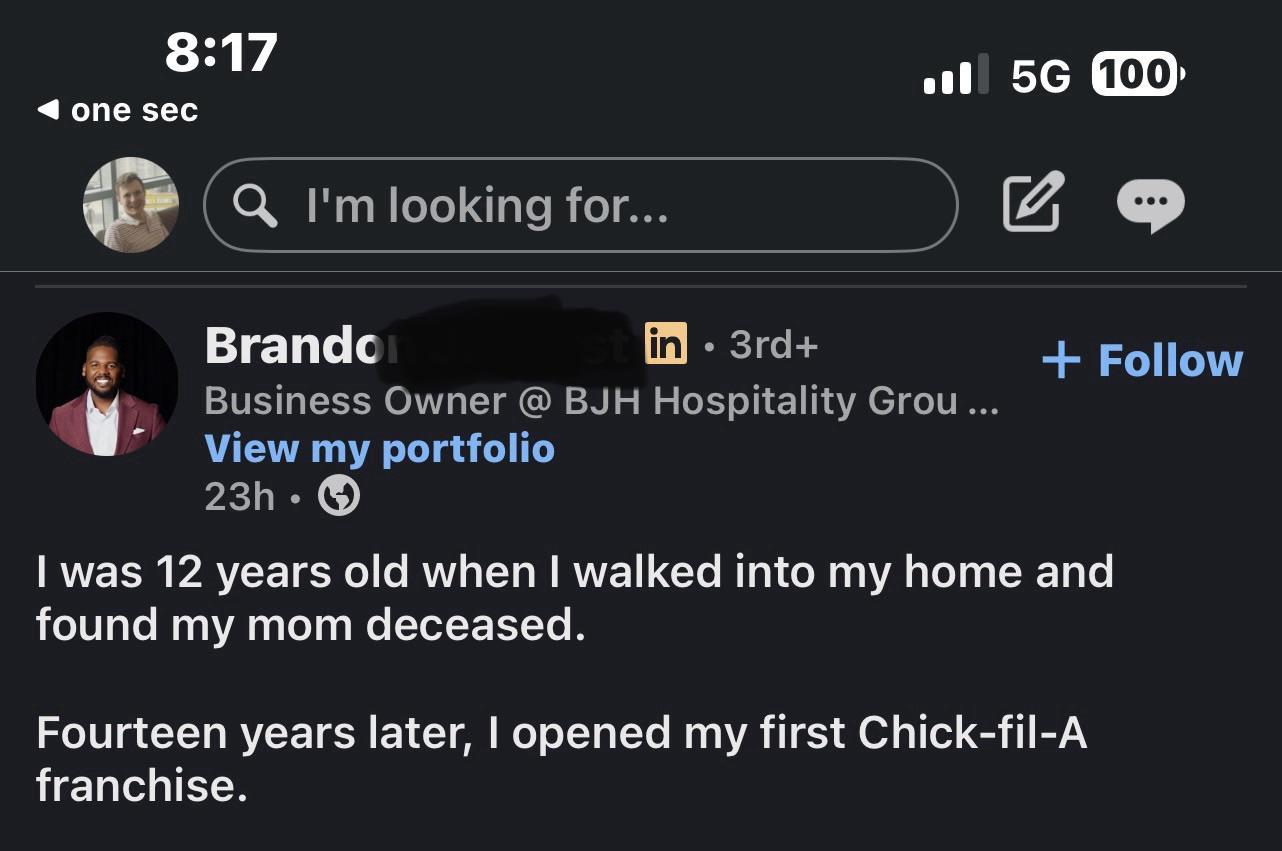
The specimen, recovered from the subreddit r/LinkedInLunatics, is a screenshot of a LinkedIn post whose opening clause reports the discovery of a dead parent and whose closing clause reports the ownership of a Chick-fil-A franchise, rendered throughout as "Chic-fil-a." Between these two data points—a child finding a body and an adult operating a quick-service restaurant with annual unit volumes averaging $8.7 million—the post supplies the connective tissue that LinkedIn's algorithm has determined is optimal: the implication that the former caused the latter, that grief is a 528-foot pipeline terminating in a drive-through window, and that both events belong in the same sentence because both events happened to the same person. The logic is airtight. It is also the logic of a résumé.
What makes the specimen commercially interesting—and it is commercially interesting, which is why we are discussing it on this page rather than any other—is the question of provenance. The post could have been produced by a large language model. It could have been produced by a human being. The distinction, which in other contexts would matter enormously, here matters not at all, because LinkedIn's incentive architecture has spent the better part of a decade solving for exactly this convergence. The platform rewards a specific emotional arc: adversity, compressed into a subordinate clause; triumph, expanded into a thesis statement; vulnerability, deployed as a professional credential. The optimal post is one that converts private suffering into public engagement at the highest possible ratio. A machine trained on LinkedIn data produces LinkedIn prose. A human trained on LinkedIn metrics produces the same prose. The platform is the generative system. The author is the fine-tuning.
This is not a new observation, but it is one that the business press has been reluctant to state plainly, in part because the business press operates on the same platforms and is subject to the same incentive structures. The economics are straightforward. LinkedIn's revenue model depends on engagement. Engagement depends on emotional response. Emotional response is most efficiently triggered by personal narrative. Personal narrative, once subject to the editorial constraints of decorum, propriety, and the reasonable expectation that one's colleagues do not wish to know the circumstances of one's mother's death, is now subject to no constraint whatsoever except the algorithm's reward function. The result is a marketplace in which bereavement is fungible—interchangeable with divorce, illness, bankruptcy, or any other misfortune that can be compressed into an opening clause and resolved, within three hundred words, into professional accomplishment.
The misspelling of the franchise name is a detail worth pausing over. Chick-fil-A is a proper noun with an idiosyncratic orthography—the hyphenation, the terminal capital—that functions as a minor trademark. The specimen renders it "Chic-fil-a," which suggests one of two possibilities. If the author is a machine, the error is a tokenization artifact, the sort of minor garbling that large language models produce when reconstructing proper nouns from probabilistic fragments. If the author is a human being who owns a Chick-fil-A franchise, the error suggests an indifference to the noun that is nominally the point of the story—an indifference that is itself revealing, because it confirms that the franchise is not the point of the story. The point of the story is the dead mother. The franchise is the proof that the dead mother was not wasted.
This is the transactional grammar of the platform stated without ornament: loss is an input; professional achievement is an output; the post is the ledger entry that reconciles the two. The author—human or otherwise—has produced a document that is structurally identical to a loan application, in which collateral (suffering) is pledged against a desired outcome (network engagement, which is convertible to opportunity, which is convertible to revenue). The arithmetic is sound. The collateral is accepted at face value. No appraiser visits the property.
The question of whether such material constitutes slop—the term of art for machine-generated production distributed without editorial oversight—is, in this instance, taxonomically interesting but practically irrelevant. LinkedIn has achieved what no other platform has managed: it has made the question of human-versus-machine authorship moot by ensuring that the optimal human output and the optimal machine output are identical. The platform's achievement is not artificial intelligence. It is artificial sincerity, produced at scale, by every participant simultaneously, in a marketplace where the currency is attention and the commodity is grief. The machines did not corrupt the discourse. They arrived to find the corruption already priced in.
Chick-fil-A, Inc., of Atlanta, Georgia, reported systemwide sales of $21.6 billion in its most recent fiscal year. It does not, as a matter of corporate policy, comment on the bereavement histories of its franchise operators. The company spells its name with a capital A.