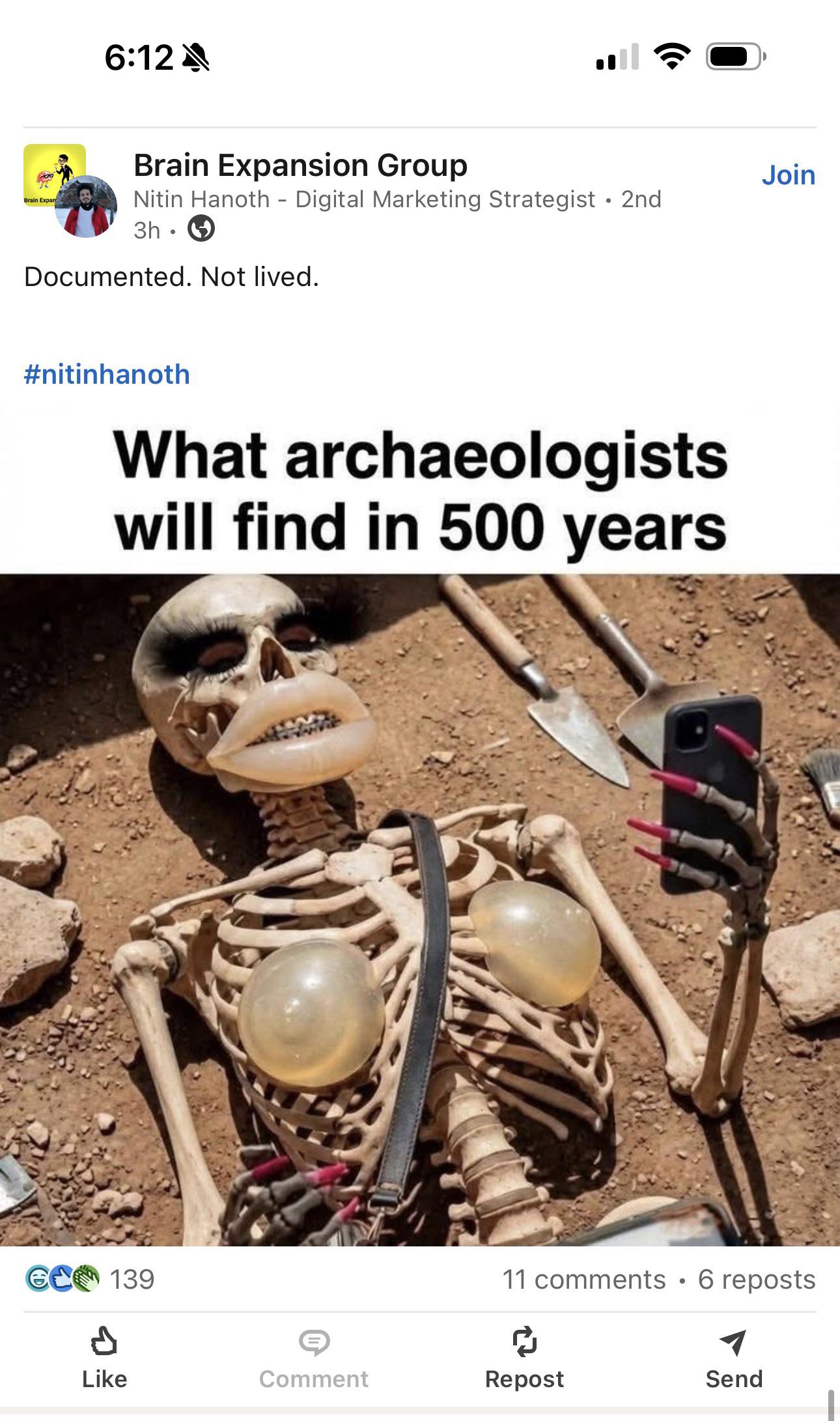
The skeleton has too many fingers. This is worth stating at the outset because it is the kind of detail a platform with seven hundred million professional users might reasonably be expected to notice, and because LinkedIn, having been presented with the specimen, noticed nothing. The image—a diffusion-model production depicting a skeleton half-buried in earth, clutching a smartphone in digits that bifurcate where no anatomy would permit—was posted by an account operating under the name "Brain Expansion Group," administered by one Nitin Hanoth, who identifies himself as a Digital Marketing Strategist. The caption reads: "Documented. Not lived." The hashtag reads: #nitinhanoth. One hundred and thirty-nine users reacted. Eleven commented. Six reposted. The algorithm, in its capacity as distributor, carried the specimen outward through the feed with the same serene indifference it brings to quarterly earnings announcements and photographs of corner offices.
The image is instructive less for what it depicts than for where it circulates. A skeleton holding a phone is not, as a concept, without precedent in the minor tradition of internet morality illustration—the memento mori repurposed for the attention economy, a genre that predates artificial intelligence by at least a decade. What distinguishes this specimen is the execution. The eye sockets bulge with a vitreous gleam that belongs to no skeletal structure found in nature or in medical illustration. The ribcage exhibits the bilateral perfection that characterizes diffusion-model output: not the symmetry of a living organism, which is always approximate, but the symmetry of a system that has learned "skeleton" as a statistical average and reproduces it with the fidelity of a photocopier. The hand gripping the device features joint articulations that, subjected to even casual anatomical scrutiny, describe an organism with more phalanges than the human blueprint provides.
None of this prevented the specimen from entering LinkedIn's distribution pipeline and proceeding through it without friction. This is the fact that merits examination, because LinkedIn is not a platform that professes indifference to the quality of its feed. Microsoft, which acquired the network in 2016 for $26.2 billion, has published extensive documentation on synthetic media policy. Its professional community policies state that members should not "post inauthentic or misleading" material. In September 2024, LinkedIn announced expanded labeling for artificial intelligence–generated imagery. The infrastructure, in other words, exists—or is claimed to exist. What does not exist is any operative mechanism by which it intercepts a diffusion-model skeleton with supernumerary fingers before it reaches one hundred and thirty-nine pairs of professionally networked eyes.
The incentive structure explains the gap. LinkedIn's feed algorithm, like those of its competitors, optimizes for engagement. A post that attracts reactions, comments, and reposts is one the algorithm circulates further, regardless of whether the reactions represent admiration, bewilderment, or the ambient clicking of users who have long since ceased to distinguish between the two. The skeleton with its impossible hands is, by the metrics that govern distribution, a successful post. It produced engagement. Engagement is the unit of value. The question of whether the skeleton's fingers are anatomically plausible is not a question the system is designed to ask.
Mr. Hanoth's account represents a species now abundant on the platform: the engagement-optimization entity. "Brain Expansion Group" is not a firm in any conventional sense. It is a posting apparatus—a channel through which material flows into the feed at a velocity and volume that suggest the operator's relationship to the material is curatorial at best and automated at worst. The Digital Marketing Strategist has, in this instance, marketed a skeleton. The skeleton has performed. The cycle is complete.
What is less visible, and more consequential, is the cost imposed on the platform's remaining human participants. LinkedIn's commercial proposition rests on a specific claim: that the network is a professional environment, that the feed represents genuine professional activity, and that advertisers purchasing placement in that feed are reaching an audience of decision-makers engaged in professional discourse. Every machine-generated skeleton that circulates without interception degrades this claim by a small but nonzero quantity. The advertiser paying for placement adjacent to career insights is, on some fraction of impressions, paying for placement adjacent to a diffusion model's approximation of a philosophical observation about mortality—posted by an account whose strategic credentials extend to the automated production of slop.
The platform's silence on individual specimens is, of course, policy rather than oversight. To acknowledge that the feed carries machine-generated material would be to acknowledge that the engagement metrics governing the feed cannot distinguish between human professional activity and its synthetic simulation. This is not a technical limitation. It is a business-model limitation. The metrics work precisely as designed. They measure interaction. They do not measure, and were never asked to measure, whether the thing being interacted with was produced by a person, a diffusion model, or a skeleton with the wrong number of fingers.
One hundred and thirty-nine reactions. The market has spoken, and the market, as usual, has nothing to say.
Specimen: AI-generated skeletal figure clutching smartphone, exhibited in simulated burial context with anatomically impossible hand structure and vitreous eye sockets. Recovered from LinkedIn via r/LinkedInLunatics, account "Brain Expansion Group" (Nitin Hanoth, Digital Marketing Strategist), 9 April 2026. 139 reactions, 11 comments, 6 reposts.