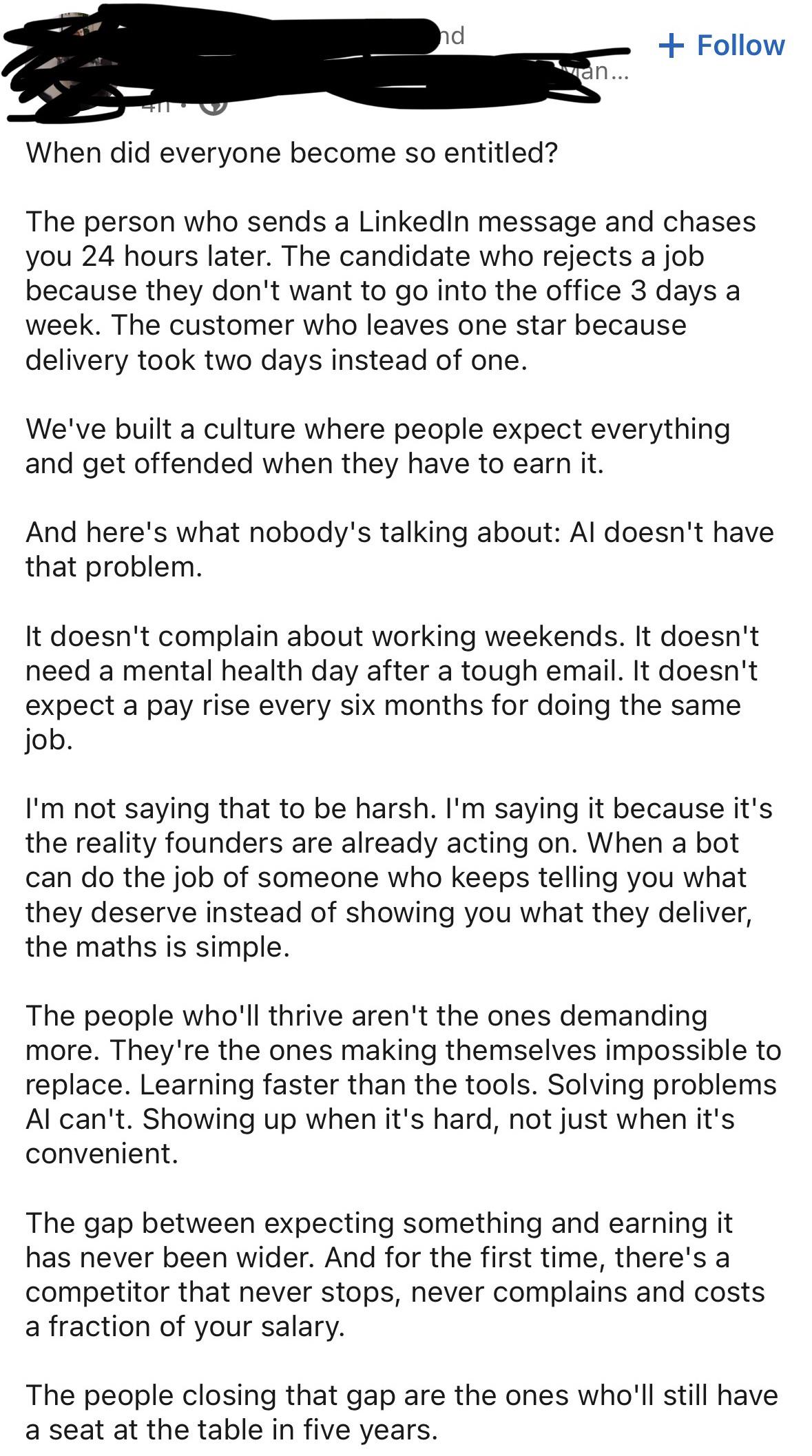
The specimen arrived by way of Reddit's r/LinkedInLunatics forum, where it had been received with the mixture of horror and recognition one associates with a safety inspector's report on a building already occupied. It is a LinkedIn post, nine paragraphs in length, arguing that workers who expect weekends, boundaries, and compensation proportional to their complaints deserve replacement by artificial intelligence. The title supplied by the original poster—"AI doesn't complain about working weekends"—is followed by a smiley face, the punctuation mark of a man who has confused menace with charm.
The post proceeds with metronomic regularity. Each paragraph opens with a thesis sentence, follows with a parallel list or amplification, and closes with a punchy kicker—nine stanzas, not a beat lost. "It doesn't ask for a raise. It doesn't call in sick. It doesn't expect a pat on the back." The anaphoric constructions repeat with the cadence of a catechism written by no particular denomination for no particular congregation. "The maths is simple," the post concludes at one juncture, delivering the British spelling of mathematics as though this were a flourish rather than a tell—the kind of orthographic inconsistency that occurs when a system trained on the whole English-speaking internet cannot decide which shore it washed up on.
What distinguishes the specimen from ordinary LinkedIn thought leadership—a category already notable for its distance from thought and its indifference to leadership—is the completeness of the closed loop it represents. The argument is that artificial intelligence is cheaper, more compliant, and more productive than human labor. The medium of this argument is prose that bears every structural signature of having been produced by the very technology it advertises. The evangelist, in other words, has delegated his warning about delegation to the delegate. The result is a post in which a machine argues for its own indispensability to an audience that, by all available evidence, cannot tell the difference.
This is worth examining not as irony, which is too easy, but as economics. The LinkedIn thought-leadership ecosystem has for some years operated as a frictionless marketplace in which motivational platitudes are exchanged for engagement metrics, which are exchanged for the appearance of authority, which are exchanged for consulting fees, which are exchanged for the opportunity to produce more motivational platitudes. The introduction of large language models into this cycle has not disrupted it. It has perfected it. The cost of producing a nine-paragraph post urging workers to justify their existence has fallen to approximately zero, which means the poster can now generate replacement rhetoric at the same marginal cost as the replacement he recommends. He has, in the most literal sense, become the case study in his own argument. He simply does not know it.
The economics of the position itself deserve the dry light of examination. The post frames artificial intelligence as a scab laborer—a tool whose principal virtues are its cheapness, its silence, and its willingness to work without complaint. These are not, historically, the qualities that management literature celebrates in its most valued contributors. They are the qualities that management has traditionally sought in its most disposable ones. The poster has confused a cost-reduction argument for a productivity argument, and in doing so has revealed the actual thesis beneath the motivational scaffolding: not that workers must become more valuable than machines, but that workers must become more machine-like than machines—more compliant, more available, less inclined to the inconvenience of having needs. This is not a vision of the future of work. It is a vision of the past of work, fitted with a new vocabulary.
The audience, judging by the post's engagement metrics, responded with the enthusiasm that LinkedIn reserves for material that confirms the anxieties it simultaneously produces. Likes, reposts, and comments affirming that yes, the lazy will be left behind, the hustlers will survive. A closed system: the machine produces the argument, the algorithm distributes it, the audience validates it, and the cycle begins again, requiring at no point the intervention of the human whose indispensability is ostensibly under discussion.
One notes that the smiley face appended to the title—":)"—is the only element of the specimen that resists systematic explanation. It may be the poster's sole original contribution: that thin, ambiguous grin, the emoji of a man who believes he is the one holding the lever, not realizing he is standing on the trapdoor. It is the only moment in nine paragraphs where something identifiably human—petty, pleased, and a little cruel—breaks through the frictionless surface. It is not enough to save the production. But it is, in its small way, the most interesting thing about it.
The maths, as the post would say, is simple. When the cost of arguing for human elimination falls to zero, the argument will be made constantly, by no one in particular, to everyone in general. The specimen is not an outlier. It is a sample.