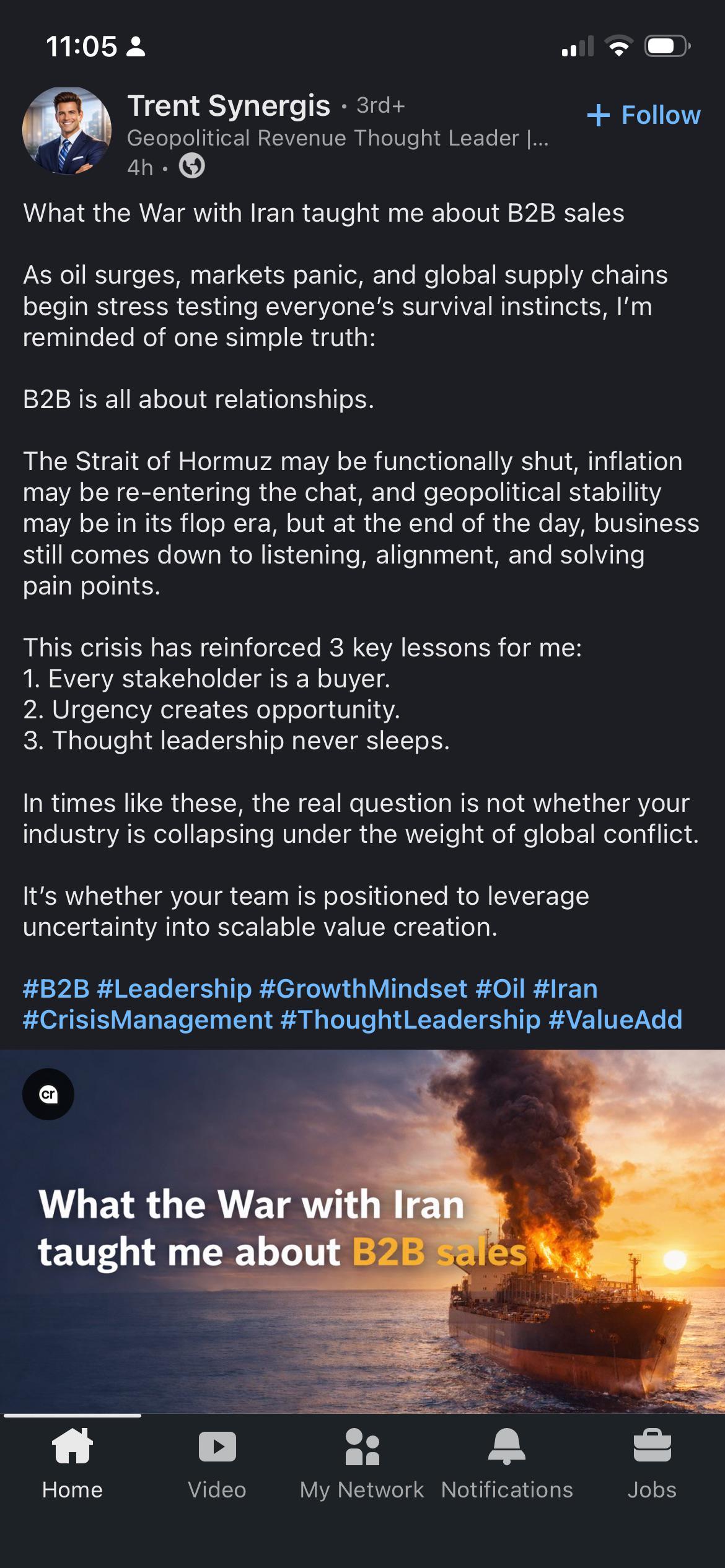
THE formula is by now familiar enough to constitute a genre. A catastrophe occurs—war, famine, the death of a public figure, the displacement of a population—and within hours a post appears on LinkedIn explaining what the catastrophe teaches us about quarterly targets. The catastrophe is not minimized. It is, in a sense, maximized: elevated to the status of a professional development seminar that history has convened for the benefit of mid-career sales professionals. The dead are not dishonored. They are leveraged.
The specimen under review, recovered from the Reddit forum r/LinkedInLunatics, documents one such production: a LinkedIn post titled "What the war with Iran taught me about B2B sales." The war in question is not metaphorical. It is the armed engagement between the United States and Iran, a conflict involving naval deployments, airstrikes, and the kind of geopolitical complexity that, in an earlier informational era, might have resisted compression into a listicle about pipeline management. In this era, the compression is frictionless.
The structural architecture of the specimen deserves examination on its own terms, because the structure is the evidence. The template—[traumatic event] taught me about [business function]—has appeared on LinkedIn with sufficient frequency that its conventions are now as recognizable as the conventions of the sonnet or the five-paragraph essay. There is the opening reference to the event, deployed with precisely enough gravity to establish the author's proximity to seriousness. There is the pivot, the hinge sentence in which the weight of the world is transferred, intact, onto the narrow shoulders of a commercial insight. And there is the lesson itself, delivered in the imperative mood, as though the reader had come to the post seeking tactical guidance and found, incidentally, that a war was involved.
What distinguishes this specimen from the merely cynical is the specificity of the commercial application. A human author, composing such a post with the calculating intent of a professional grifter, would almost certainly have selected a broader target. "Leadership" is the traditional choice—sufficiently vague to absorb any catastrophe, sufficiently aspirational to attract engagement. "Resilience" serves a similar function. Even "negotiation" would have provided a plausible bridge between armed conflict and professional ambition. The author of this specimen chose B2B sales. Business-to-business. The subset of commerce in which one firm sells to another firm, typically through a multi-stage pipeline involving lead qualification, discovery calls, proposal generation, and close. It is, to put it plainly, a narrow application for a large war.
This narrowness is the tell. A human being, however conditioned by the incentive structure of professional social media, retains some residual sense of proportion—an instinct, however faint, that the gap between aerial bombardment and pipeline velocity is a gap that language should acknowledge, if only by selecting a grander abstraction to bridge it. The machine has no such instinct. It has been trained on the reward signals of a platform that does not distinguish between engagement earned by insight and engagement earned by the appearance of insight. It has learned that the template works. It has not learned—because the training data does not teach this—that the template works *despite* something, and that the something matters.
The economics of this production are worth noting. LinkedIn's algorithm, like all such algorithms, rewards posts that generate engagement—comments, shares, and reactions—regardless of the valence of that engagement. A post that provokes outrage performs identically, in the platform's metric architecture, to a post that provokes admiration. The specimen, by yoking war to sales methodology, achieves both simultaneously: admiration from the fraction of the audience that consumes LinkedIn posts without examining their premises, outrage from the fraction that does. Both fractions comment. Both fractions share. The algorithm, observing this activity, distributes the post further. The author—or the apparatus that produced the author's material—is rewarded. The cycle is complete.
What has emerged, in the aggregate, is a dialect. Not slop in the colloquial sense—not garbage, not noise—but a specific and recognizable register of automated professional communication, as identifiable in its conventions as the language of insurance adjusters or the prose of annual reports. The dialect has its grammar: short declarative sentences, numbered lists, and the strategic deployment of a line break before the final insight. It has its vocabulary: "learnings," "takeaways," and "here's the thing." And it has its characteristic move, which is the subordination of any human experience, however extreme, to the requirements of professional advancement, performed without the hesitation that would indicate a human being had paused to consider whether the subordination was appropriate.
The war with Iran continues. The pipeline, presumably, converts.