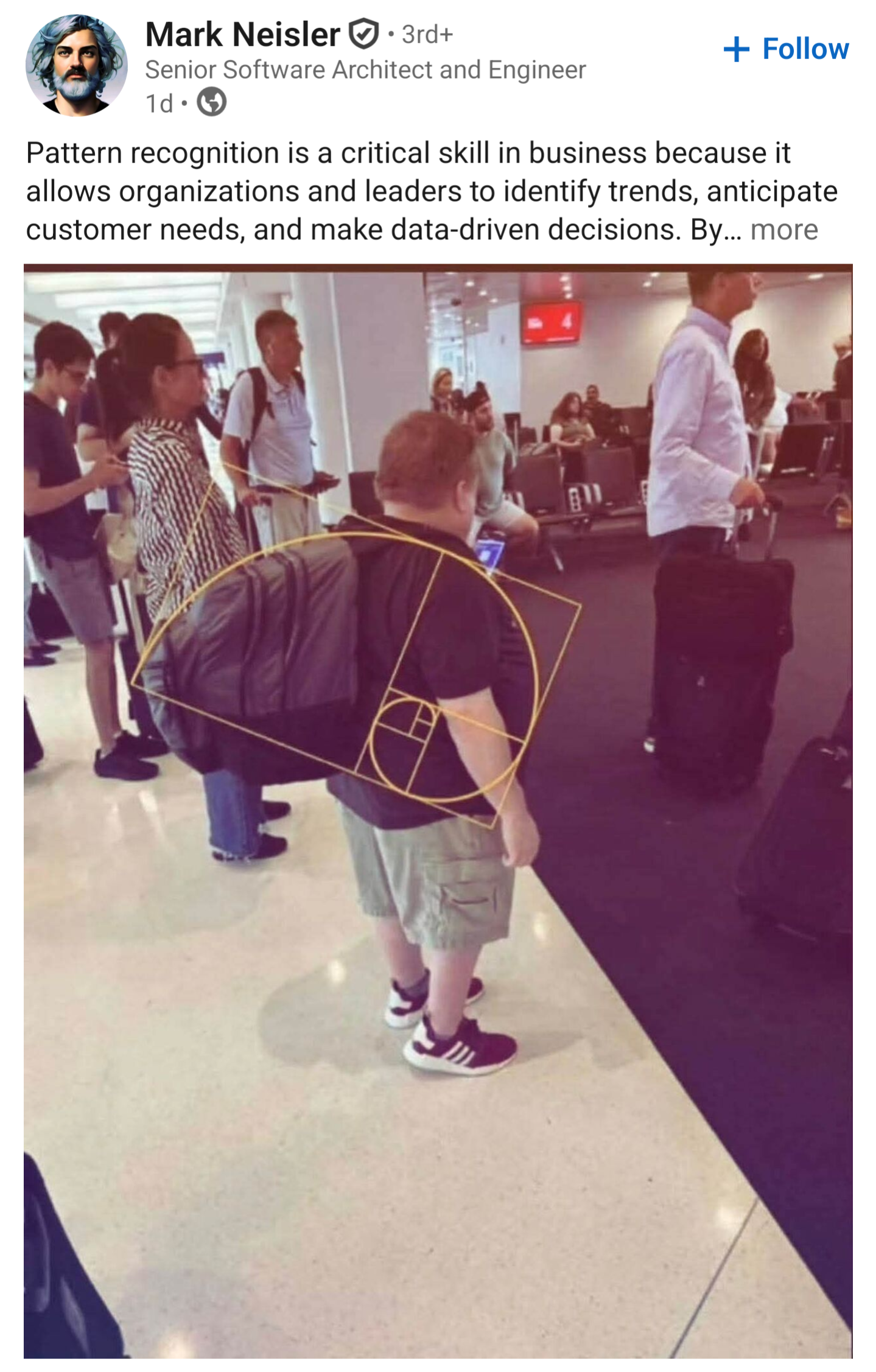
THE specimen, which circulated on LinkedIn before being archived by the forensic enthusiasts of Reddit's LinkedInLunatics forum, consists of a machine-generated image of a child accompanied by the caption "Critical skill." The image was produced, in all probability, by a stable-diffusion model. The child possesses extra limbs and at least one joint whose articulation would require the absence of a skeleton. The post received engagement. It was not taken down.
These facts may be stated without editorializing, because they require none.
The economics of what might be called the professional-class synthetic image are worth examining with some care. LinkedIn, which Microsoft acquired in 2016 for $26.2 billion—a figure that seemed extravagant at the time and now appears to have been a precise wager on the future appetite of white-collar workers for mutual affirmation—operates on an engagement model structurally identical to that of any other social platform, with one critical difference: its users believe they are doing something professional. The self-improvement post, the inspirational quotation overlaid on an image of a child or a sunrise, the three-sentence parable about leadership gleaned from a taxi ride—these are the platform's native productions, and they have always carried a faint odor of the fabricated. What has changed is not the sentiment but the means of manufacture.
The production cost of an inspirational LinkedIn post was, until recently, the cost of locating a stock photograph, composing a caption, and pressing a button. The stock photograph, whatever its aesthetic limitations, depicted a real child with a plausible number of elbows. The machine-generated image reduces even this modest cost. It eliminates the stock photograph entirely, and with it the need to select from existing images one that approximately matches the desired sentiment. It permits the user to produce, in seconds, at no marginal expense, an image of a child gazing upward, or forward, or into the middle distance, with an expression calibrated to suggest the very quality the caption names. The savings are real. The losses, it turns out, are also real, and they are skeletal.
The specific irony of the specimen under review is too clean to ignore but too obvious to belabor: a post urging the cultivation of "critical skill" reproduces an artefact whose maker evidently possessed none. The child's arm—if it can be called an arm, for the joint structure suggests something closer to a tentacle that has been told about arms but has not seen one—bends at an angle that no human limb has achieved outside of a medical textbook on compound fractures. The additional limb, partially occluded, emerges from a region of the torso where no limb has business emerging. They are the defects of a system that has ingested millions of photographs of children and has learned everything about them except what a child is.
What is notable, from a strictly commercial standpoint, is that none of this appears to have mattered. The post circulated. It was liked. It was, presumably, seen by the algorithmic apparatus that governs LinkedIn's feed, and it was distributed accordingly. The platform's incentive structure does not distinguish between an image of a child and an image of something that resembles a child in the way that a department-store mannequin resembles a person—close enough to trigger the recognition, wrong enough to trigger nothing else. The engagement was real even if the child was not. The metrics were captured. The professional network, that vast and earnest machine for the conversion of human anxiety into scrollable material, processed the specimen and found it acceptable.
There is a market analysis to be conducted here, though it is not a cheerful one. The production of synthetic motivational imagery represents a new vertical in the broader slop economy—one distinguished from its consumer-facing counterparts by its target demographic and its moral pretensions. The consumer variant asks only to be consumed. The professional variant asks to be taken seriously. It wraps itself in the language of growth, skill, and human potential, deploying images of children because children signify futurity, aspiration, and the not-yet-achieved. That the children in question increasingly arrive with superfluous limbs and joints that would alarm an orthopedist is a detail the market has, for the moment, elected to absorb.
The poster's identity is, as is customary in these cases, less interesting than the poster's function. He or she is an engagement farmer operating on professional terrain, producing material for an audience that will scroll past it in approximately the time it takes to like it. The specimen is not an error in this system. It is the system operating precisely as designed, at the lowest possible cost, with the lowest possible attention to whether the image of a child looks like a child. The critical skill, as it happens, was not acquired.