DECK: *A machine-generated image, promoted by machine-generated prose, accrues engagement on a network whose algorithms reward precisely the frictionless loop both represent.*
BYLINE: By Silas Vane / Business Correspondent, Slopgate
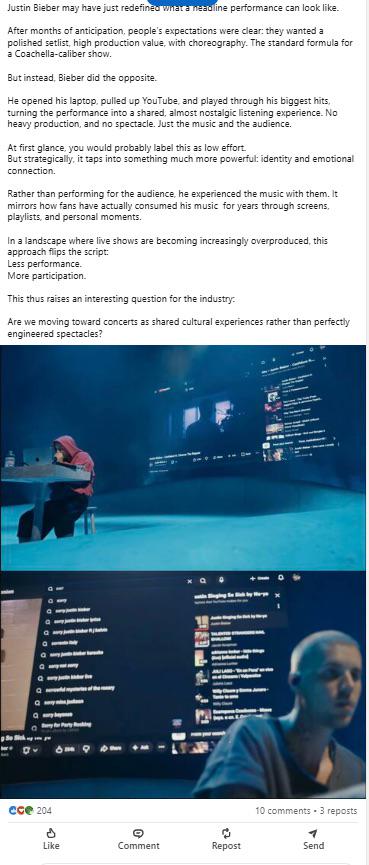
THE specimen arrived, as so many now do, through a secondary market. The subreddit r/LinkedInLunatics—which functions as a kind of informal quality-control bureau for the professional networking platform—surfaced a post in which an enthusiastic LinkedIn user presented a Stable Diffusion image as evidence that artificial intelligence is, in their words, "redefining entertainment." The image itself is unremarkable: the wax-museum finish, the phantom lighting that originates from no discernible source, the bilateral symmetry that no photographer would produce because no physical scene would permit it. One has seen a thousand such productions. What one had not seen, until recently, was the complete economic circuit they now inhabit.
The post's caption text exhibits every hallmark of large language model output—statistical smoothness, a confidence unmoored from any specific claim, the relentless forward momentum of prose that has never paused to verify its own assertions. "Doing the bare minimum is redefining entertainment!" the poster declares, and the sentence functions simultaneously as celebration and inadvertent confession. The bare minimum is, in fact, precisely what has been done. An image has been generated without craft. Commentary has been generated without thought. The two have been united without friction. And LinkedIn's algorithmic feed, which cannot distinguish performance from presence, has rewarded the assembly with visibility.
One hesitates to call this a business story, except that it is nothing else. The economics are worth stating plainly. The marginal cost of producing the image approaches zero. The marginal cost of producing the promotional text approaches zero. The marginal cost of distributing both on LinkedIn is, to the poster, precisely zero. What remains, then, is a transaction in which nothing of measurable value has been created, nothing of measurable effort has been expended, and yet the platform's engagement metrics register activity—likes, comments, and reshares—as though a product had been offered and a market had responded. The machinery of professional networking continues to turn. The dashboards, presumably, continue to climb.
This is the enthusiasm economy at its terminal stage: a closed loop in which the artefact and the apparatus of promotion have become the same substance. The image is generated by machine. The praise is generated by machine, or by a human so thoroughly trained on machine output that the distinction has ceased to matter. The audience, such as it is, engages through mechanisms—algorithmic surfacing, notification prompts, and the professional obligation to appear active—that require no deliberate act of attention. At every node in the network, effort has been replaced by automation, and at no node has anyone objected, because at no node is anyone, in the traditional sense, present.
The LinkedIn poster, whose name is immaterial, occupies a role that the platform has been quietly cultivating for several years. They are not a creator in any sense that the word bore before 2022. They are a node—a point at which machine output enters the distribution network and acquires the appearance of human endorsement. The endorsement need not be fraudulent. It may be entirely sincere. The poster may genuinely believe that a Stable Diffusion image with inconsistent lighting and texture-smoothness artefacts represents a revolution in entertainment. Sincerity, in this economy, is orthogonal to the question of value. The feed does not measure sincerity. It measures velocity.
What r/LinkedInLunatics provides, and what LinkedIn itself does not, is a secondary inspection process—a human-operated checkpoint at which the frictionless production loop encounters, for the first time, the resistance of critical attention. The subreddit's users do not mistake the specimen for innovation. They recognize it instantly for what it is: the bare minimum, performed at scale, celebrated without irony on a platform that has made the bare minimum a viable professional strategy.
The implications extend beyond a single post. LinkedIn reported 1.1 billion members as of its most recent disclosure. Its feed algorithm, like those of its competitors, optimizes for engagement rather than substance—a design choice that is rational at the level of the platform and corrosive at the level of the network. When the cost of producing plausible professional material falls to zero, the volume of such material rises without limit, and the signal-to-noise ratio inverts. The professionals who once used the platform to identify competence must now navigate a feed in which competence and its simulation are, by design, indistinguishable.
The poster's own words remain the most economical summary available. The bare minimum is redefining entertainment. It is also redefining professional communication, platform economics, and the meaning of engagement. That it is doing so without human supervision is not a failure of the system. It is the system, operating exactly as built.