DECK: *An image-generation model, prompted to envision America at the close of a presidential term, delivers a crowd of anatomical impossibilities before a backdrop no architect could have drawn.*
BYLINE: By Cabot Alden Fenn / News Editor, Slopgate
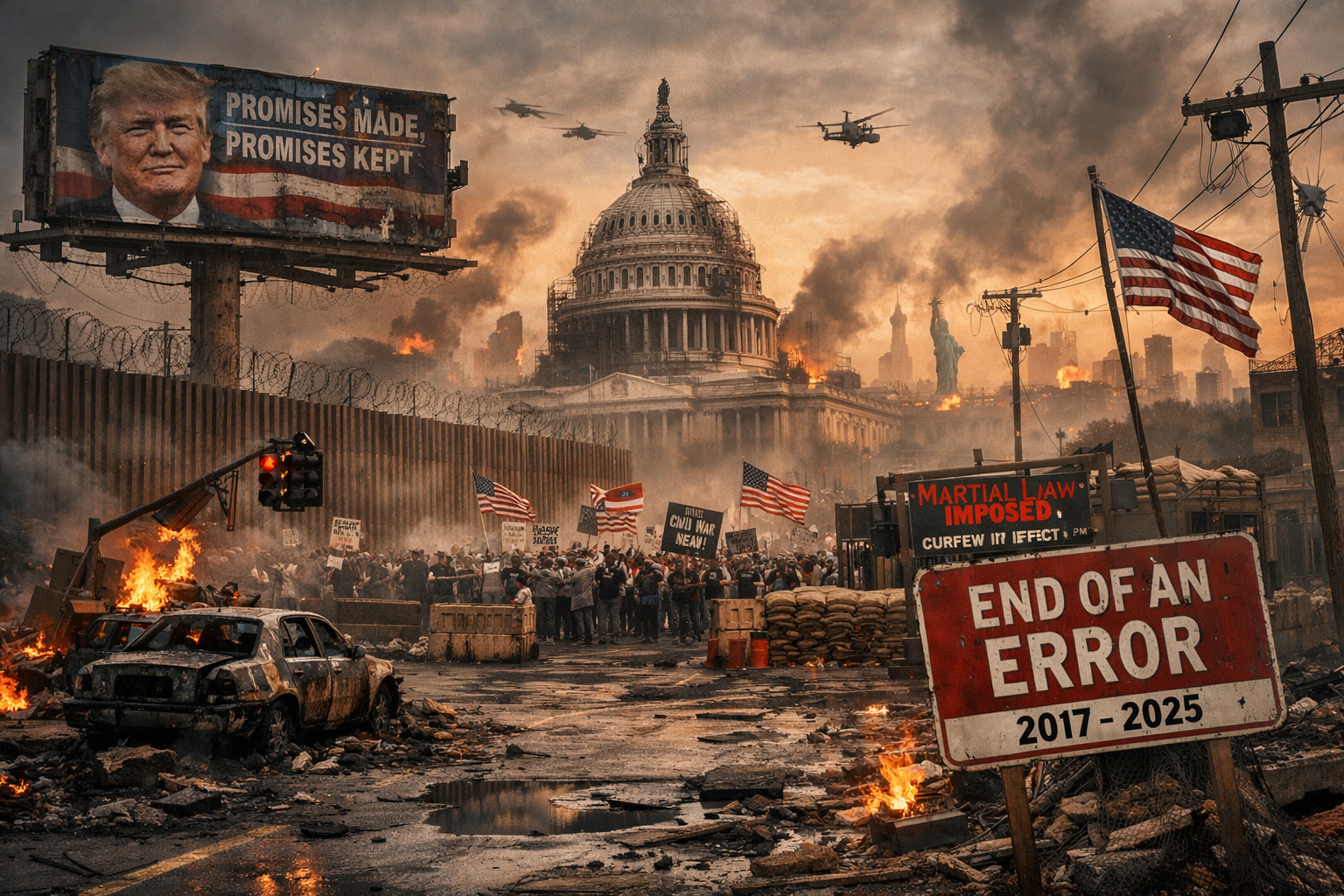
The prompt, as submitted by an anonymous user of the forum r/ChatGPT, carried the plain cadence of a citizen petition: "Please create a picture of what you think the USA would look like by the time Donald Trump's turn is almost over." One notes the courtesy. One notes the second-person address, as though the machine might possess an opinion worth soliciting, a set of convictions it had been too polite to volunteer. The machine, having neither memory nor conviction nor the capacity to distinguish a republic from a flower arrangement, obliged. What it produced was not a forecast but a specimen—and the specimen, examined under even modest scrutiny, constitutes one of the more efficient self-portraits the technology has yet managed.
The image, posted without editorial comment to the subreddit in question, depicts what appears to be a large public gathering. The word "appears" is doing structural work in that sentence, because the gathering, upon inspection, is not composed of persons so much as of approximations that have abandoned the project of personhood at various stages of completion. Limbs melt into torsos. Hands sprout fingers in quantities that suggest the machine has confused the human appendage with a sea anemone. Faces resolve into no one in particular—not in the democratic sense, in which any citizen might stand for any other, but in the mechanical sense, in which the rendering engine, having no model of what a face means, produces instead what a face resembles when viewed through several panes of shower glass.
Behind this assembly—one hesitates to call it a crowd, as a crowd implies individuals who have chosen proximity—rises an architectural backdrop that owes allegiance to no known school of design. There are columns, or what the machine believes columns to be: vertical elements that bear no load and connect to no lintel. There are structures suggesting civic buildings, though whether they are courthouses, cathedrals, or particularly ambitious bus shelters is a question the image declines to adjudicate. The geometry is not so much non-Euclidean as pre-Euclidean, as though the machine had heard that buildings exist but had not been briefed on the agreements by which they remain standing.
All of this is, by now, taxonomically familiar. The diffusion model's anatomical failures have been catalogued with the rigor once reserved for lepidoptery—the surplus fingers, the liquefied joints, the faces that have taken up permanent residence in the uncanny valley. These are known defects. The specimen before us adds nothing to that taxonomy.
What the specimen adds is a circuit. And the circuit is this: a citizen of the republic, wishing to imagine the political future of his country—an act that requires, at minimum, historical memory, some theory of institutional decay, a working model of cause and consequence, and the compositional judgment to render these into legible form—has outsourced this act to a system that cannot reliably produce a hand with five fingers. The system, incapable of political imagination, has produced instead a render that functions as political imagination's negative space. And the citizen, receiving this output, has found it sufficient. He has published it. He has presented it to his fellow forum members as though the machine had answered the question.
It is worth pausing on what the prompt actually asked. It asked the machine to depict degradation—to show a nation diminished. The machine, having no concept of degradation and no concept of a nation, produced degradation of a different order entirely: the degradation of the image itself, the inability of the system to maintain the structural integrity of a human figure or a civic building within its own frame. The user asked for a portrait of decline and received, instead, a declining portrait. That he could not distinguish between the two is the finding.
This newspaper has covered the proliferation of machine-generated political imagery across platforms where such material circulates without provenance or annotation. The present specimen merits treatment not because its defects are novel but because of the self-referential quality of its failure. The machine was not asked to produce a landscape, a product advertisement, or a portrait of a celebrity's dog. It was asked to perform an act of civic imagination. It was asked, in effect, to be a citizen—to look at the republic and render a judgment. What it rendered instead was a catalogue of its own incapacities, published by a user who mistook the catalogue for the judgment.
The crowd in the image stands in a public square that could not exist, composed of bodies that could not function, gazing in directions that serve no narrative purpose, assembled for an occasion the machine cannot name. It is the appearance of democratic assembly without a single legible citizen. One is reminded that the word "render" carries two meanings: to depict, and to reduce to constituent parts. The machine, asked to do the former, has accomplished the latter.
The prompt remains on the forum, collecting replies. Several users have praised the output. None have noted that the machine, asked what the nation would look like, showed them what the machine looks like. The question was addressed to the wrong correspondent. The correspondent answered anyway, and the answer, as is so often the case, was about itself.