DECK: *An artificial intelligence system, tasked with depicting political tyranny, produces not a vision of oppression but a labeled diagram of one, in which each atrocity is captioned for the convenience of viewers the machine assumes cannot identify martial law without assistance.*
BYLINE: By Cabot Alden Fenn / News Editor, Slopgate
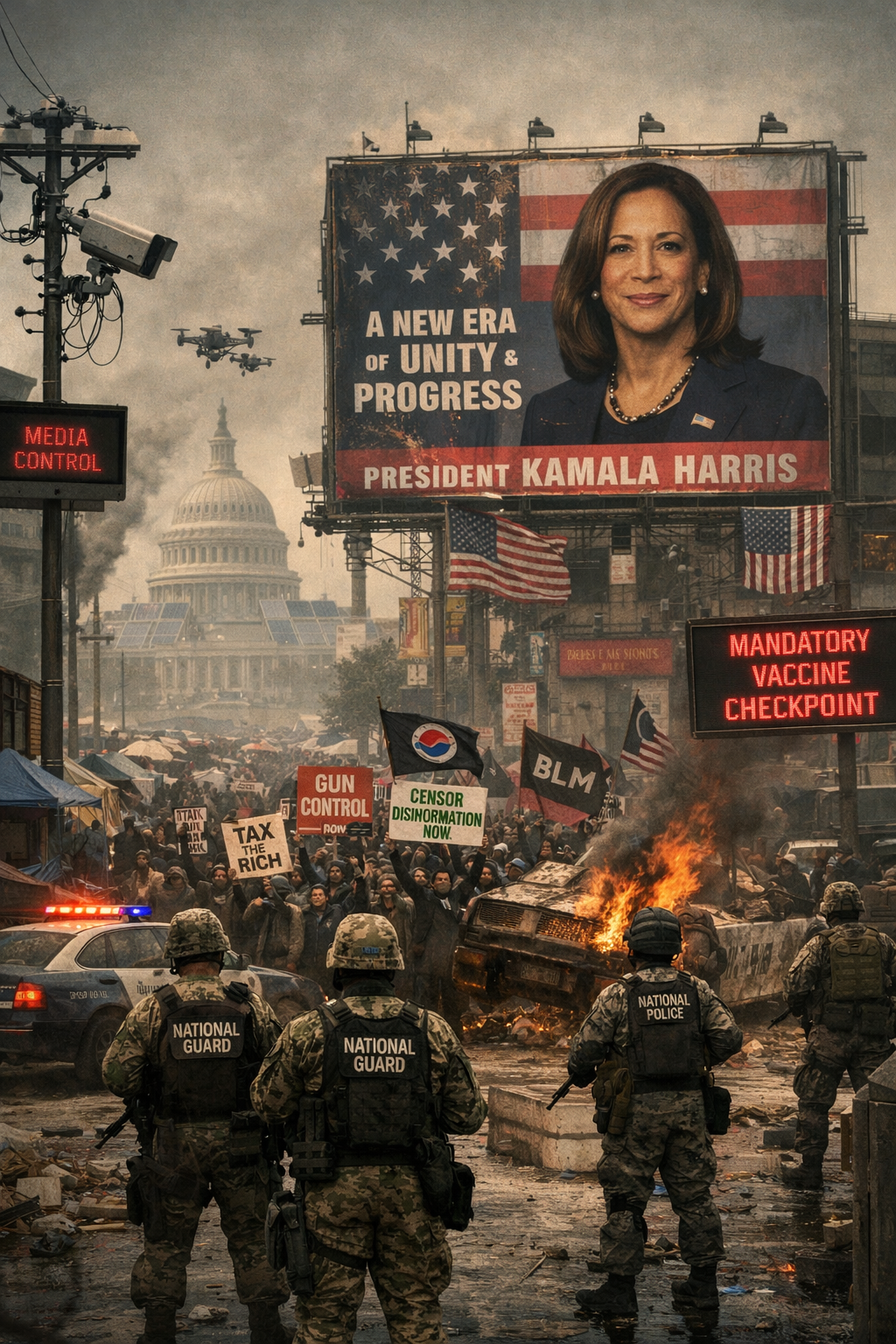
T he specimen is a single image, posted to the Reddit forum r/ChatGPT under the title "WTF CHAT-GPT!?!!"—the punctuation itself a small monument to the poster's alarm—and it depicts what its creator apparently intended as a dystopian political tableau set in a fictional United States. National Guard troops occupy a city street. Vehicles burn. Protest signs crowd the middle distance. A surveillance apparatus looms. The Capitol dome floats in the background at a scale and proximity that would place it roughly where the Washington Monument stands, which is to say the machine has rearranged the capital's geography with the confidence of a set designer who has never visited the city but has seen photographs of it from several angles simultaneously.
What arrests this desk's attention is not the image's politics, which are the predictable inventory of anxieties one encounters in any survey of American political forums, but its epistemology. Every element in the composition is labeled. The soldiers wear text on their uniforms and equipment as though participating in a corporate training exercise in which each role must be identified for liability purposes. A checkpoint bears the legend "MANDATORY VACCINE CHECKPOINT." Billboards declare "GUN CONTROL" and "TAX THE RICH." A surveillance camera is marked "MEDIA CONTROL," lest the viewer mistake it for a traffic camera or a bird. Another sign insists "CENSOR DISINFORMATION NOW." The fire burns in the foreground, and one suspects that if the resolution permitted it, the flames too would carry a small placard reading "FIRE (SYMBOLIC)."
The machine has produced, in other words, not a scene but a taxonomy. It has taken the political fears distributed across its training data—surveillance, disarmament, compulsory medical intervention, speech regulation, and taxation—and arranged them in a single frame with the compositional logic of a refrigerator door on which every magnet has been deployed at once. The result is not frightening. It is not even coherent as propaganda. It is a diagram, and diagrams do not frighten; they instruct. The propagandist who labels his horrors has already conceded that the horrors cannot speak for themselves.
This is the distinction that separates the specimen from the long tradition of dystopian political art it inadvertently parodies. Orwell did not caption the telescreen. Huxley did not label the soma. The power of the imagined tyranny resided precisely in its refusal to announce itself, in the reader's dawning recognition that the apparatus of control had been naturalized into the scenery of daily life. The machine, lacking this understanding, has done the opposite: it has produced a tyranny so thoroughly annotated that every instrument of oppression arrives with its own explanatory text, as though the dystopia came with a docent. The effect is not of a world in which freedom has been lost but of a diorama assembled for a congressional hearing at which each exhibit must be legible from the back row.
The forensic markers confirm what the eye suspects. The image bears the signatures of a diffusion-based generation system—floating objects detached from their architectural moorings, textures that resolve into impossibility upon inspection, a bilateral symmetry no actual street would produce. The Capitol dome hovers behind a billboard at a scale that places the viewer simultaneously at street level and at aerial remove, a contradiction the machine does not recognize because it has never occupied a body in space. It knows what buildings look like from photographs. It does not know where buildings are.
The poster's reaction merits examination. "WTF CHAT-GPT" is the exclamation of a person who prompted a system to produce something and was startled by what arrived—which is to say it is the exclamation of a person who lit a match, held it to a fuse, and is now reporting the explosion with the urgency of a bystander. The subreddit's customs make it impossible to determine the exact prompt, but the output's specificity—a named political figure's implied presidency, partisan grievances arranged as catastrophe—strongly suggests a prompt of corresponding specificity. The machine did not volunteer this. It was asked. The alarm is not at the machine's initiative but at its compliance, which is a different kind of alarm and one that implicates the alarmed.
What the specimen finally demonstrates is the machine's fundamental relationship to political imagination: it can inventory fears, but it cannot compose them into meaning. It can retrieve "surveillance" and "military presence" and "protest" and "checkpoint" from the archive of images and captions on which it was trained, and it can place them in spatial proximity to one another, but it cannot make them cohere into a world. The result is not slop in the ordinary sense—it is too detailed, too laboriously assembled, too dense with reference. It is something more instructive: a machine's confession that it understands political anxiety as a list of keywords rather than as a condition of life. The dystopia it produces is comprehensive and uninhabitable. Every element is present. Nothing is alive.
The image remains on the forum, its labels legible, its fires still burning, its checkpoint still mandatory, its Capitol still floating in a sky that has never existed above a city that the machine has never seen.