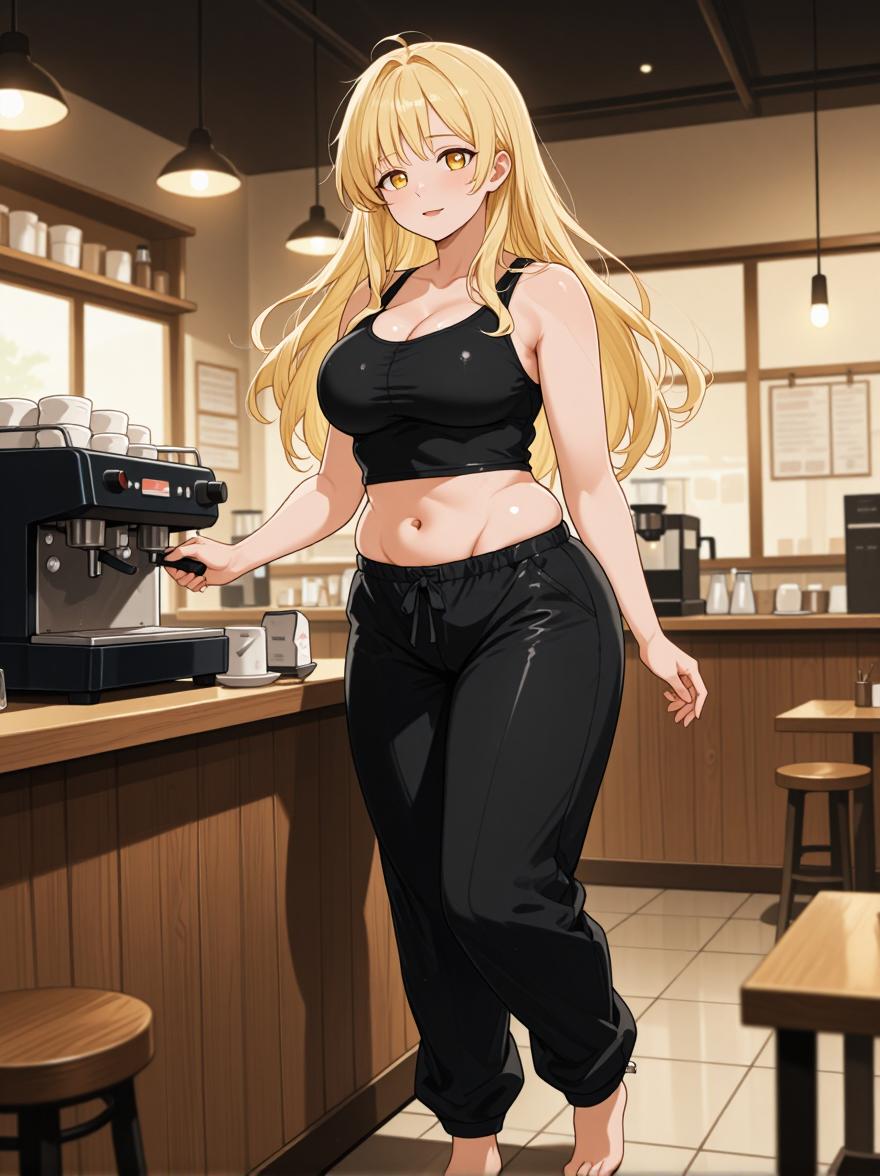
THE specimen before us—recovered from the subreddit r/AIGeneratedArt, where it was posted under the title "Mia spent forever picking an outfit for her café shift, found nothing, and ended up showing up in her home clothes 😄"—is, in the strictest sense, an image of a young woman in casual attire. But the image is not the artefact under review. The artefact under review is the sentence that accompanies it, a sentence which, in forty-one words and one emoticon, attempts to do what sentences have been doing since Defoe: to make a person real by giving her a morning.
Let us attend to the apparatus. We are given, first, a proper name: Mia. Not "a woman" or "the figure" but *Mia*, which is to say a name that implies prior acquaintance, that presumes we have been introduced. We have not been introduced. No one has been introduced, because Mia does not exist, has never existed, and—one must be precise on this point—is not a fictional character in the sense that Emma Bovary or Clarissa Dalloway is a fictional character, because those women were brought into being by acts of sustained imaginative labour undertaken by persons who had themselves been alive. Mia was produced by a prompt. The distinction matters.
We are given, second, a duration: "forever." Mia spent *forever* picking an outfit. The word is deployed in its colloquial diminutive—not the forever of theological consequence but the forever of the telephone call one's roommate will not end. It is a word that belongs to a specific register of intimate complaint, the register in which one recounts the small frictions of cohabitation to someone who already knows the person being described. The author of this caption—if "author" is not too grave a word for the operator of a text field—has borrowed the cadence of affection without having anyone to be affectionate about. One does not spend forever choosing an outfit unless one is known to someone who finds the habit endearing. Mia is known to no one.
We are given, third, and most remarkably, a workplace. Mia has a café shift. She is employed. She is, we are to understand, the sort of young woman who works at a café—an archetype so thoroughly established in the imaginative economy of the internet that the machine can generate her without instruction: youngish, presentable, slightly harried, and relatable in the manner of a protagonist in a romantic comedy. The café shift is the detail upon which the entire construction depends, because it is specific enough to suggest that someone has observed Mia—has watched her leave for work, has noted her sartorial indecision—whilst being so wholly generic that it could not possibly have been observed anywhere. No café is named. No city is implied. The shift floats in the textureless middle distance of machine-generated domesticity, where all cafés are the same café and all shifts begin at the same unspecified hour.
We are given, fourth, a resolution: she "ended up showing up in her home clothes." The phrasing is instructive. "Ended up" carries the faint fatalism of a person who has tried and been defeated by circumstance, which in this case is the circumstance of not owning clothes she likes—a circumstance invented for her by the sentence that reports it. "Showing up" implies arrival at the café, which implies a commute, which implies a geography, which implies a world. An entire material reality is being conjured by a subordinate clause, and none of it is load-bearing. Pull at any thread and one finds not fabric but the absence of fabric—the machine's approximation of what specificity feels like, deployed in place of specificity itself.
We are given, finally, the emoticon: 😄. It is doing more work than anything else in the sentence. It is the signal that all of this is meant to charm us, that we are meant to find Mia's morning amusing in the way one finds a friend's minor catastrophe amusing. The emoticon is the operator's bid for tone, and it is the only honest element in the production, the only element that accurately represents what has occurred: someone has looked at a machine-generated image of a woman who does not exist and has felt, or wished to feel, or wished us to feel, something like fondness. The emoticon does not describe Mia's emotional state. It describes the operator's aspiration for ours.
What we have, then, is a biography in miniature—name, habit, workplace, narrative arc, and emotional register—constructed for a subject who possesses none of these things, distributed to an audience invited to feel as though they do. It is fiction with the ambition of an anecdote and the depth of neither.
Specimen: Young woman in casual dress, standing. Recovered from r/AIGeneratedArt, anonymous account, December 2024. The subject's expression suggests mild contentment, which is precisely the expression one would wear if one had never existed and therefore had nothing to be discontent about.