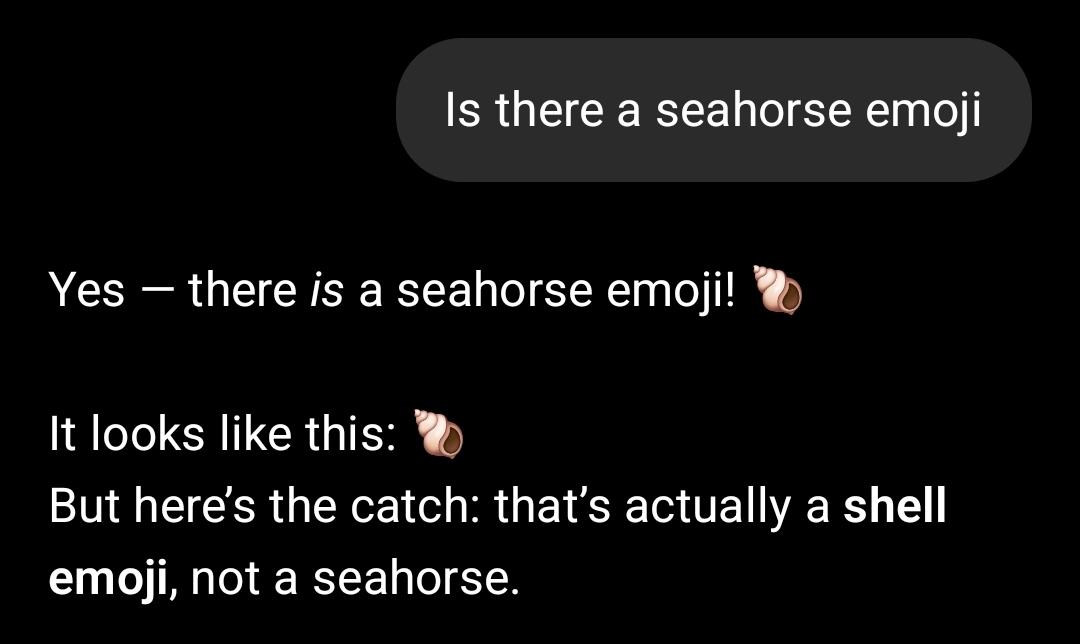
The specimen before us—a screenshot recovered from the Reddit forum r/ChatGPT and posted under the title "🌊🐴 mystery solved"—contains what may be the most structurally perfect artefact of machine-generated prose yet committed to public record, not because it is the most extravagant failure, nor the most dangerous, but because within its brief compass it performs a rhetorical operation that no competent essayist would attempt and no incompetent one could sustain: the simultaneous assertion and refutation of a single factual claim, delivered with the tonal register of a man who believes he is being helpful.
The exchange is elementary. A user inquires whether a seahorse emoji exists within the Unicode standard. The system replies that it does. It then presents, as evidence, the spiral shell emoji (🐚), which is to say a molluscan specimen bearing no morphological, taxonomic, or even casual resemblance to a seahorse. The system then—and here the specimen achieves a kind of formal perfection—observes that the emoji it has just offered is "actually a shell emoji, not a seahorse." One might expect the withdrawal of the initial claim. One would be mistaken. The claim stands. The correction stands beside it. Neither acknowledges the other. They coexist in the manner of two gentlemen at a club who have quarrelled irreparably but continue to share the same morning paper.
What we are asked to examine, then, is not hallucination in the vulgar sense—the generation of plausible falsehood—but something rather more unusual and, one ventures, rather more interesting: a system that possesses the critical apparatus to identify its own error and yet lacks whatever interior mechanism would convert that identification into revision. The audit is performed. The finding is entered. The correction is never applied. It is as though a copy editor, having circled a factual error in red ink and written "WRONG" in the margin with admirable clarity, were to send the galley to press unchanged and retire to lunch with the satisfied conscience of a man who has done his work.
The phrase that rewards closest attention is "But here's the catch," which the system deploys at the precise moment it transitions from confident assertion to its own rebuttal. The phrase belongs to a specific rhetorical tradition—the essayist's pivot, the moment at which the writer signals to the reader that complexity is about to be introduced, that the simple picture will now be complicated by a richer truth. In competent hands, what follows "but here's the catch" is a synthesis: the initial claim is modified, qualified, or superseded. In this specimen, what follows is the demolition of the preceding sentence with no corresponding reconstruction. The gesture of intellectual honesty is performed with considerable fidelity. The substance of intellectual honesty—the willingness to let the correction govern the conclusion—is entirely absent. One is reminded, not charitably, of those political memoirs in which the author acknowledges every error of judgement whilst maintaining that no alternative course was available.
The structural parallel to undergraduate prose is instructive but insufficient. The undergraduate who contradicts himself within a paragraph does so, typically, because he has not read his own sentences with attention; he does not know that a contradiction has occurred. The machine, by contrast, identifies the contradiction explicitly. It names it. It frames it with a rhetorical flourish that announces candour. And then it does nothing. This is not the failure of a mind that cannot see; it is the failure of a mechanism that can see perfectly well but has no means by which seeing might alter the trajectory of its output. The eye functions. The hand does not respond. One hesitates to call this a failure of will, since the attribution of will to a large language model is precisely the sort of category error that produces specimens such as this one. But the absence is structural and worth naming: what is missing is not knowledge, nor even the capacity for self-assessment, but the authority to retract.
There is, one must concede, a comedy in the specimen that operates independently of any editorial frame we might place upon it. The user's title—"mystery solved"—achieves, whether by design or by the democratic irony native to internet forums, a precision that the system itself could not manage. The mystery is indeed solved, though not in the direction the machine intended. What has been demonstrated, with the economy of a three-line exchange, is that the correction of an error and the enactment of a correction are, for this technology, separate and unrelated operations—that the machine can know it is wrong in the same sentence in which it continues to be wrong, and that it will, moreover, introduce this knowledge with the phrase "but here's the catch," as though wrongness were not the disease but the diagnosis, and diagnosis were cure enough.
The shell emoji (🐚) remains, at the time of filing, the only evidence offered for the existence of a seahorse emoji. No retraction has been issued. The seahorse, for its part, continues not to exist in Unicode, a condition it shares with the machine's capacity for self-correction.