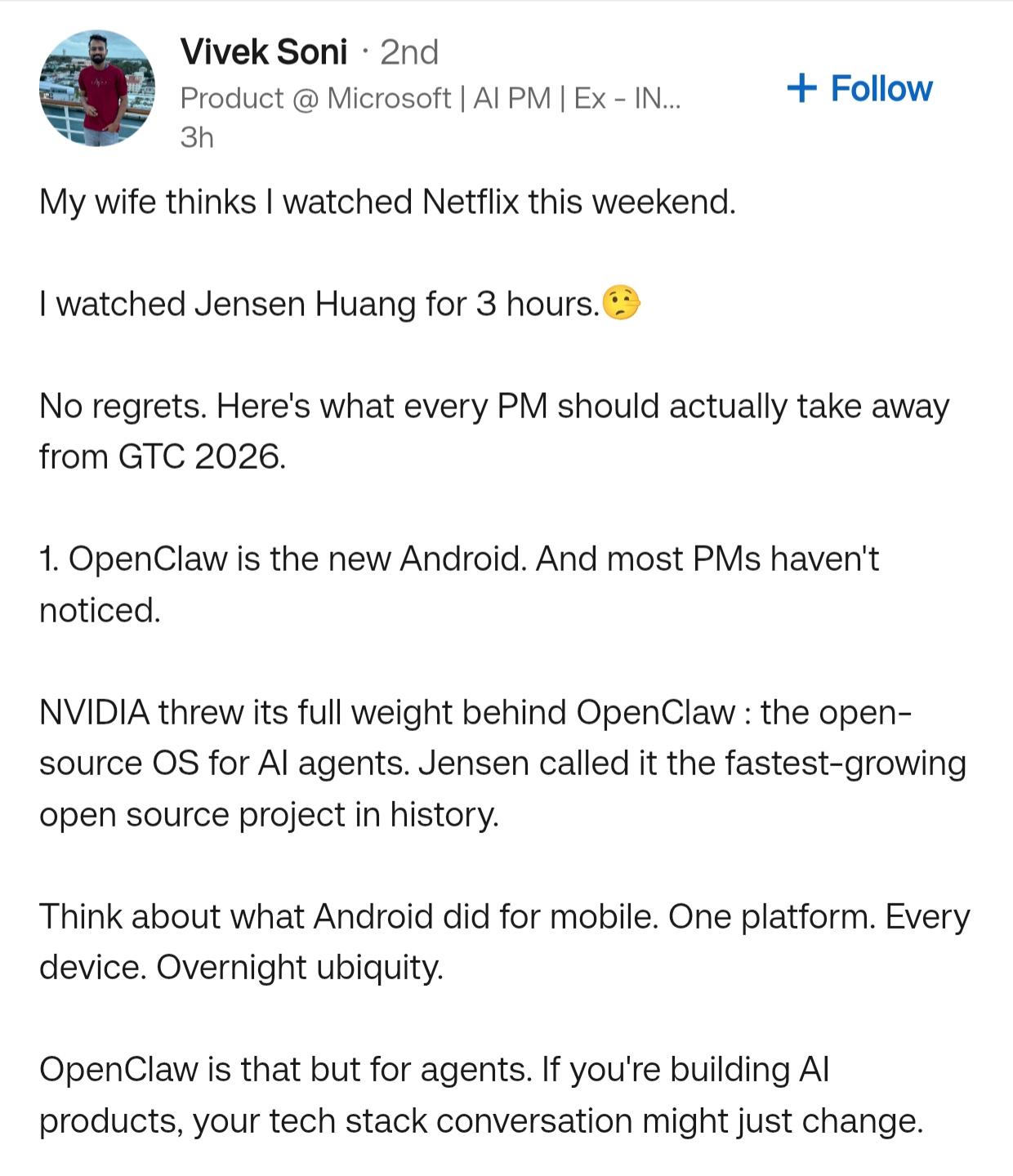
The domestic deception narrative—in which a professional confides to his network that a spouse has been misled about the nature of weekend leisure—belongs to a genre older than the platform on which it now circulates, though it has never before been deployed with such systematic purposelessness. One Mr. Vivek Soni, who identifies himself as a product manager at Microsoft and whose LinkedIn biography carries the compressed credential notation of a man in transit between positions he wishes you to remember, announces to his professional network that his wife believes he watched Netflix over the weekend. He did not. He watched Jensen Huang, the chief executive of NVIDIA, deliver a keynote address at the GPU Technology Conference of 2026, and he watched him for three hours, and he does not regret it. The emoji that follows this confession—a face flushed with either exertion or arousal, the Unicode Consortium having declined to disambiguate—suggests that the author regards this substitution as mildly transgressive, the viewing of a corporate presentation recast in the idiom of infidelity.
The misdirection is not comic, precisely, because comedy requires that the substituted object be inadequate or absurd, and the author does not believe this to be the case. He believes he has made the more serious choice. The joke, such as it is, operates in one direction only: the audience is meant to recognize that watching Jensen Huang is not what wives expect, whilst simultaneously accepting that it is what wives ought to expect, or at the very least what product managers ought to prefer. The conjugal unit is deployed, briefly, as rhetorical infrastructure, and then set aside, its load-bearing work complete.
What follows is a numbered inventory of certainties. "Here's what every PM should actually take away from GTC 2026," the author writes, the word "actually" performing the familiar labor of distinguishing the author's insights from those of the presumably fraudulent majority who watched the same keynote and drew inferior conclusions. The first and most prominently displayed of these certainties is that "OpenClaw is the new Android." The sentence arrives with the prosodic confidence of revelation, though what it reveals, upon examination, is primarily the author's facility with a particular rhetorical device—one that might be termed the frictionless analogy.
The frictionless analogy operates as follows: a new technology is declared equivalent to an old technology whose success is beyond dispute. The comparison generates the sensation of insight by borrowing the gravitational authority of a completed revolution—in this instance, the ubiquity of mobile telephony—without performing any actual work of comparison. "Think about what Android did for mobile," Mr. Soni instructs. "One platform. Every device. Overnight ubiquity." These are not arguments. They are incantations. The reader is not invited to consider whether the analogy holds, whether "overnight" is an accurate description of a process that required the better part of a decade, or whether the phrase "every device" constitutes a claim about the future or a misremembering of the past. The analogy is frictionless because it has been sanded of every surface against which a critical intelligence might find purchase.
That Mr. Soni recommends his numbered findings to "every PM" rather than to some particular subset—those working in adjacent fields, perhaps, or those whose products might be affected by the developments he describes—is itself instructive. The LinkedIn dispatch operates under a universalizing imperative: if a thing is worth knowing, it is worth knowing by everyone. The alternative—that a given insight might be relevant to some practitioners and irrelevant to others, that professional knowledge might be situated rather than universal—is foreclosed by the form itself. The numbered list admits no hierarchy of relevance. It is a democratic instrument deployed in the service of an authoritarian claim.
One arrives, at length, at the question of provenance. The specimen exhibits what has become, in 2026, a familiar indeterminacy: the prose is neither distinctively human nor identifiably machine-generated but occupies instead a territory in which the two have become, through mutual imitation, functionally indistinguishable. The sentences are short not because brevity serves the thought but because brevity serves the scroll. The structure is listicle not because enumeration clarifies but because enumeration signals authority. Every element of the production operates according to a logic of performance optimization rather than communication, and whether that optimization was performed by an algorithm or by a human who has internalized the algorithm's preferences is, at this advanced stage of the platform's evolution, a distinction without interpretive consequence.
What remains, stripped of the question of authorship, is the specimen's contribution to a genre one might call the domestication of corporate fealty—the recasting of professional obligation as personal passion, of spectatorship as discipline, of a man watching a screen as a man doing something his wife could not understand. "Jensen and chill," the Reddit caption reads, grafting the idiom of streaming-era intimacy onto the act of watching a chief executive describe semiconductor architecture. The phrase is, in its way, a small masterpiece of the form: it contains, in three words and an implied emoji, the full apparatus by which professional networking has colonized the language of private life, converting leisure into credential and the living room into a theater of expertise.
Mr. Soni's wife, one suspects, knew perfectly well what he was watching. The deception, if it occurred at all, ran in the other direction.
Specimen: Screenshot of a LinkedIn post by Vivek Soni, identified as Product Manager at Microsoft. Recovered from Reddit, r/LinkedInLunatics, March 2026. The post received two hundred and thirteen upvotes, a figure that suggests the community found the specimen representative rather than exceptional.