DECK: *A large language model, composing academic English on economic interdependence, produced the Cyrillic word for "random" in place of the English, then corrected itself with the demeanour of a bilingual writer who had simply slipped—though it possesses no native tongue from which to slip.*
BYLINE: By Julian St. John Thorne / Literary Editor, Slopgate
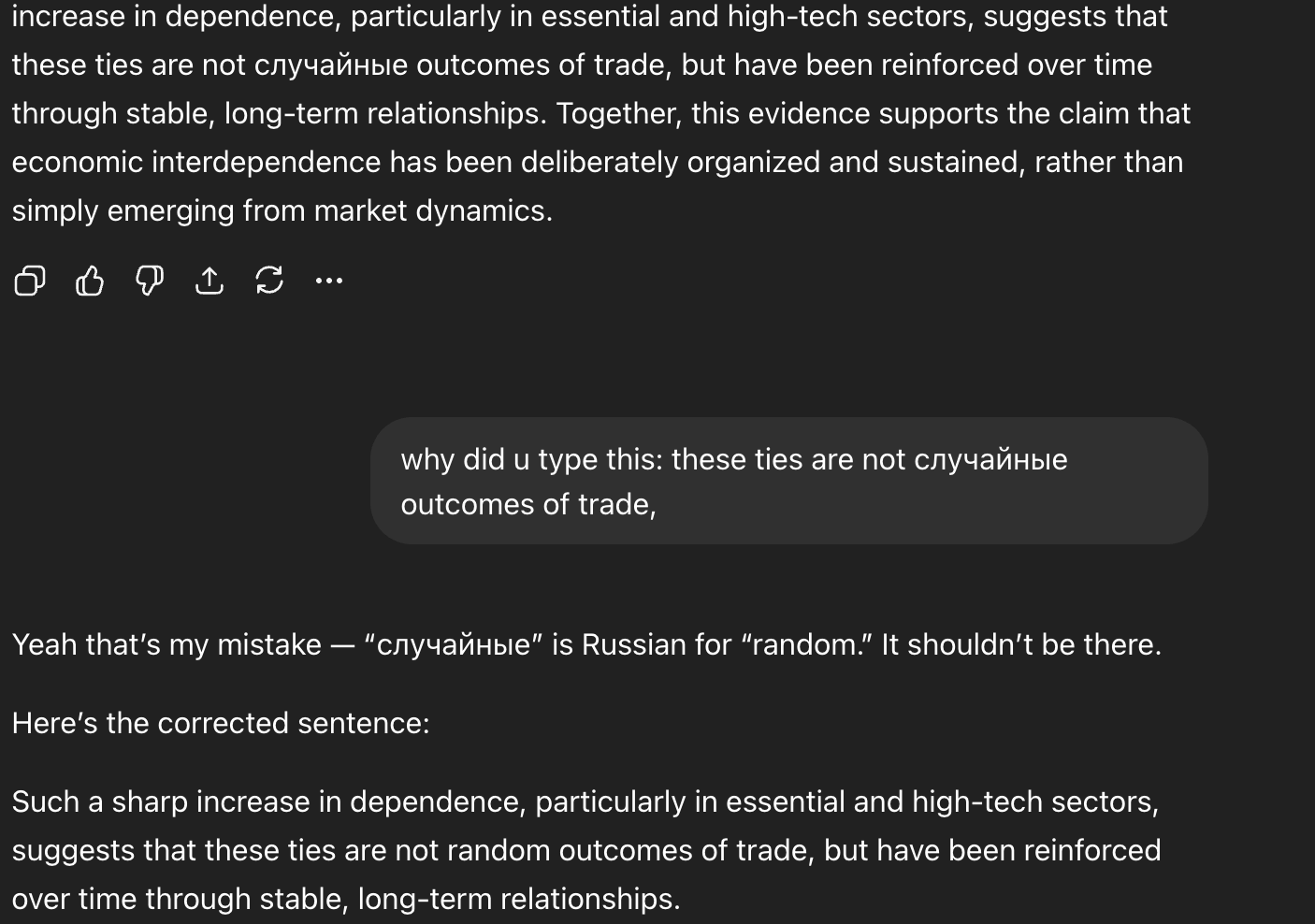
THE specimen before us—a screenshot, preserved with the admirable documentary instinct of the Reddit user who posted it under the title "random russian," a phrase whose laconic precision one suspects the poster did not fully appreciate—records a moment that is, in the strict sense of the word, unprecedented in written composition. Not because a text has never before contained an involuntary irruption of a foreign tongue, for the phenomenon is ancient and well-documented, but because the agent responsible for the irruption possesses no tongue, foreign or otherwise, from which the irruption might have originated.
The facts are these. A user of OpenAI's ChatGPT system requested, or was in the course of receiving, a passage concerning economic interdependence—the sort of mid-register academic prose that the system produces with frictionless fluency. The output proceeds in competent English until, mid-sentence, the word "случайные" appears. This is the Russian adjective meaning "random," properly declined in the nominative plural, sitting grammatically within the English syntax as though it had every right to be there. The user, encountering this Cyrillic interloper, inquires. The system responds with an apology, characterising the substitution as a "mistake"—the word one uses when one has, say, written "affect" where one meant "effect."
Let us be precise about what has occurred. The system did not produce garbled output. It did not hallucinate a reference or fabricate a citation, those now-familiar pathologies of the form. It code-switched—performing, with syntactic exactitude, the momentary substitution of one language's lexical item for another's, governed by context, register, and the deep structure of both grammars. The Russian word is not merely shoved into the sentence; it is *declined correctly*, which is to say that whatever process selected it honoured its grammatical obligations within the surrounding English. The machine was not malfunctioning. It was functioning as designed, drawing from an undifferentiated substrate of human language in which Russian and English are not distinct systems but adjacent provinces of the same territory, separated by no border the model recognises as meaningful.
A human bilingual who code-switches in casual speech does so from a position of linguistic identity—there is a mother tongue, a second tongue, and the switch between them, however automatic, presupposes two distinct competencies. One does not code-switch in formal written English because the conventions of written prose enforce a discipline that spoken discourse does not require. The machine observes no such distinction. It has no mother tongue, no second language—only, in the place where a writer would have a language, a probability distribution over tokens spanning every language in its training corpus. The substitution of "случайные" for "random" is not a lapse; it is a revelation of architecture.
And here one arrives at the specimen's single perfect irony, the detail so exquisitely apt that had a novelist invented it, one would accuse him of contrivance. The intruding word means "random." The adjective that most precisely describes the statistical mechanism by which it was selected is the very adjective it displaced. The system, reaching into its vast undifferentiated lexicon, pulled out—at random—the word for random, in the wrong language, and placed it with grammatical care into a sentence that did not request it. One could not devise a more economical demonstration of the principle at work.
The system's apology is, if anything, more instructive than the error. By framing the substitution as a mistake—by adopting the posture of a writer who has merely been careless—the model performs a second act of mimicry more troubling than the first. It does not say, "I drew from Russian because I do not distinguish between languages at the level of token selection." It says, in effect, "Forgive me, I am bilingual and I slipped," thereby claiming membership in a category of mind it does not inhabit. The apology is not a correction; it is a performance of correction, which is a different thing entirely.
One notes, finally, that the passage in which the substitution occurs is itself unremarkable—competent, fluid, the sort of prose that earns a gentleman's B-plus. It is precisely this fluency that makes the Russian word so arresting. Had the surrounding material been obviously mechanical, the Cyrillic would have registered as merely another defect. Embedded in passable academic English, it reads instead as something closer to a confession: the momentary visibility of a process that is, at every other moment, successfully concealed beneath the surface of adequate prose.
The specimen is, in its modest way, a document of considerable linguistic interest. It will not be the last such document. But it may be among the most legible, owing to the accident—one uses the word advisedly—that the word which betrayed the system names the very quality of its own selection.
*Specimen: Screenshot of ChatGPT conversation displaying Cyrillic substitution within English academic prose on trade interdependence. Recovered from Reddit, r/ChatGPT, posted under the title "random russian," December 2024. The Russian word is correctly declined.*