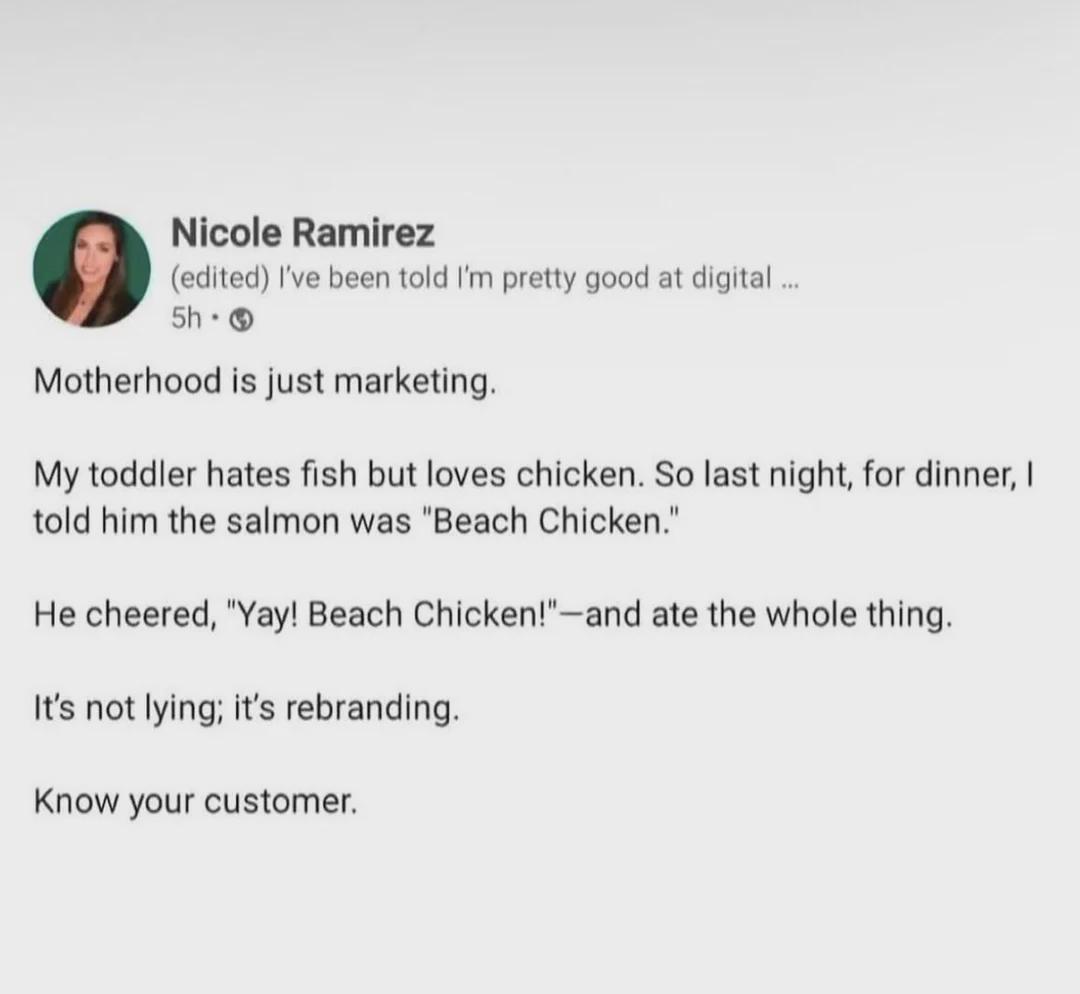
The specimen before us—a LinkedIn post of approximately one hundred and twenty words, attributed to a self-described digital marketing professional whose profile photograph carries the soft-focus luminosity of the computationally enhanced—announces its thesis in the opening sentence with the confidence of a person who has confused the aphoristic with the profound: "Motherhood is just marketing." One pauses, not because the claim is arresting, but because the period following it performs so much labour, transforming what might have been the idle observation of an exhausted parent into a declaration requiring, evidently, a case study, a moral, and an imperative addressed to the general public.
The case study is this. The author's toddler refuses salmon. The author renames the salmon "Beach Chicken." The toddler eats the salmon. From this domestic episode—which, one might note, describes the successful deployment of a falsehood upon a person who has not yet mastered the conditional tense—the author derives a universal principle of commerce: "Know your customer." The five sentences that carry us from thesis to proof to peroration reproduce, with a fidelity that borders on the liturgical, the fixed architecture of the LinkedIn homily: provocation, anecdote, climax, restatement, and imperative. One does not read the specimen so much as watch it assemble itself from prefabricated components, each clicking into its designated position with the satisfied precision of a child's interlocking brick.
It is the restatement that warrants the closest attention. "It's not lying," the author writes. "It's rebranding." The semicolon that separates these clauses—or rather the period, for the author has elected to grant each fragment its own sentence, as though the observation were too weighty to be borne by a single syntactic unit—performs the essential work of the entire production. It asks the reader to accept that the substitution of one word for another, undertaken with the specific intention of producing a false belief in the listener, is not deception but professional practice. That the listener in question is a child who trusts the speaker absolutely is, within the logic of the post, not a complication but a proof of concept. The customer who trusts you most completely is the customer most efficiently rebranded to.
One might object that parents have lied to children about vegetables since the invention of both, and that the observation hardly requires a professional framework. But the specimen's interest—and it does possess interest, of the taxonomic variety—lies not in the novelty of its material but in the totality of its form. The LinkedIn homily has achieved, through sheer repetition across the platform, the status of a fixed literary mode, as rigid in its conventions as the Petrarchan sonnet and considerably less accommodating of variation. The octave-sestet structure of Petrarch at least permitted the volta to surprise; the LinkedIn homily's pivot from anecdote to abstraction is as predictable as sunrise and approximately as illuminating.
This formal rigidity produces a consequence that the specimen illustrates with unintended clarity. The question of whether the post was composed by a human being, by a machine, or by some collaboration of the two is, within the terms of the form itself, unanswerable and—more damningly—immaterial. When a literary mode has been reduced to a template of such mechanical regularity that its execution requires no decisions, only population of fields, the distinction between the authored and the generated dissolves. The homily does not require an author. It requires only inputs: one profession, one domestic anecdote, and one abstraction capacious enough to flatter the reader into believing that the anecdote has taught them something. The machine can supply these. So, evidently, can the digital marketing professional. The outputs are indistinguishable because the process admits no point at which distinction could occur.
The author's own defence of the practice described—"It's not lying; it's rebranding"—is, one cannot help but observe, precisely the defence that machine-assisted composition makes of itself. The words are not fabricated; they are repositioned. The sentiment is not invented; it is optimised. The author is not replaced; the author is augmented. In each case the claim rests upon the proposition that a sufficiently thorough renaming constitutes a change in kind rather than merely in label. The toddler, at least, has the excuse of not yet possessing the conceptual apparatus to evaluate this claim. The four hundred million professionals to whom the post is addressed have no such defence, and yet one suspects the salmon goes down just as easily.
What remains, when the form has been catalogued and the logic examined, is the profile photograph—rendered in that particular soft focus which the computationally generated portrait favours, wherein the skin achieves a smoothness that no dermatologist could promise and no camera could capture. The prose is the evidence, and the prose convicts itself: not of slop, precisely, but of a perfection so frictionless that it cannot be distinguished from the absence of a writer. The toddler ate the Beach Chicken. The platform ate the post. Neither enquired too closely into the provenance of what was served.